

Reported by: Ijeoma G | Edited by: Oravbiere Osayomore Promise.
The historic Mapo Hall in Ibadan, a colonial‑era edifice that has witnessed the birth of political movements for generations, shook to its foundations on Thursday, May 14, 2026, as Oyo State Governor Seyi Makinde fired the starting gun for the 2027 political season. With the ancient arcade draped in a sea of party colours and the roar of thousands of supporters echoing through the hills, the governor formally declared his intention to contest the presidency of Nigeria, choosing as his platform the relatively unknown Allied Peoples Movement (APM). The declaration, which was billed as a “Unity Mega Rally,” rapidly transformed into a high‑octane launchpad for a new national movement, as a powerhouse faction of the Peoples Democratic Party (PDP) and the APM moved towards formalising a formidable strategic alliance.
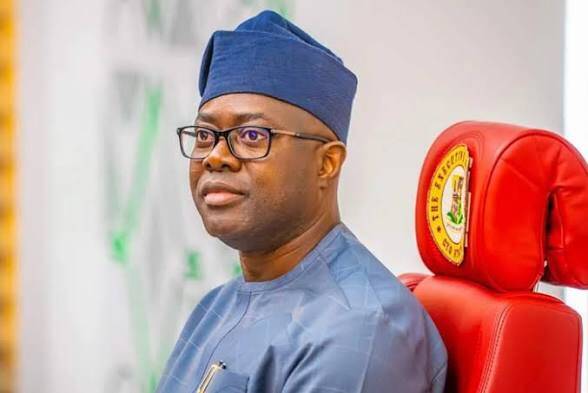
Clad in a symbolic attire of blue jeans, a white T‑shirt, and a blue cap, Makinde stood before a massive surge of “Makinde‑for‑President” volunteers and made his historic announcement. “I, Oluseyi Abiodun Makinde, Excellency, announce my candidacy for the position of the President of the Federal Republic of Nigeria,” he declared, according to multiple reports from the scene. The governor, who has served two terms in office and is constitutionally barred from seeking a third as governor, has long been rumoured to harbour national ambitions, and his formal entry into the race immediately reshaped early calculations for the 2027 polls. Makinde described his decision as driven by the need to “reset” Nigeria, a slogan that was quickly adopted by his new campaign movement, which he unveiled as the “Reset Nigeria Movement,” alongside a dedicated campaign website and media resource centre.
Speaking at the rally, Makinde did not mince words about the state of the nation. “Nigeria cannot continue with politics as usual,” he said, according to multiple reports. “This is the time to reset our nation, rebuild public trust, strengthen institutions, and create a system that works for all Nigerians.” He stressed that the country needs competent and accountable leadership capable of restoring public confidence. The governor’s agenda, as outlined in the “Reset Nigeria” project, is focused on economic growth, job creation, education, healthcare, infrastructure development, power sector reforms, security, and institutional strengthening – a broad platform designed to appeal to a wide cross‑section of the electorate weary of nearly two decades of unbroken rule by the same political establishment.
The strategic alignment with the APM signals a calculated move by Makinde to build a cross‑party bridge and position Ibadan, the Oyo State capital, once again as the heartbeat of South‑West and national politics. The alliance further flexed its muscles by announcing that a full slate of candidates for the presidential, senatorial, House of Representatives, and Houses of Assembly elections would be presented for the 2027 general elections. The rally, which drew a who’s who of the political class from Oyo State and beyond, also featured the signing of a Memorandum of Understanding between the PDP faction loyal to Makinde and the APM. The agreement was signed by Seyi Bamidele on behalf of the PDP, while Oladele Oyadeji signed for the APM, with Governor Makinde and APM National Chairman Yusuf Dantalle also putting pen to paper.
The move effectively formalises what political analysts are branding as a new “Ibadan Declaration,” a reference to the historic 1951 conference that birthed the Action Group. This latest declaration, however, is rooted in the fractious reality of Nigeria’s opposition politics. Makinde, who found himself increasingly isolated within the PDP following his public fallout with the party’s national leadership, has been actively courting alliances with other opposition figures. His embrace of the APM, a party with limited national presence, is a clear signal that he is willing to operate outside the traditional structures to achieve his presidential ambition. The APM, for its part, gains a high‑profile standard‑bearer and access to the governor’s formidable political machinery in the South‑West.
The governor’s declaration did not come as a complete surprise. In the days leading up to the rally, several PDP lawmakers loyal to Makinde had defected to the APM. Among them are five House of Representatives members: Dhikirulahi Stanley Olajide (Ibadan South West/Ibadan North West); Abass Adigun (Ibadan North East/South East); Folajimi Oyekunle (Ibadan North Federal Constituency); Anthony Adepoju (Ibarapa North/Ibarapa Central); and Shina Oyedeji (Iseyin/Itesiwaju/Kajola/Iwajowa). Their defection, coupled with the rally, signalled that a significant realignment within the opposition was underway. Bauchi State Governor Bala Mohammed, another PDP governor who has defected to the APM, has already secured the party’s senatorial ticket, adding further weight to the emerging coalition.
Reactions to Makinde’s announcement have been swift and varied. Supporters have praised the governor for his courage and vision, pointing to his achievements in Oyo State, including infrastructure renewal, agribusiness expansion, fiscal discipline, education reforms, and security improvement, as evidence of his capacity to lead national transformation. Critics, however, have questioned the viability of a presidential run on a small, lesser‑known party platform and have pointed to the fragmentation of the opposition as a boon to the ruling All Progressives Congress. The Wike‑led faction of the PDP, which had earlier dismissed the Ibadan gathering as a “public celebration” and not a genuine coalition, reiterated that the party remains united under its leadership.
Political observers say the declaration positions Makinde as one of the leading contenders in early permutations for the 2027 presidential race, particularly within opposition coalition discussions. However, the path ahead is fraught with challenges. The APM, despite its new high‑profile adherents, lacks the national infrastructure and financial resources of the major parties. Makinde will need to build a nationwide campaign organisation from the ground up, a task that will require significant time, money, and political skill. He will also face competition from within the opposition, including potentially from his new ally Bala Mohammed, as well as from the Labour Party’s Peter Obi and the Nigeria Democratic Congress’s coalition. The ruling APC, for its part, is widely expected to rally behind President Bola Tinubu’s re‑election bid, setting the stage for a potentially crowded and fractious contest.
For now, however, the ancient Mapo Hill has delivered a new political earthquake. Seyi Makinde has thrown his hat into the ring, and the battle for the soul of Nigeria’s opposition has only just begun.
📩 Stone Reporters News | 🌍 stonereportersnews.com
✉️ info@stonereportersnews.com | 📘 Facebook: Stone Reporters News | 🐦 X (Twitter): @StoneReportNew | 📸 Instagram: @stonereportersnews
Add comment
Comments