

Published by Oravbiere Osayomore Promise.
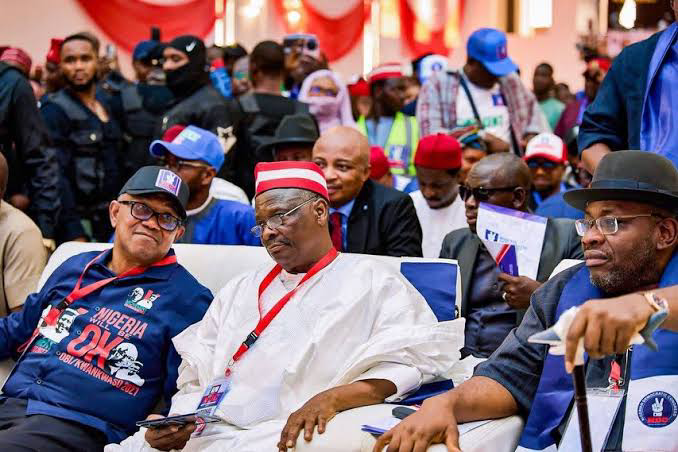
The Nigeria Democratic Congress (NDC) has officially closed the sale of Expression of Interest and Nomination Forms for its 2027 presidential ticket, and the result has delivered a striking political outcome: only one aspirant stepped forward. Former Anambra State governor and 2023 Labour Party presidential candidate, Mr. Peter Obi, is now the sole presidential aspirant of the party, effectively positioning him to clinch the NDC’s presidential ticket unopposed, barring any unforeseen disqualification during the screening process. The deadline for presidential form submissions was Sunday, May 17, 2026, at 6 p.m., and according to party sources, Obi was the only politician who purchased the forms before the window closed. The party’s National Secretary, Ikenna Morgan Enekweizu, confirmed that while the presidential collection portal is now permanently shut, the party has extended the deadline for governorship, Senate, House of Representatives and State Houses of Assembly aspirants by one week to midnight on Sunday, May 24, 2026. This decision, according to the party, was intended to allow wider participation in lower-level races, but the presidential ticket has already assumed its definitive shape. The development marks the culmination of a rapid and dramatic political realignment that has reshaped opposition politics in Nigeria over the past several weeks, with Obi emerging as the central figure around whom the NDC is now building its national campaign.
The road to this unopposed candidacy began in early May, when Obi and former Kano State governor Rabiu Musa Kwankwaso formally defected from the African Democratic Congress (ADC) to the NDC, citing persistent internal crises, endless court cases, and what they described as a toxic environment that had made genuine coalition-building impossible. The ADC, which had been positioned as the main opposition coalition vehicle for several opposition leaders, became increasingly unstable amid internal disagreements and fears of prolonged litigation. Obi, in a lengthy statement posted on his official X handle at the time, expressed dismay that the same forces that had created crises within the Labour Party appeared to be infiltrating the ADC. Within days of their defection, senators, House of Representatives members and political blocs began gravitating toward the NDC, instantly giving the relatively new party national visibility and legislative presence. The NDC, led by former Bayelsa State governor Henry Seriake Dickson, then moved swiftly to consolidate the realignment. On May 9, the party announced that its 2027 presidential ticket would be zoned to Southern Nigeria for a single four-year term, a decision widely interpreted as deliberately structured to favour Obi, who hails from Anambra State in the South-East.
Obi has not been shy about his intentions or his conditions. In an interview scheduled to air on News Central Television on Thursday, May 14, 2026, the former governor reiterated his longstanding pledge to serve only one term of four years if elected president in 2027, insisting that he would not remain in office beyond a single term under any circumstance. “I want to be a one-term president because of stability. I would not stay a day longer than four years, even with a gun to my head,” Obi declared. The promise, which he has maintained since a Twitter Space hosted by Parallel Facts in June 2025, is presented as a stabilising arrangement intended to reassure northern political interests and preserve the country’s unwritten rotational balance between the North and South. However, the pledge has generated sharply divided reactions across Northern Nigeria. Many northern stakeholders have described the proposal as politically strategic but lacking enforceable guarantees. A major concern repeatedly raised is the issue of trust, with many recalling the events that followed the death of former President Umaru Musa Yar’Adua in 2010 and the subsequent decision by former President Goodluck Jonathan to contest for another term in 2011. For many northern politicians, that episode remains a defining moment that shaped the region’s scepticism toward informal zoning arrangements and unwritten political understandings. Political analyst and youth leader Murtala Abubakar described Obi’s one-term pledge as a political gimmick designed to secure electoral sympathy, arguing that no constitutional mechanism exists to compel compliance once a president is elected. The National President of the Northern Youth Council of Nigeria, Isah Abubakar, said the North now approaches such promises with a “once bitten, twice shy” mentality, noting that memories of the 2011 political transition remain fresh among many northerners who believe the region was politically disadvantaged after Yar’Adua’s death.
Despite these reservations, the NDC has pressed ahead with its internal processes. The party has released a detailed timetable for the screening of aspirants. According to the schedule, screening of aspirants who have purchased and completed the forms will commence on Tuesday, May 19, and end on Tuesday, May 26, 2026. The party also disclosed that the collection and return of Nomination Forms for screened and cleared aspirants would begin on May 20 and end on May 26. The NDC has warned that no further extension would be granted beyond the new deadline and has urged aspirants to strictly comply with the guidelines and timelines. The party directed all aspirants to appear for screening and pre-qualification interviews at designated venues nationwide with relevant documents, including educational certificates, birth certificates or declarations of age, passport photographs, voter’s cards, NDC membership cards and curriculum vitae. All documents, according to the party, must be submitted in six copies. The NDC further said screening would be based on the wishes of the electorate, local peculiarities, capacity and competence, as well as the character of aspirants. The party has also directed the Screening Committee to take into consideration its affirmative action policy for women, youths and persons living with disabilities.
The emergence of Obi as the sole aspirant has not come without internal pushback, at least rhetorically. On May 8, just days after Obi and Kwankwaso joined the party, House of Representatives aspirants on the NDC platform issued a stern warning that Obi would be removed from office if elected president in 2027 and failed to meet Nigerians’ expectations. Speaking during a press conference in Abuja, Nnamdi Iroegbu, NDC aspirant for Aboh Mbaise/Ngor Okpala Federal Constituency of Imo State, declared: “Every government must be held accountable, including a Peter Obi presidency. By the time he comes on board and fails to do the bidding of the Nigerian people, he will be disengaged.” The remarks reflect a growing determination within the party’s rank and file to ensure that the presidential candidate does not assume a sense of entitlement simply because he has no primary challenger. Meanwhile, the NDC has encouraged aspirants to embrace consensus-building, stressing that only aspirants cleared through the screening process would be eligible to purchase nomination forms. With the presidential form sales closed and Obi standing alone, the party now faces the task of building a national structure capable of translating its aspirant’s popularity into a credible challenge against the ruling All Progressives Congress (APC) in 2027. The opposition landscape remains fragmented, with former Vice-President Atiku Abubakar still active within the ADC and other blocs yet to fully align. But for now, in the NDC at least, the path has been cleared for one man. Whether that unopposed emergence proves to be a strength or a liability will be tested in the months ahead as the party moves from internal processes to the broader contest for the nation’s highest office.
📩 Stone Reporters News | 🌍 stonereportersnews.com
✉️ info@stonereportersnews.com | 📘 Facebook: Stone Reporters News | 🐦 X (Twitter): @StoneReportNew | 📸 Instagram: @stonereportersnews
Add comment
Comments