

Reported by: Oahimire Omone Precious | Edited by: Oravbiere Osayomore Promise.
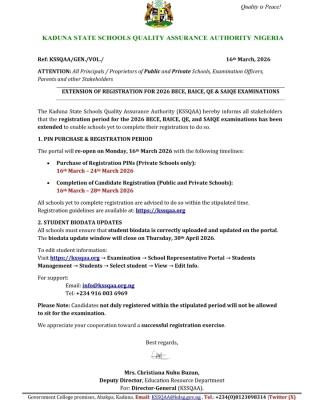
In a significant administrative update affecting thousands of students and educational institutions across Kaduna State, Nigeria, the Kaduna State Schools Quality Assurance Authority (KSSQAA) has officially extended the registration period for key standardized examinations scheduled for 2026. This directive directly impacts the Basic Education Certificate Examination (BECE), Basic Arabic & Islamic Certificate Examination (BAICE), Qualifying Examination (QE), and the Senior Arabic & Islamic Qualification Examination (SAIQE) — all of which play pivotal roles in the academic progression of pupils and candidates within the state’s education system.
The extension was communicated via a formal statement released by the Authority, led by Mrs. Christiana Nuhu Buzun, Deputy Director of the Education Resource Department, and is intended to accommodate schools that have been unable to complete their registrations within the original timeframe due to logistical or administrative challenges. The move recognises the impact of tight timelines on data capture, entry processing, and the delivery of key examination materials — challenges that have been amplified by the volume of candidates and the diversity of institutions involved.
According to the revised schedule, the portal was re‑opened on Monday, 16th March 2026, with the following new deadlines: private schools can purchase registration PINs from 16th to 24th March, and completion of candidate registration for both public and private schools is now set for 28th March 2026. Additionally, the window for schools to update, correct or validate student biodata will remain open until 30th April 2026.
The Authority has been clear that these extensions represent a final opportunity to regularise entries, emphasising that candidates who remain unregistered after the new deadlines will become ineligible to sit for their respective exams. This warning underscores the high stakes involved — particularly for BECE candidates, for whom successful registration and participation are prerequisites for placement into senior secondary schools and other post‑basic educational pathways.
The BECE, BAICE, QE and SAIQE are cornerstone assessments within Kaduna’s educational landscape. BECE serves as the principal certification for students completing junior secondary education and is a mandatory step for advancement into senior secondary levels and specialized learning tracks. BAICE and SAIQE provide certification for students in Arabic and Islamic studies, reflective of the cultural and educational priorities within the region. The QE is designed to evaluate the readiness of candidates for further academic engagements, often determining eligibility for specific academic tracks or streams.
Education administrators and school leaders in Kaduna have reacted to the extension with a mix of relief and urgency. Many schools — particularly in rural and peri‑urban areas — reported difficulties in meeting the original deadlines, citing challenges that range from delayed internal data gathering to inconsistencies in online system access. Several school principals noted that prolonged delays in procuring registration PINs, matching student biodata, and handling continuous assessment scores had placed undue pressure on school registration officers. This situation was made more acute by the sheer volume of candidates and the need for accuracy in all entries.
One headteacher from a private school in Kaduna emphasised the stakes involved, noting that “missing the extended deadline would mean denying some of our students their rightful opportunity to sit for these critical exams.” This concern reflects widespread anxiety among educators who are acutely aware that any administrative lapse — whether due to data mismatch or late submission — could result in students being excluded from the examinations.
A key pillar of the extension is the emphasis on the accuracy of candidate information. The Authority has stressed that student biodata — such as names, dates of birth, gender, National Identification Numbers (where applicable), and other demographic details — must be precise and free of errors. KSSQAA officials have made clear that inaccurate entries could lead to administrative complications later in the year, including delays in issuing examination numbers, admission slips, and ultimately the certificates that follow successful completion.
To facilitate these final updates, the Authority has provided explicit instructions for school personnel. Registered users are directed to access the official KSSQAA portal, navigate to the examination sections, and use the school representative interface to make necessary updates to student records. These steps are intended to streamline corrections and reduce avoidable errors in the lead‑up to the exams.
The extension comes at a time when educational quality assurance and examination administration are under heightened scrutiny across Nigeria. National and state authorities have, in recent years, grappled with systemic challenges associated with large‑scale candidate registration, data management, and examination integrity. In some states, delayed entries or registration mismatches have led to last‑minute amendments, additional administrative burdens, and even situations where results issuance has been postponed. Some educational officials argue that extensions — when managed transparently and with clear guidelines — can alleviate pressure on administrators and reduce errors that might otherwise disadvantage candidates.
However, there are risks associated with such extensions if they are not accompanied by adequate technical support and clear communication with stakeholders. Schools with limited digital infrastructure or constrained technical resources may find it difficult to utilise the additional time effectively unless supported by the Authority’s technical teams. In response, KSSQAA has expanded its contact support channels, providing dedicated email addresses and telephone lines to address inquiries and technical challenges during the extended registration period.
With the new deadlines in place, schools across Kaduna State are focusing their efforts on finalising entries, completing biodata verification, and ensuring that all eligible candidates are adequately registered. The extended timeframe has brought a sense of cautious optimism among educators who had previously feared that administrative setbacks might result in the exclusion of hard‑working students from the 2026 examination cycle.
As March transitions into April, the responsibility for accurate and timely data entry now rests heavily on schools and their examination officers. The coming weeks will test not just administrative resilience but also the effectiveness of coordination between the Authority and educational institutions throughout the state.
Ultimately, the extension underscores a broader challenge facing educational policymakers in Nigeria: balancing stringent examination timelines with the practical realities of on‑the‑ground implementation. For students and their families, however, the message is clear — with the extended registration window, many candidates now have a final chance to ensure their participation in examinations that will shape their academic futures.
📩 Stone Reporters News | 🌍 stonereportersnews.com
✉️ info@stonereportersnews.com | 📘 Facebook: Stone Reporters | 🐦 X (Twitter): @StoneReportNew | 📸 Instagram: @stonereportersnews
Add comment
Comments