

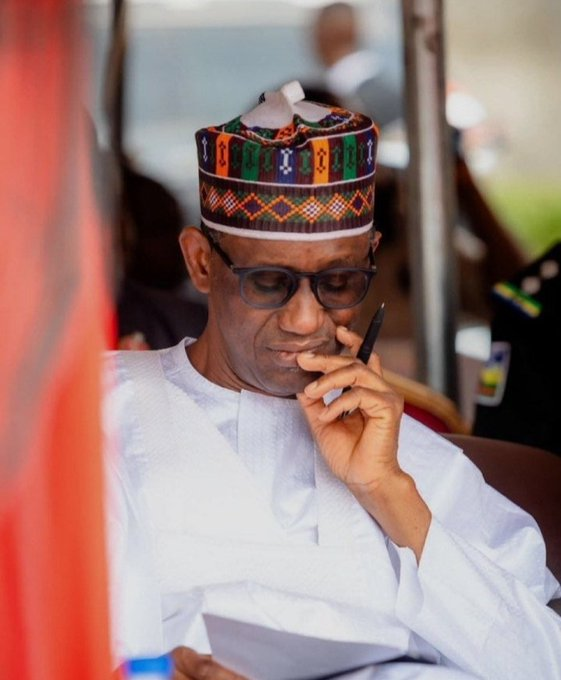
Ribadu’s Expanding Security Role Under Tinubu Faces Test of Results as Nigeria Battles Multiple Threats
Mallam Nuhu Ribadu, Nigeria’s National Security Adviser under President Bola Ahmed Tinubu, has become one of the central figures in the federal government’s attempt to impose greater coherence on a security system long criticized for fragmentation, weak coordination and slow response. His office sits at the centre of the state’s security planning architecture, and official Nigerian counterterrorism structures describe the Office of the National Security Adviser as the coordinating office for the country’s counterterrorism efforts. Since Tinubu appointed him in 2023, Ribadu has increasingly been presented by the presidency as the coordinator of intelligence, inter-agency alignment and strategic security partnerships at a time when Nigeria faces simultaneous threats from insurgents in the northeast, bandits in the northwest, communal violence in the Middle Belt and wider cross-border instability.
The broad outline of Ribadu’s approach is visible in official statements and institutional moves over the past two years. At the African Counter-Terrorism Summit in Abuja in April 2024, Ribadu said terrorism in Africa is driven not only by armed violence itself but also by organized crime, foreign terrorist financing, poverty, inequality and prolonged conflict. In the same remarks, he said Nigeria was seeking to tackle “all drivers of violent extremism,” while enhancing intelligence gathering through stronger inter-agency collaboration and confidence-building with citizens. That framing matters because it shows Ribadu’s office trying to move beyond a purely kinetic military model toward a more layered security doctrine that links force, intelligence, prosecution and prevention.
A consistent theme under Ribadu has been the push for tighter coordination among agencies that have historically operated in parallel rather than in sync. Presidency statements on high-level security engagements show the NSA regularly working alongside the inspector-general of police, the DSS, defence intelligence, the military high command and the National Counter Terrorism Centre. That pattern is significant in Nigeria’s context, where failures of intelligence sharing and overlapping mandates have often been blamed for missed warnings and inefficient operations. Meetings with foreign partners have also reinforced Ribadu’s position as the lead coordinator rather than simply an adviser in the background. During a June 2024 meeting between President Tinubu and FBI Director Christopher Wray, Ribadu was part of a security chiefs’ group that included police, DSS, defence intelligence, NDLEA, EFCC and the National Counter Terrorism Centre, illustrating the multi-agency ecosystem his office is expected to help align.
That coordination role has increasingly extended beyond domestic agencies into foreign security cooperation. In November 2025, the presidency said a high-level Nigerian delegation led by Ribadu held meetings in Washington with senior U.S. officials and secured commitments including enhanced intelligence support, faster processing of defence equipment requests, humanitarian assistance for affected populations and technical support for early-warning mechanisms. The statement also said both governments agreed to implement a cooperation framework and establish a joint working group to ensure a unified approach. Reuters later reported that the United States began intelligence-gathering flights over Nigeria after a November 20 meeting involving Ribadu and U.S. Defence Secretary Pete Hegseth, with Nigerian and U.S. officials acknowledging expanded cooperation against militant groups. These developments point to Ribadu’s role not only as a domestic coordinator but as a principal channel for external security partnerships.
On the operational side, Ribadu’s office has repeatedly emphasized intelligence-led action. Official remarks at the Abuja summit said Nigeria had resumed prosecution of Boko Haram suspects and was strengthening the judiciary to deal more effectively with terrorism cases, while also earmarking funding to boost counterterrorism efforts. That is important because one longstanding criticism of Nigeria’s security response has been the gap between arrests, investigations and durable legal consequences. Ribadu’s public line suggests an attempt to connect battlefield pressure with legal follow-through. The strategic logic is straightforward: intelligence is meant to generate more precise operations, those operations are meant to produce arrests and recovered material, and prosecutions are meant to stop the cycle of release, regrouping and return to violence.
Yet the central question is whether this architecture is producing results at the scale Nigerians need. The record remains mixed. Despite expanded coordination and foreign support, the security picture has stayed deeply volatile. Reuters reported in November 2025 that Tinubu declared a nationwide security emergency and ordered mass recruitment of police and army personnel after worsening attacks and kidnappings across the country. In April 2026, Reuters and AP both reported fresh major violence, including the killing of a brigadier general in an assault on a military base in Benisheikh, Borno State, and continuing attacks in the northwest and north-central zones. Reuters also reported new abductions in Zamfara this month, while the U.S. expanded its Nigeria travel warning and authorized the departure of non-emergency embassy staff and families from Abuja because of deteriorating security conditions. Those developments underscore the gap between improved coordination at the top and the persistence of deadly insecurity on the ground. (Reuters)
That gap helps explain why Ribadu’s tenure draws both support and criticism. Supporters argue that he inherited a security environment shaped by years of institutional weakness, porous borders, understaffed policing, entrenched insurgent networks and expanding bandit economies, and that no coordinator could reverse those conditions quickly. They point to clearer inter-agency messaging, expanded counterterrorism diplomacy and the integration of community-based early warning into the broader security conversation. Critics, however, say those structural improvements have yet to translate into sufficient civilian protection, especially in remote communities where attacks still unfold with alarming frequency. Even where government offensives disrupt armed groups, violence often mutates geographically rather than disappearing. (statehouse.gov.ng)
Stone Reporters note that Ribadu’s role is best understood not as that of a field commander but as the system’s chief coordinator, strategist and broker of intelligence and institutional alignment. On paper, his office is more central to Nigeria’s security response than it has been in many previous periods, and official statements show a deliberate effort to connect counterterrorism, law enforcement, prosecution, international partnerships and early warning under one umbrella. But the measure that matters most is whether ordinary Nigerians become safer. For now, Ribadu’s approach has clearly reshaped the architecture of response. Whether it can decisively change the outcomes remains the unresolved test of Tinubu’s wider national security agenda. (nctc.gov.ng)
📩 Stone Reporters News | 🌍 stonereportersnews.com
✉️ info@stonereportersnews.com | 📘 Facebook: Stone Reporters News | 🐦 X (Twitter): @StoneReportNew | 📸 Instagram: @stonereportersnews
Reported by: Oahimire Omone Precious | Edited by: Gabriel Osa
Add comment
Comments