

Reported by: Oahimire Omone Precious | Edited by: Pierre Antoine
Nigeria’s internal security coordination has received renewed focus as the Nigeria Immigration Service (NIS) and the Nigerian Army (NA) formally reaffirmed their commitment to closer operational collaboration in Plateau State, a region that has experienced recurring security challenges ranging from communal violence to transborder crime.
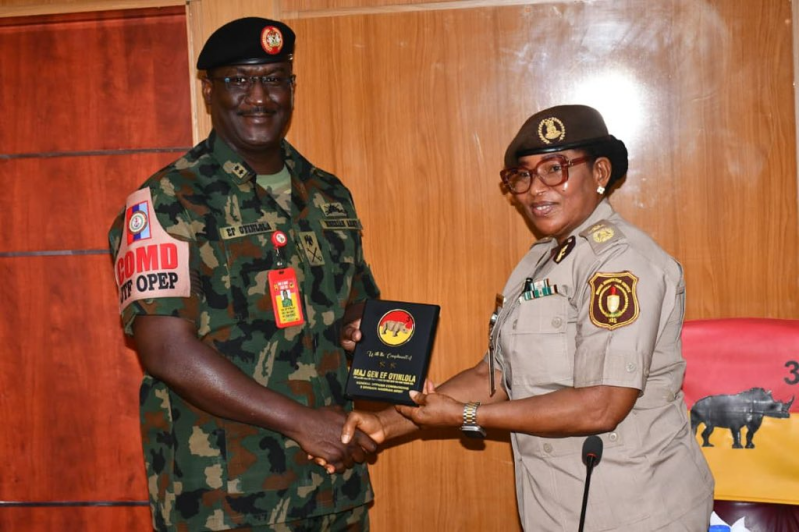
The renewed pledge was announced during a high-level engagement in Jos, where the Comptroller of Immigration for Plateau State Command, MU Abang, paid a courtesy visit to the General Officer Commanding 3 Division of the Nigerian Army and Commander of Operation ENDURING PEACE, Folusho Oyinlola, at the Maxwell Khobe Cantonment. The meeting formed part of Abang’s familiarisation tour following her recent assumption of duty and was aimed at consolidating institutional ties between both agencies.
During the visit, Abang emphasised the importance of strengthening inter-agency cooperation in response to evolving security threats. She commended the Nigerian Army for its sustained operations in maintaining stability across Plateau State, particularly through Operation ENDURING PEACE, which has been central to efforts aimed at curbing violence and restoring calm in affected communities.
Stone Reporters note that Plateau State remains one of Nigeria’s most sensitive security flashpoints, with a history of ethno-religious tensions, land disputes, and sporadic attacks that have led to loss of lives and displacement. In such an environment, coordination between agencies responsible for border management, internal security, and intelligence gathering is considered critical.
Abang stressed that the Nigeria Immigration Service plays a strategic role in national security through its mandate covering migration control, border surveillance, and monitoring of transborder movements. She noted that effective collaboration with the military would enhance the service’s ability to detect and prevent the movement of criminal elements, including those involved in arms trafficking, illegal migration, and cross-border insurgent activities.
She further advocated for an “open-door” policy between the NIS and the Nigerian Army, arguing that seamless communication and operational coordination would significantly improve response times and intelligence-sharing capabilities. According to her, such synergy is essential in addressing complex security threats that often cut across institutional mandates.
A key component of her request was the need for capacity building. Abang appealed for the support of the Nigerian Army in training immigration personnel, particularly in areas related to tactical operations, intelligence gathering, and crisis response. She argued that equipping NIS officers with enhanced skills would strengthen their contribution to national security efforts and improve overall service delivery.
In his response, Major General Oyinlola welcomed the initiative and reaffirmed the Army’s commitment to maintaining strong working relationships with sister security agencies. He congratulated Abang on her appointment and described inter-agency collaboration as indispensable to achieving sustainable peace and security in Nigeria.
Oyinlola highlighted that modern security challenges are increasingly complex and require a unified approach involving multiple institutions. He noted that no single agency can effectively address threats such as banditry, kidnapping, or transnational crime in isolation. According to him, coordinated operations and timely intelligence sharing are essential in pre-empting attacks and neutralising criminal networks.
The Army commander also underscored the importance of actionable intelligence from the Nigeria Immigration Service, particularly given its frontline role in monitoring cross-border movements. He stated that improved intelligence flow from NIS would enable the military to take proactive measures rather than reactive responses, thereby enhancing operational effectiveness.
Stone Reporters note that this emphasis on intelligence sharing reflects a broader shift in Nigeria’s security strategy, where collaboration between agencies is increasingly prioritised over siloed operations. Past security lapses have often been attributed to gaps in communication and coordination, prompting reforms aimed at fostering joint operations and information exchange.
The meeting also reinforced the Army’s readiness to support the Nigeria Immigration Service in critical areas, including training, logistics, and operational planning. Oyinlola reiterated that the Nigerian Army remains committed to assisting all relevant agencies in ensuring peace and stability in Plateau State and beyond.
The engagement concluded with symbolic gestures including the exchange of souvenirs, the signing of the visitors’ register, and a group photograph, underscoring the formalisation of the renewed partnership.
Security analysts say the development, while largely procedural, carries significant implications for the broader security architecture in Nigeria. Strengthened collaboration between border management authorities and military units is expected to improve surveillance, disrupt criminal supply chains, and enhance rapid response capabilities.
However, analysts also caution that sustained impact will depend on consistent implementation, resource allocation, and institutional commitment beyond official meetings. Effective collaboration requires not only agreements at leadership levels but also integration at operational levels, including joint training exercises, shared communication systems, and coordinated field operations.
As Plateau State continues to navigate complex security dynamics, the renewed alliance between the Nigeria Immigration Service and the Nigerian Army signals a strategic effort to address vulnerabilities through cooperation. Whether this translates into measurable improvements in security outcomes will depend on how effectively both agencies operationalise their commitments in the months ahead.
📩 Stone Reporters News | 🌍 stonereportersnews.com
✉️ info@stonereportersnews.com | 📘 Facebook: Stone Reporters News | 🐦 X (Twitter): @StoneReportNew | 📸 Instagram: @stonereportersnews
Add comment
Comments