

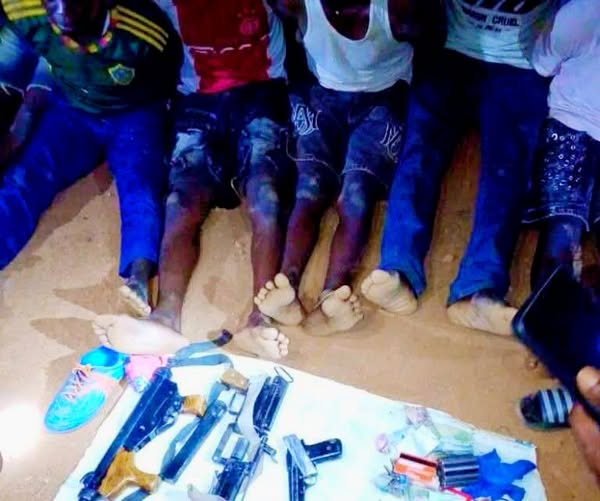
Troops of Operation Enduring Peace under the Nigerian Army have arrested nine suspected militia members in Plateau State during a late-night operation targeting individuals allegedly linked to a series of targeted killings, in what security sources describe as part of intensified efforts to stabilise the state’s volatile rural communities.
The arrests were carried out in the early hours of April 18, 2026, at approximately 1:35 a.m., following intelligence reports of suspicious movements toward the Danwal area in Riyom Local Government Area. According to security updates, troops stationed in Ganawuri responded swiftly to the alert, intercepting and apprehending the suspects before they could disperse.
The suspects are believed to be members of a Berom militia group allegedly involved in recent attacks across parts of Plateau State. Reports indicate that at the time of their arrest, some of the individuals showed signs suggesting possible recent involvement in violent activities, prompting further investigation by military authorities.
Items recovered from the suspects during the operation included a cache of weapons and equipment. These comprised one pistol, one submachine gun, a locally made revolver rifle, another fabricated rifle, and about 20 rounds of ammunition. Security operatives also seized three motorcycles believed to have been used for mobility during operations.
The identities of the suspects have been reported as residents of the Danwal axis, with names including Gyang Dantoro, Samson Davou, Choji Yakubu, Vincent Adamu, Pam Dalyop, Femi Badung, Jacob Musa, and Choji Chaga. Authorities have indicated that the individuals are currently in custody and are assisting with ongoing investigations aimed at uncovering broader networks linked to the violence in the area.
The arrests come against the backdrop of persistent insecurity in Plateau State, particularly in Riyom, Barkin Ladi, Bokkos, Mangu, and surrounding local government areas. These regions have witnessed recurring cycles of violence involving armed groups, often rooted in long-standing tensions between farming and herding communities.
Security analysts note that the conflict in Plateau has evolved over time into a complex mix of communal clashes, reprisal attacks, and criminal activity. Armed groups operating within local communities have been linked to ambushes, cattle rustling, abductions, and targeted killings, further complicating efforts to restore lasting peace.
Recent incidents underscore the fragile security situation. In early April, reports indicated that gunmen attacked communities in Bokkos Local Government Area, resulting in multiple casualties. In another development, clashes between farmers and herders in Barkin Ladi left several individuals injured, including a police officer, before troops intervened to restore calm.
Military operations in the state have increasingly relied on intelligence-led strategies, including surveillance and rapid-response deployments, to intercept suspected attackers before incidents escalate. The arrest of the nine suspects is seen as part of this broader shift toward preemptive action.
Earlier in the same week, troops conducted search-and-rescue operations in Bassa Local Government Area after reports of a missing herder, recovering both the body of the victim and livestock believed to have been taken during the incident. Additional operations led to the arrest of suspected illegal migrants in Riyom, further highlighting the range of security challenges facing the region.
The military has also reported engagements with armed groups in other parts of Plateau, including confrontations in Barkin Ladi where several suspected attackers were neutralised during exchanges of gunfire. These developments point to ongoing efforts by security forces to dismantle networks involved in violence and criminality.
Plateau State has long been one of Nigeria’s most conflict-prone regions, with tensions often driven by disputes over land, resources, and identity. Historical patterns of violence have shown that attacks are frequently followed by retaliatory actions, creating cycles that are difficult to break without sustained intervention and community engagement.
Observers say the latest arrests could provide valuable intelligence to security agencies, particularly if the suspects cooperate with investigators. Authorities believe that dismantling local militia structures and disrupting their operations is key to reducing the frequency of attacks and restoring stability.
However, experts caution that military action alone may not be sufficient to resolve the underlying causes of the conflict. They emphasise the need for comprehensive approaches that include dialogue between communities, enforcement of justice, and socio-economic interventions aimed at addressing grievances that fuel violence.
The Nigerian Army has reiterated its commitment to maintaining pressure on armed groups operating in Plateau State, while also calling on residents to support security efforts by providing timely and credible information. Community cooperation, officials say, remains a critical component in preventing attacks and ensuring effective response.
As investigations into the arrested suspects continue, security agencies are expected to expand their operations in identified hotspots, with a focus on preventing further incidents and consolidating recent gains. The situation remains fluid, but authorities maintain that ongoing efforts are yielding results in the push to restore peace in Plateau State.
📩 Stone Reporters News | 🌍 stonereportersnews.com
✉️ info@stonereportersnews.com | 📘 Facebook: Stone Reporters News | 🐦 X (Twitter): @StoneReportNew | 📸 Instagram: @stonereportersnews
Add comment
Comments