

Reported by: Ijeoma G | Edited by: Oravbiere Osayomore Promise.
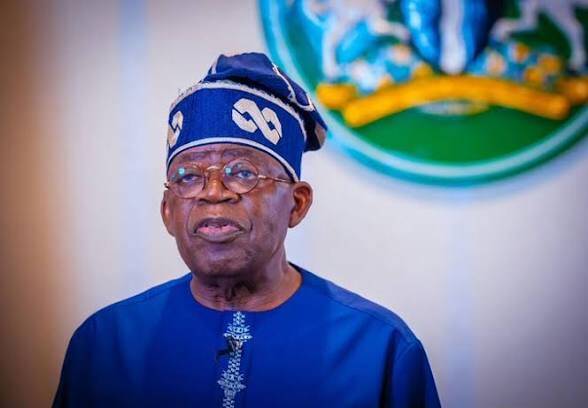
President Bola Ahmed Tinubu has squarely blamed Nigeria’s crippling electricity crisis on past leaders who he said oversaw a deeply flawed privatisation of the power sector, leaving the country in darkness while his administration struggles to fix the damage. Speaking on Tuesday while receiving a high-level delegation from Enugu State led by Governor Peter Mbah at the Presidential Villa in Abuja, the President accused opposition figures of failing Nigerians through policies that prioritised political interests over technical competence and public welfare. “They privatised electricity that is not working. They gave us darkness,” Tinubu declared, urging Nigerians to hold past administrations accountable for a power sector that has defied decades of reforms, billions of dollars in interventions, and countless promises of stable electricity.
The President’s remarks come at a time when Nigerians across the country are enduring widespread blackouts, with many northern states facing a six-week power cut scheduled from April 9 to May 22, 2026, for grid modernisation work. The outages have crippled businesses, disrupted healthcare services, and forced households to rely on expensive generators, deepening public frustration with a government that inherited a sector many experts now describe as a national embarrassment. Tinubu acknowledged the pain but insisted that the root causes lie in decisions made long before he assumed office. “These are leaders who had privatised electricity, which is not working. They gave us darkness, and we are trying to get through it to build a nation of bright hope and joyful people and leave our children with a life worthy of pride,” he said.
The privatisation of Nigeria’s power sector was carried out in 2013 under the administration of then President Goodluck Jonathan. The reform transferred ownership of 11 distribution companies (DisCos) and six generation plants (GenCos) to private investors, with the aim of improving efficiency, attracting investment, and ending the era of chronic blackouts. However, energy experts have since described the process as deeply flawed, citing the failure to privatise the transmission infrastructure, the award of licences to undercapitalised entities, and the influence of political interests over technical considerations. Over a decade later, Nigeria still oscillates between 4,000 and 5,000 megawatts of generation capacity for a population exceeding 200 million, while countries with smaller economies and fewer resources produce and distribute far more power reliably.
President Tinubu, who himself was a private sector player before entering politics, did not name specific individuals, but his remarks were widely interpreted as a swipe at opposition leaders, particularly those from the Peoples Democratic Party (PDP) who presided over the 2013 privatisation. His comments were delivered on the same day he dismissed opposition criticism of his administration’s economic policies, telling his audience: “Democracy will survive, despite all the intimidation. Ignore it, as I advise myself; stay focused. When you are succeeding, and they are angry, leave them in their corner”. The statement was seen as part of a broader political offensive aimed at shifting blame ahead of the 2027 general elections, as the ruling All Progressives Congress (APC) seeks to deflect growing public anger over the high cost of living and unreliable infrastructure.
The President’s defence of his administration’s record included a call for long-term planning, which he said had been absent in previous governments. “What has been the problem in the past is a Nigerian that is trying to finance long-term projects with short-term funding. We have not embarked upon a serious long-term outlook for our country,” Tinubu observed. His government has taken steps to address the sector’s financial crisis, including a controversial N3.3 trillion power sector bailout aimed at settling debts owed to generation companies, gas suppliers, and banks. The bailout, however, has been met with scepticism by civil society groups and labour unions who argue that it rewards inefficiency and does nothing to guarantee more reliable electricity for ordinary citizens.
The Nigeria Labour Congress (NLC) has repeatedly demanded a comprehensive public audit of the power sector and a fundamental review of the privatisation model, calling for a return to public-led generation and transmission. Similarly, trade unions and civil society organisations have called for the reversal of all privatisations in the electricity, water, and waste sectors, arguing that the current arrangement has failed to serve the public interest. Critics point to the fact that despite over $10 billion in post-privatisation investments, Nigerians still endure daily blackouts, frequent grid collapses, and some of the highest electricity tariffs in Africa.
Governor Peter Mbah, who led the Enugu delegation, reportedly pledged support for Tinubu’s re-election bid in 2027, according to a statement by presidential aide Bayo Onanuga. Tinubu welcomed the endorsement, describing it as part of broader national cooperation across political divides. “The Nigeria of our dream is achievable,” the President said. “We will continue to work hard despite the challenges”. He also praised Governor Mbah for tackling insecurity and improving healthcare, education, and infrastructure in Enugu State, adding that such testimonies validate the impact of his administration’s economic reforms.
The debate over electricity privatisation has intensified as the 2027 election cycle gathers momentum. Opposition figures have seized on the persistent power outages to criticise the Tinubu administration, while the President has chosen to deflect by revisiting the failures of past governments. For ordinary Nigerians, however, the political blame game offers little relief. In Borno, Plateau, Bauchi, and other northern states, residents are bracing for weeks of scheduled blackouts. In Lagos and the South-West, the national grid remains vulnerable to collapse, with the Transmission Company of Nigeria (TCN) recently declaring force majeure after a rainstorm felled a key 330kV power tower, highlighting the sector’s extreme fragility. As the political battle lines harden, the question remains: who will ultimately fix the darkness, and when?
📩 Stone Reporters News | 🌍 stonereportersnews.com
✉️ info@stonereportersnews.com | 📘 Facebook: Stone Reporters News | 🐦 X (Twitter): @StoneReportNew | 📸 Instagram: @stonereportersnews
Add comment
Comments