

Reported by: Ijeoma G | Edited by: Jevaun Rhashan
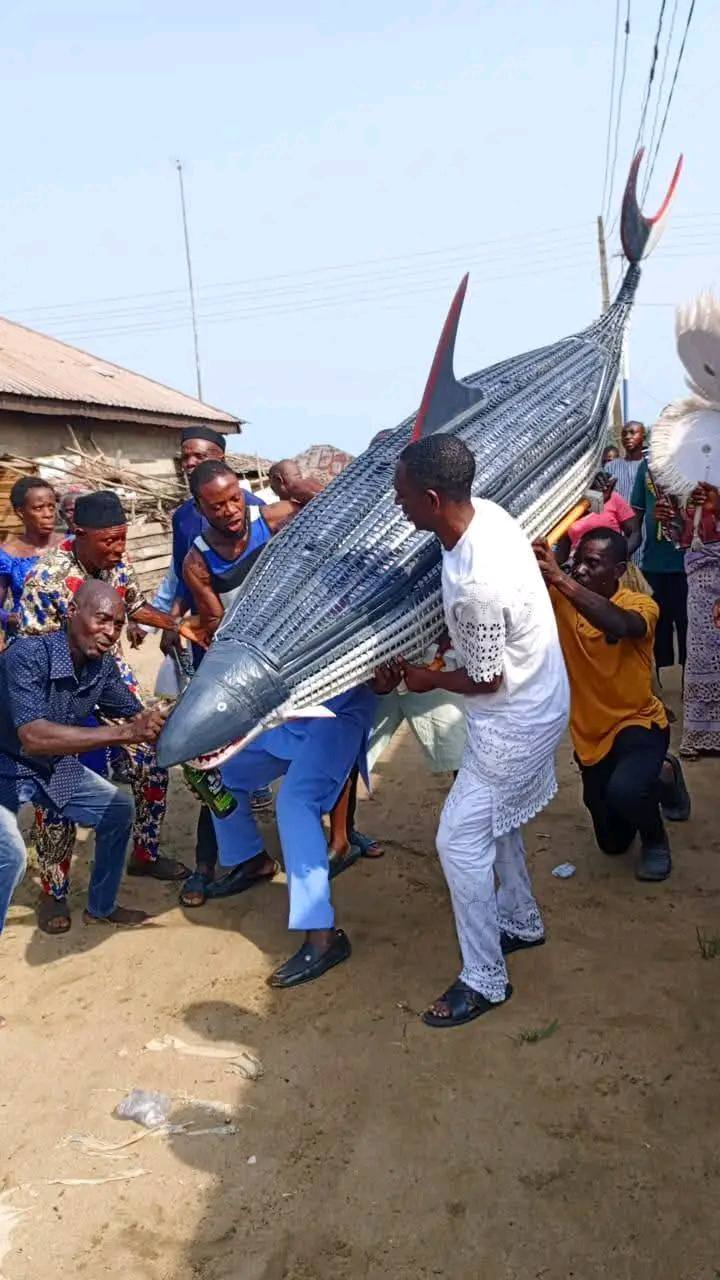
A remarkable burial in Oboro community, Bomadi Local Government Area, Delta State has drawn attention across social media and local audiences after the body of a 120-year-old fisherwoman was laid to rest in a custom-designed dolphin-shaped coffin. The ceremony was held in late February 2026 and generated discussion for both the advanced age attributed to the deceased and the symbolic nature of her funeral rites.
Local residents and sources reporting the event said the burial was intended as a celebration of the woman’s life and work. According to multiple community accounts, she spent most of her life engaged in fishing — a trade central to the culture and economy of their riverine community. The dolphin motif for the coffin was chosen deliberately to honour her deep connection to the water and to reflect her decades spent on the river.
Images and posts shared on social media depict a large and elaborately crafted dolphin-shaped casket, which served as the centrepiece of the funeral procession. While independent birth records confirming her age were not available publicly, witnesses in Oboro cited family testimony and community memory when discussing her longevity. In rural Delta communities, formal registration of births many decades ago was often not undertaken, so age estimates are typically based on oral histories and family lineage.
The vibrant funeral attracted significant interest from local residents, with community members gathering to pay their respects and reflect on the fisherwoman’s life. Supporters of the ceremony highlighted the positive symbolism embodied in the coffin’s design — a reflection not only of her profession but also of her identity as someone who lived in harmony with the riverine environment. Videos and photographs posted online show mourners gathered around the unique coffin, with many praising the family for the creativity of the tribute.
The dolphin, in this context, is seen locally as a representation of grace and resilience in the water, traits that community members said the deceased displayed in her work. Her life, according to extended family and neighbours who spoke about the event, was defined by her enduring presence on the water and her ability to sustain her household through fishing even in advanced age.
Reactions to the burial have been mixed across social media. Many observers applauded the family’s choice of a coffin that resonates with the woman’s life story, viewing it as a creative and culturally grounded way to commemorate her legacy. Others expressed scepticism about the age attribution, noting that formal verification of age beyond 100 years generally requires documented records — which are rarely available for births occurring many decades earlier in rural areas. However, supporters have framed the honour as symbolic rather than literal in terms of exact age.
The practice of using figurative or symbolic coffins to reflect an individual’s life or occupation has precedent in West Africa, where artisans sometimes craft memorial caskets shaped like objects that represent the deceased’s identity, profession or personal passions. While more commonly associated with nearby cultures such as those in Ghana, similar traditions have occasionally emerged in Nigerian riverine and coastal communities where a person’s relationship to their environment is deeply honoured.
Friends and neighbours described the deceased in affectionate terms, noting her hard work, community presence and the respect she commanded among fellow fisherfolk. Some accounts said she remained active into very old age, routinely taking part in fishing activities that sustained her family long after many of her contemporaries had retired from labour.
No official documentation from state civil registration authorities confirming her age has been cited in relation to this event, which means the figure of 120 years is drawn from community recollection rather than verified records. Nonetheless, the burial has become a point of local pride and a talking point that highlights the cultural practices of Oboro and its surrounding riverine settlements.
As stories and images from the funeral continue to circulate online, the event has sparked wider discussion about cultural expressions in funerary rites, the significance of symbolic memorials, and the ways in which communities choose to honour individuals whose lives were deeply entwined with their environment.
📩 Stone Reporters News | 🌍 stonereportersnews.com
✉️ info@stonereportersnews.com | 📘 Facebook: Stone Reporters | 🐦 X (Twitter): @StoneReportNew | 📸 Instagram: @stonereportersnews
Add comment
Comments