

Reported By Mary Udezue | Oravbiere Osayomore Promise.
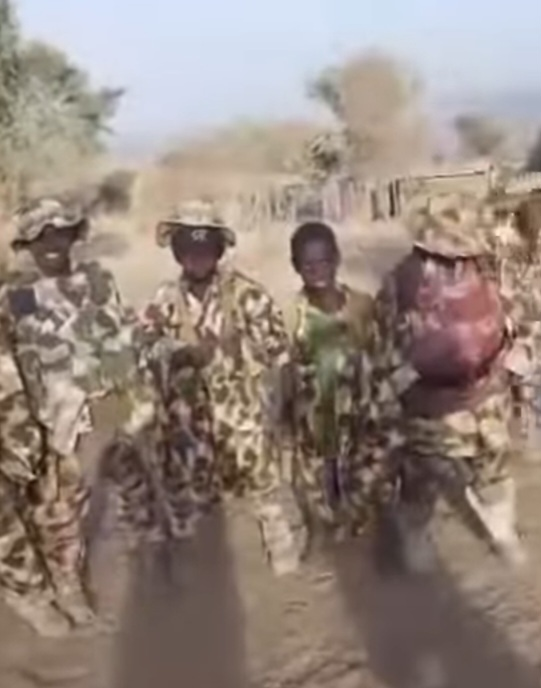
Public concern is mounting across northeastern Nigeria following the circulation of a disturbing video showing a group of children dressed in military-style clothing in what appears to be a remote forest in Borno State. The footage, which surfaced online and quickly spread across social media platforms, has raised fresh fears about the potential recruitment or exploitation of minors by armed insurgent groups operating in the region.
According to reports from residents and local observers, the video shows approximately eighteen young boys standing in formation in an isolated wooded area while wearing camouflage-style uniforms. The children appear to be jubilant and chanting while lined up in a coordinated manner. While the exact location where the footage was recorded has not been officially confirmed, some observers believe the language spoken by the children suggests links to the Ngoshe axis in Gwoza Local Government Area of southern Borno State.
The video quickly drew widespread condemnation from community members and social commentators who fear the images may reflect the continued presence of child fighters within extremist networks operating in northeastern Nigeria. Junaid Jibril Maiva, a youth leader associated with a political coalition in Borno South, warned that the situation could signal a dangerous escalation if left unaddressed. He described the footage as a “ticking time bomb,” urging authorities to respond decisively to prevent further exploitation of children in the conflict.
Other observers have suggested that the children seen in the video might not necessarily be voluntary recruits but rather victims held by insurgent groups. One commentator noted that armed groups in the region often hold large numbers of hostages, including women and children, which complicates military operations against them. In such circumstances, minors may be forced to wear uniforms or participate in propaganda videos designed to intimidate communities or project strength.
Officials in Borno State have acknowledged the circulation of the video and are seeking to understand its origins and context. Zuwaira Gambo, the state’s Commissioner for Women Affairs and Social Development, explained that children seen in such situations are often victims of abduction during militant raids on villages, schools or displaced persons camps. She emphasized that insurgent groups sometimes forcibly adopt children, training or using them for various roles within their networks.
The commissioner added that Borno State authorities had previously implemented a range of measures aimed at preventing the recruitment of minors into extremist groups. These initiatives include awareness campaigns in communities, school-based programmes, engagement with religious and traditional institutions, and efforts to reintegrate vulnerable children back into education. In recent years, the government has also conducted rehabilitation programmes that removed hundreds of children from the streets and reunited them with their families while enrolling them in school.
Officials say such initiatives contributed to international recognition that the state had made progress in reducing the recruitment of child soldiers. However, the resurgence of violent attacks in parts of Borno has renewed fears that children could once again become targets for coercion by armed groups seeking to replenish their ranks.
The northeastern region of Nigeria has endured more than fifteen years of insurgency linked primarily to Boko Haram and the Islamic State West Africa Province. Since the conflict began in 2009, thousands of civilians have been killed and millions displaced as militants attack villages, schools and military facilities across Borno and neighboring states.
Human rights groups have repeatedly warned that insurgent factions in the Lake Chad basin have used children in multiple capacities. Reports over the years indicate that minors have been forced to serve as messengers, informants, cooks and fighters, while some girls have been subjected to forced marriage or exploitation. In some cases, abducted children are indoctrinated through militant training camps in remote forest areas.
The latest video has resurfaced painful memories of previous incidents involving children and armed groups in Nigeria’s northeast. Security analysts note that extremist organizations have occasionally released propaganda videos featuring minors as a means of demonstrating loyalty to their cause or signaling that a new generation of fighters is being trained.
The situation has heightened calls for stronger monitoring and intervention by both government and humanitarian agencies. Child protection advocates say immediate steps should be taken to verify the identities of the children in the footage and determine whether they were abducted or coerced into participating in the scene. They stress that if the children are indeed victims of militant recruitment, urgent rescue and rehabilitation efforts will be necessary to prevent further psychological and physical harm.
Community leaders in Borno say the incident also underscores the broader humanitarian challenges facing the region. Years of displacement, economic hardship and disrupted education have left many families struggling to support their children, creating vulnerabilities that armed groups may exploit. In some rural communities, schools have been destroyed or closed due to insecurity, leaving large numbers of young people without formal education.
Security authorities have not yet issued a definitive statement confirming the authenticity of the viral video or identifying the group behind it. Investigations are expected to focus on determining where the footage was recorded, whether the children were acting under duress, and whether it forms part of a propaganda campaign by insurgent factions.
For residents of Borno State, however, the images have reignited anxiety about the long-term consequences of a conflict that has already affected an entire generation. Many families fear that children growing up amid violence, displacement and insecurity remain at risk of being manipulated by armed groups if stronger protective measures are not implemented.
As Nigeria continues its military and humanitarian efforts to stabilize the northeast, the emergence of such footage serves as a stark reminder of the human cost of the insurgency and the urgent need to safeguard the rights and futures of children caught in its shadow.
📩 Stone Reporters News | 🌍 stonereportersnews.com
✉️ info@stonereportersnews.com | 📘 Facebook: Stone Reporters | 🐦 X (Twitter): @StoneReportNew | 📸 Instagram: @stonereportersnews
Add comment
Comments