

Reported by: Ijeoma G | Edited by: Oravbiere Osayomore Promise.
A disturbing video showing abducted residents of Ariko community in Kachia Local Government Area of Kaduna State has intensified national concern following a deadly Easter Sunday attack that left several people dead and dozens kidnapped, with emerging details revealing the scale and coordination of the assault.
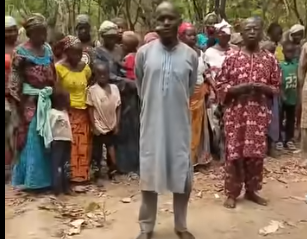
The footage, which has circulated widely across social media platforms, depicts a group of visibly distressed captives—men, women, and children—surrounded by armed men believed to be members of a criminal gang or terrorist group. The victims appear to be speaking under duress, with some pleading for assistance and identifying themselves and their community. The captors, armed with rifles, are seen asserting control in what appears to be a remote forest location, consistent with known hideouts used by armed groups operating in the region.
The video is linked to a coordinated attack on Ariko, a rural farming settlement, where gunmen reportedly stormed church services during Easter celebrations. According to multiple verified accounts, the attackers targeted worshippers gathered at local churches, including Evangelical Church Winning All and a Catholic congregation, opening fire during services and causing widespread panic.
Eyewitnesses and local leaders confirmed that the assault resulted in multiple fatalities, with the death toll estimated between eight and twelve as more victims were discovered in the aftermath. Dozens of others were abducted during the হামলা, with the gunmen forcing them into nearby forests. Survivors described chaotic scenes as people fled in different directions while others were rounded up and taken away.
Accounts from residents indicate that the attackers operated in a coordinated manner, arriving in significant numbers and surrounding the community before launching simultaneous strikes. Some witnesses reported that the gunmen remained in the area for an extended period, carrying out the нападение with little immediate resistance, before retreating with their captives.
Security forces were subsequently deployed to the area, and follow-up operations reportedly led to the rescue of several victims from the kidnappers’ hideouts. While exact figures remain uncertain, multiple accounts suggest that more than 30 individuals may have been freed during these operations. However, authorities have yet to provide a comprehensive breakdown of those rescued versus those still in captivity.
The emergence of the video after these rescue efforts has raised fears that a significant number of victims remain under the control of their abductors. In the footage, the captives appear grouped together, with some showing signs of exhaustion or possible injury, heightening concerns about their wellbeing.
Local authorities have acknowledged the attack and the ongoing security operations, though official statements have been cautious, emphasizing that investigations are still underway. The authenticity of the video has not been formally confirmed by security agencies, but officials familiar with the situation say it aligns with established patterns seen in previous kidnapping cases in Kaduna State.
Community leaders in Kachia have voiced frustration over what they describe as delayed security response during the нападение. Some residents claim that the attackers operated for nearly an hour before any meaningful intervention occurred, a delay they say contributed to the high number of casualties and abductions. These claims have added to growing criticism of security arrangements in rural areas.
The Ariko attack reflects a broader pattern of violence affecting Kaduna State and other parts of northern Nigeria. Over the years, armed groups—commonly referred to as bandits—have carried out repeated raids on villages, schools, and highways, engaging in mass abductions for ransom, cattle rustling, and other criminal activities. In recent times, their operations have increasingly taken on characteristics associated with organized terrorist groups.
Security analysts note that the use of videos to parade victims has become a strategic tool for these groups. By publicly displaying captives, they aim to exert psychological pressure on families and communities while signaling their strength and control. In many cases, such footage is used to initiate ransom negotiations, with abductors demanding large payments for the release of victims.
The humanitarian impact of the Ariko incident has been severe. Families of the abducted are reportedly in distress, struggling to confirm whether their loved ones are among those shown in the video. In similar situations, negotiations often occur informally, sometimes involving intermediaries, placing significant financial burdens on affected households.
Despite official government policies discouraging ransom payments, many families feel compelled to comply with kidnappers’ demands due to the absence of immediate rescue operations. This dynamic has contributed to the persistence of kidnapping as a profitable criminal enterprise in the region.
Religious organizations and civil society groups have condemned the attack, describing it as a violation of fundamental human rights and an assault on places of worship. They have called for urgent action to improve security, particularly in vulnerable rural communities where state presence is limited.
The Nigerian military has, in recent months, intensified operations targeting armed groups across the northwest and north-central regions. Airstrikes and ground offensives have reportedly destroyed several camps and disrupted criminal networks. However, security experts caution that these efforts must be sustained and complemented by improved intelligence gathering and community engagement to achieve lasting results.
Kaduna State remains one of the most affected areas in Nigeria’s ongoing security crisis. The combination of vast forested terrain, limited infrastructure, and socio-economic challenges has created conditions that allow armed groups to operate with relative ease. Analysts argue that addressing the root causes of insecurity—including poverty, unemployment, and local conflicts—will be critical to long-term stability.
As the investigation into the Ariko attack continues, authorities face mounting pressure to secure the release of those still in captivity and bring the perpetrators to justice. The incident has reignited national debate over the effectiveness of current security strategies and the need for more decisive action.
For the victims seen in the video, their fate remains uncertain. Their ordeal highlights the human cost of Nigeria’s security challenges and the urgent need for comprehensive solutions. As families wait anxiously for news, the images from Ariko serve as a stark reminder of the dangers faced by communities across the region.
📩 Stone Reporters News | 🌍 stonereportersnews.com
✉️ info@stonereportersnews.com | 📘 Facebook: Stone Reporters News | 🐦 X (Twitter): @StoneReportNew | 📸 Instagram: @stonereportersnews
Add comment
Comments