

Published by Oravbiere Osayomore Promise.
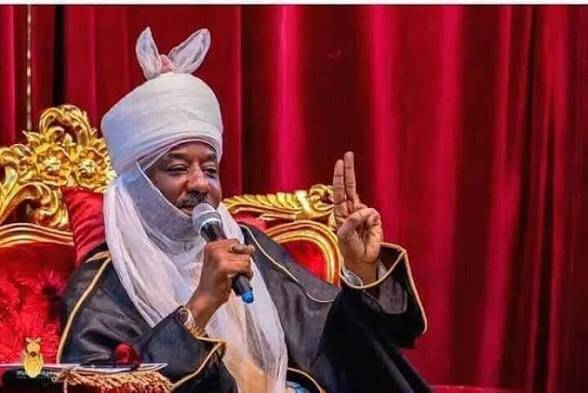
The Emir of Kano, Muhammadu Sanusi II, has launched a withering critique of the Federal Government’s continued borrowing, questioning why the nation’s debt profile keeps climbing despite the official end of the petrol subsidy regime. In an interview posted by News Central TV on Friday, the former Central Bank of Nigeria governor threw a pointed question at the Tinubu administration: “If you’re not paying the subsidy and you’ve got the money, why are we still borrowing and borrowing? What are we borrowing for?” The question cuts to the heart of one of the most puzzling contradictions in Nigeria’s current fiscal story: the removal of a notorious drain on public finances has not yet translated into a visible reduction in the country’s appetite for new loans.
Sanusi made clear that he does not oppose the removal of the fuel subsidy itself. He described the old regime as “unsustainable” and recalled that as far back as 2012 he had warned that Nigeria was borrowing simply to pay the difference between global and local pump prices, a practice he now bluntly calls “bankruptcy by policy.” He commended President Bola Tinubu for finally taking the painful step, and he also applauded the liberalisation of the exchange rate, noting that “artificial exchange rates, especially when you’re printing money, cannot work.” His critique is not of the reforms themselves, but of what has happened after them.
The Emir argues that the logic of the reforms demanded that the savings be used to reduce borrowing, not to create room for more of it. “We’ve removed the subsidy. We’re not spending it. What we should not see is fiscal consolidation. You cannot remove wastages and continue borrowing,” he said. The numbers appear to support his point. According to a Budget report, the Federal Government increased its 2026 borrowing plan upward by N11.31 trillion, bringing the total projected borrowing for the year to a staggering N29.20 trillion. On the very day Sanusi’s interview aired, President Tinubu also sought Senate approval for a fresh $516 million loan to fund the Sokoto-Badagry Superhighway. Debt service alone is projected to consume a staggering share of revenue, leaving little for hospitals, schools, or roads, which are precisely the areas where Nigerians were told the subsidy savings would be redirected.
The Emir’s intervention is not a sudden change of heart. For more than a year, he has been consistent in his warning. In October 2025, speaking at the Oxford Global Think Tank Leadership Conference in Abuja, he used the same powerful image: “If you stop paying subsidies but continue borrowing more, it means you’ve filled one hole only to dig another.” At that time, he also raised uncomfortable questions about the size and cost of government: “Why do we need 48 ministers? Why do we need convoys of vehicles?” He warned that without a serious effort to cut waste and make spending more efficient, the benefits of the subsidy removal would quickly be undone. He has also expressed support for the government, saying he agrees with about 70 to 80 percent of its policy direction, but that support has always been conditional on fiscal discipline.
The rising debt stock gives increasing weight to his questions. As of December 2025, Nigeria’s total public debt stood at N159.28 trillion, according to the Debt Management Office. Domestic debt accounted for a slight majority, reflecting a deliberate shift away from vulnerable external borrowing. However, the cost of that domestic borrowing has been punishing. Interest rates on government securities have climbed steeply, crowding out private sector credit and leaving the government caught in a familiar trap: higher borrowing costs lead to higher debt service, which leaves less room for capital spending, which then forces more borrowing just to keep the lights on.
The debt service-to-revenue ratio is perhaps the most alarming indicator. BudgIT, a civic organisation, reported that the ratio peaked at 83.62 percent in the second quarter of 2025, far above the 20 percent benchmark considered sustainable for low-income countries. “Nigeria faces a severe fiscal inflection point driven by explosive debt accumulation, weak revenue mobilisation, currency depreciation and heavy reliance on high-cost borrowing,” the organisation warned. In those circumstances, every naira of new borrowing feels less like an investment in the future and more like a desperate attempt to keep the present from collapsing.
Sanusi has also highlighted the human dimension of the contradiction. The removal of the subsidy has imposed real pain on ordinary Nigerians, yet they are still waiting for the promised relief. Roads are still in disrepair, hospitals are still underfunded, and the cost of living has not come down. “If you ask the Nigerian people, they will not say, ‘Thank you for removing the subsidy,’ because they are yet to see any tangible benefit,” he has said. The failure to demonstrate visible gains has eroded public trust and made it harder for the government to defend its continued borrowing.
The government has defended its borrowing as necessary for infrastructure and development. Officials point to major projects such as the Lagos-Calabar Coastal Highway and the rehabilitation of key ports, arguing that such projects require long-term financing that cannot be funded by short-term revenue alone. They also note that Nigeria’s debt-to-GDP ratio, projected at 32.3 percent in 2026, remains below the internationally recognised threshold of 60 percent. Sanusi and other economists, however, caution that the debt-to-GDP ratio is a poor measure of fiscal health when most revenue is already swallowed by servicing existing debt.
The Emir’s critique is also a reminder that fiscal discipline is not just about how much money comes in, but about how it is spent. He has repeatedly called for a leaner, more efficient government, one that spends less on itself and more on the public. “You cannot ask the common man to tighten his belt while the government is buying new jets and expanding the size of the cabinet,” he said in a recent interview. His words echo a sentiment that is widely shared, even among those who support the government’s broader economic direction. The question is no longer whether the subsidy should have been removed; the question is what has been done with the savings.
For now, the Emir’s words hang in the air, unanswered. The government has not provided a clear breakdown of how the subsidy savings have been allocated, nor has it explained why borrowing has not only continued but accelerated. Sanusi’s question — “Why are we still borrowing?” — is not merely an academic one. It is a question that goes to the very heart of Nigeria’s economic survival. He has framed it in the simplest possible terms: “If you fill one hole, why dig another?” Until that question is answered, the fiscal debate in Nigeria will remain stuck in a loop of borrowing, spending, and debt. And the ordinary citizen, left to wonder where the subsidy money went, will continue to ask the same thing.
📩 Stone Reporters News | 🌍 stonereportersnews.com
✉️ info@stonereportersnews.com | 📘 Facebook: Stone Reporters News | 🐦 X (Twitter): @StoneReportNew | 📸 Instagram: @stonereportersnews
Add comment
Comments