

Reported by: Oahimire Omone Precious | Edited by: Oravbiere Osayomore Promise.
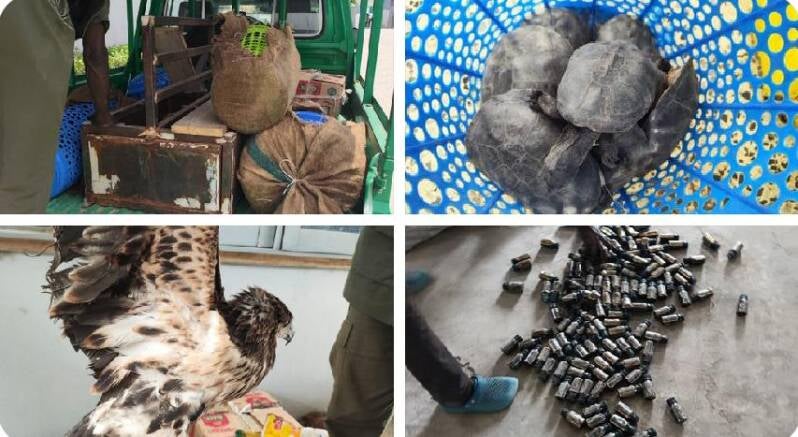
The National Drug Law Enforcement Agency (NDLEA) has intercepted a massive consignment of 180 bags containing an estimated 90,000 bottles of a substance known locally as ‘Akuskura’, in a carefully disguised smuggling attempt that could have flooded Nigerian communities with dangerous psychoactive substances. In a separate but equally significant operation, the agency also seized a collection of live and dead endangered wildlife species, including two live antelopes, one dead antelope, a porcupine, two civet cats, four eagles, and thirteen tortoises, all of which are protected under international conservation treaties. The seizures, announced by NDLEA spokesman Femi Babafemi on Friday, represent what the agency described as a major blow to the network of smugglers who exploit Nigeria’s porous borders to traffic both illicit drugs and imperilled animals.
According to the NDLEA, operatives acting on credible intelligence intercepted a commercial vehicle along a major highway in the North‑Central region, which was carrying 180 large sacks of ‘Akuskura’. Each bag reportedly contained about 500 bottles, bringing the total haul to approximately 90,000 bottles. The substance, popularly known in some quarters as a cheap stimulant or a herbal concoction, has been linked by health authorities to severe side effects including organ damage, mental confusion, and in extreme cases, death. The consignment was cleverly concealed and disguised as general goods, highlighting the criminals’ efforts to bypass routine checks. “The items were buried under layers of ordinary merchandise, but our operatives’ training and intelligence network exposed the ruse,” Babafemi said in a statement.
Preliminary laboratory tests on random samples of the seized bottles are underway, but the NDLEA suspects the substance contains undeclared psychoactive ingredients that could be more harmful than traditional opioids. The agency has not yet disclosed the total street value of the consignment, but initial estimates suggest it could run into hundreds of millions of naira. The driver of the vehicle was arrested at the scene and is currently being interrogated to uncover the source and intended distribution network. Authorities believe the consignment was destined for markets in the North‑East and South‑South regions, where ‘Akuskura’ has reportedly gained a worrying following among unemployed youth and informal workers.
In a separate intelligence-driven operation, NDLEA officers, acting in collaboration with the National Park Service and wildlife conservation organisations, intercepted a shipment of endangered wildlife being transported in crates labelled as “farm produce.” The animals, which include two live antelopes, one dead antelope, a porcupine, two civet cats, four eagles, and thirteen tortoises, were found to be species listed under Appendix I and Appendix II of the Convention on International Trade in Endangered Species of Wild Fauna and Flora (CITES). The presence of a dead antelope suggests that the traffickers may have already begun butchering the animals for bushmeat or traditional medicine markets. The eagles, which are protected birds of prey, are particularly prized by collectors and for ritual purposes in some local communities.
The NDLEA spokesman, Abdullahi (named in the user’s text as the source), described the wildlife seizure as “a major boost to ongoing efforts against smuggling in all its forms.” He warned that the illicit trade in endangered species does not only threaten biodiversity but also weakens national security by funding criminal networks that are often involved in drug and human trafficking. “These are not victimless crimes,” Abdullahi said. “The same routes and methods used to move drugs are used to move ivory, pangolin scales, and live animals. By disrupting this network, we have also hit the financial lifeline of organised crime.” The NDLEA has handed over the live animals to the National Park Service and the Nigerian Conservation Foundation for rehabilitation and eventual release into safe habitats. The dead antelope will be used as evidence in the prosecution of the suspects under the Endangered Species Act.
The twin seizures come at a time when Nigerian authorities are intensifying efforts to secure the country’s land borders and ports against a rising tide of transnational crime. In the first quarter of 2026 alone, the NDLEA has recorded more than 2,000 arrests and seized over 150 tons of illicit drugs, including cocaine, heroin, methamphetamine, and cannabis. The agency has also strengthened its partnership with the Wildlife Justice Commission and other international bodies to target the intersection between drug trafficking and wildlife crime. The latest operations were executed by a specialised unit trained in detecting both chemical and biological contraband, an indication that the NDLEA is evolving beyond its traditional anti‑narcotics mandate.
The arrested suspects remain in custody and are expected to be charged in court on counts of illicit drug trafficking and illegal possession of endangered species. Legal experts note that the penalties for wildlife trafficking under Nigerian law can include imprisonment of up to ten years and heavy fines. For the drug offences, the suspects face a possible life sentence, given the sheer volume of the substances involved. The NDLEA has appealed to members of the public to provide information on smuggling activities, emphasising that community cooperation is essential to dismantling the networks that profit from death and environmental destruction.
The seizure of 90,000 bottles of ‘Akuskura’ has also reignited calls for stricter regulation of traditional concoctions and psychoactive herbal mixtures, many of which are sold openly in local markets without any form of quality control. Civil society organisations have urged the National Agency for Food and Drug Administration and Control (NAFDAC) to conduct a nationwide audit of such products and to prosecute manufacturers who add unapproved chemicals to their formulas. Meanwhile, the rescue of the eagles, antelopes and other creatures has been applauded by conservationists, who see the NDLEA’s intervention as a model for how drug law enforcement can inadvertently help protect the environment. For now, the animals that survived their ordeal are recovering under expert care, and the bottles that never reached their buyers will be destroyed after serving as evidence. The fight against smugglers is far from over, but for one day, the NDLEA scored a significant victory on two very different fronts.
📩 Stone Reporters News | 🌍 stonereportersnews.com
✉️ info@stonereportersnews.com | 📘 Facebook: Stone Reporters News | 🐦 X (Twitter): @StoneReportNew | 📸 Instagram: @stonereportersnews
Add comment
Comments