

Reported by: Ijeoma G | Edited by: Oravbiere Osayomore Promise.
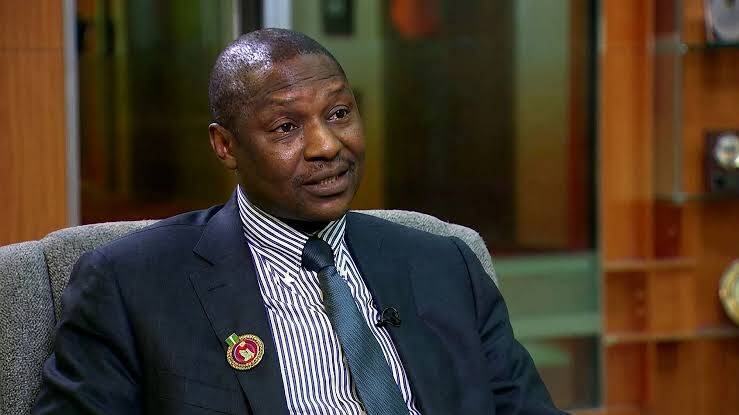
Former Attorney‑General of the Federation and Minister of Justice, Abubakar Malami (SAN), has launched a comprehensive legal assault on the Economic and Financial Crimes Commission (EFCC), accusing the anti‑graft agency of grossly inflating the value of his assets to mislead the court and secure an interim forfeiture order against dozens of properties belonging to him, his family, and companies linked to him. In a 40‑page affidavit filed before the Federal High Court in Abuja, Malami denied that any of the assets were acquired with proceeds of crime and insisted that all his wealth has been lawfully earned and properly declared to the Code of Conduct Bureau (CCB). The dispute is centred on an interim forfeiture order obtained by the EFCC on 6 January 2026, which temporarily placed under the commission’s control more than 50 properties – including houses, hotels, schools, factories and plots of land – spread across Abuja, Kano and Kebbi states.
Malami’s primary grievance is that the EFCC deliberately exaggerated the worth of the assets in order to present a misleading picture to the court. He alleged that properties purchased for hundreds of millions of naira were presented by the commission as being worth billions. In a specific example cited in his affidavit, a duplex in the upmarket Maitama district of Abuja that the EFCC valued at N5.95 billion, Malami claimed he bought for only N500 million. Similarly, he said the permanent site of Rayhaan University, which the EFCC pegged at N56 billion, was acquired for N150 million, and he attached an independent valuation by the firm Jide Taiwo & Co to back his figures. “Independent valuers have placed significantly lower and more accurate figures on the assets,” his affidavit stated.
To demonstrate the legitimacy of his wealth, the former minister laid out what he described as N15.5 billion in lawful income earned between 2015 and 2023. That figure included N374.6 million in salary and allowances received as Attorney‑General, N10.01 billion from business turnover, N3.52 billion from bank loans, N958 million from wedding gifts, and N509.8 million from proceeds of two book launches. He also pointed to assets that were acquired before he ever became a minister, such as the Rayhaan Hotel in Kano and the Malami Support Organisation Building, which he said were purchased between 2006 and 2013. To further prove his compliance with the law, he filed four CCB asset declaration forms covering the years 2015, 2019 and 2023, arguing that the disputed properties were already on record before the EFCC began its investigation.
Beyond the valuation dispute, Malami accused the EFCC of serious procedural overreach. He alleged that armed operatives of the commission seized properties without a final forfeiture order, evicted his family members – including his wives and minor children – from six Abuja homes on 24 March 2026, and confiscated title documents during his 25‑day detention in December 2025. He described the actions as “extrajudicial” and a deliberate breach of due process.
The case has already begun to affect the former minister’s business interests. Malami informed the court that the Nigeria Export‑Import (NEXIM) Bank recalled a N1.122 billion loan to Rayhaan Bustan Agro Allied, one of his companies, just days after the interim forfeiture order was issued. He also said that Zenith Bank, which had guaranteed the facility, began charging daily interest on the outstanding balance. “There is no document before the court showing these properties were acquired with proceeds of crime,” Malami’s affidavit declared, adding that he has pleaded not guilty to the underlying criminal charge, numbered FHC/CR/700/2025, and that the allegations are still being contested and have not been determined.
The interim forfeiture order was obtained ex parte by the EFCC. The court has now directed any interested party to “show cause” why the assets should not be permanently forfeited to the federal government. Malami is urging the court to set aside the order and return the properties to him, insisting they are legitimate and in no way linked to any unlawful activity.
The face‑off between the former chief law officer of the federation and the nation’s premier anti‑corruption agency is shaping up as a landmark test of the scope of asset forfeiture laws and the strict adherence to due process in Nigeria. The court is expected to decide in the coming weeks whether the properties will be permanently forfeited or returned to their owner. In the meantime, Malami’s sworn accusations of inflated valuations and extrajudicial seizures have deepened the already intense scrutiny of the EFCC’s methods.
📩 Stone Reporters News | 🌍 stonereportersnews.com
✉️ info@stonereportersnews.com | 📘 Facebook: Stone Reporters News | 🐦 X (Twitter): @StoneReportNew | 📸 Instagram: @stonereportersnews
Add comment
Comments