

Reported by: Ijeoma G | Edited by: Oravbiere Osayomore Promise.
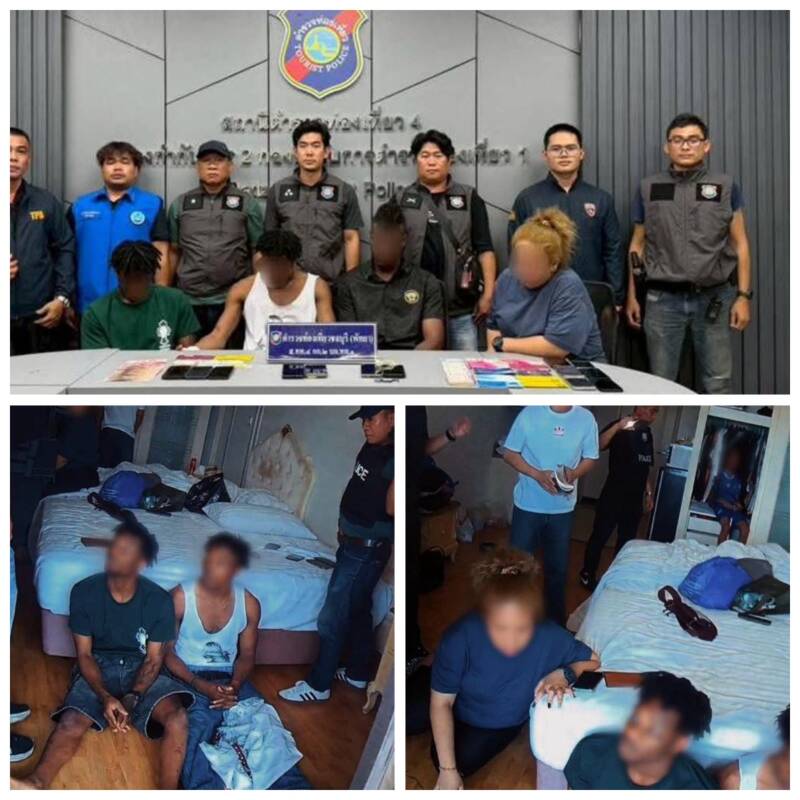
Thai authorities have dismantled a transnational romance scam network operating out of a hotel in central Pattaya, arresting three Nigerian nationals and a 41‑year‑old Thai woman accused of using bank “mule accounts” to receive and launder money stolen from victims across the globe. The raid, led by tourist police and Provincial Police Region 2 investigators, took place on 28 April 2026 at a hotel in the Nong Prue area of Bang Lamung, Chon Buri. Officers seized 12 mobile phones and 12 bank accounts, along with other evidence linking the group to a sprawling international fraud network.
The operation was the result of weeks of surveillance. According to investigators, the syndicate specialised in “mule accounts” – bank accounts opened by one person but used by another – to receive illicit transfers from victims of online romance scams. The scam typically works by building fake romantic relationships online, sometimes over weeks or months, then inventing fabricated emergencies, investments, or travel expenses to coax victims into sending money. Once the money arrives, it is quickly withdrawn and funnelled through multiple accounts to obscure its origin.
The Thai suspect, identified as 41‑year‑old Patcharin from Chon Buri, allegedly confessed to sourcing bank accounts for her Nigerian husband and for the Nigerian group. She received approximately 2,000 baht (about USD 55) for each account she provided. In addition to sourcing accounts, she handled daily cash withdrawals and transfers for the group, earning an additional commission of around 10 percent. Police reported that her earnings reached up to 30,000 baht (about USD 840) per day – a substantial sum that reflects the scale of the operation.
The three Nigerian suspects, identified by local media as Chibueze, Miracle, and John, are believed to have coordinated the network’s activities, including communicating with victims and directing the flow of funds. Patcharin reportedly named “Chibueze” as her husband. The money was quickly withdrawn after each transaction and routed through multiple intermediaries before being sent to senior figures based in Nigeria. The group is part of a wider romance scam network with similar cells operating across Thailand and in other countries.
During the raid, tourist police and regional investigators also seized a large number of mobile phones, bank passbooks, and SIM cards. The suspects face charges under Thailand’s 2023 Technology Crime Prevention and Suppression Act, including organising or facilitating the buying, selling, or lending of bank accounts and electronic payment accounts for criminal purposes. Additional charges relate to SIM card trafficking (under Sections 10 and 11 of the 2023 Emergency Decree) and membership in an organised criminal association (under Section 209 of the Criminal Code).
The case highlights the expanding role of “mule accounts” in cross‑border fraud. These accounts, often provided by complicit or financially desperate individuals, make it extremely difficult for authorities to trace the ultimate beneficiaries of criminal proceeds. Patcharin’s role as a local facilitator was crucial to the network’s ability to operate, and her arrest may provide investigators with valuable intelligence about the group’s structure and methods.
The suspects have been handed over to Bang Lamung Police Station for legal proceedings. Police say investigations will continue to identify additional members of the network and to trace financial flows linked to the group. Authorities are also working to establish connections with overseas coordinators – particularly in Nigeria – to disrupt further romance scam operations believed to be active in Thailand and abroad.
This is not the first major romance scam bust in Thailand this year. In early April 2026, Thai police arrested three Thai women and two Nigerian men in Bangkok for operating a love scam that targeted Thai women looking for foreign husbands. In late April, four Nigerian men were arrested in Ranong after allegedly using fake online identities to approach local women. And in January, a 13‑member network was busted in Muang Thong Thani, leading to the arrest of 11 Nigerians. The latest Pattaya bust shows that despite repeated crackdowns, the fraud industry continues to adapt – and the people laundering the money are increasingly being caught inside the country where the banks are located.
For the victims of this syndicate – many of whom may still be unaware that they were deceived – the arrests offer a measure of closure. But as police continue to dig deeper into the flow of funds, the Pattaya bust is likely to expose an even larger network of criminals who thought that hiding behind a thousand bank accounts would keep them safe.
📩 Stone Reporters News | 🌍 stonereportersnews.com
✉️ info@stonereportersnews.com | 📘 Facebook: Stone Reporters News | 🐦 X (Twitter): @StoneReportNew | 📸 Instagram: @stonereportersnews
Add comment
Comments