

Reported by: Oahimire Omone Precious | Edited by: Oravbiere Osayomore Promise.
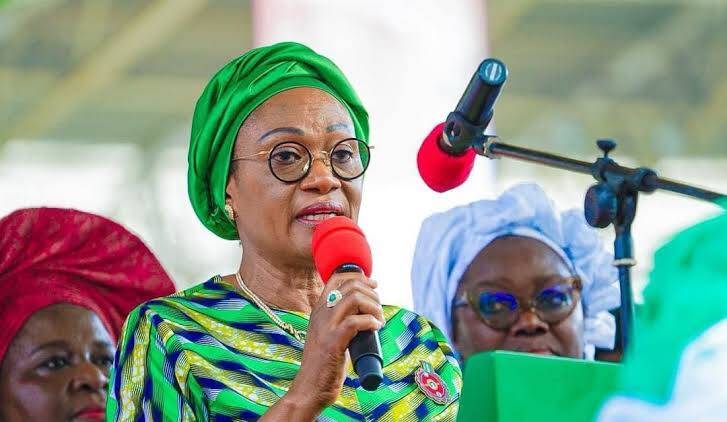
The First Lady of Nigeria, Senator Oluremi Tinubu, has called on Nigerians to emulate the peaceful coexistence found in Kaduna State, urging citizens to embrace unity across religious and ethnic divides as the nation confronts mounting economic and security challenges. Speaking on Thursday, 30 April 2026, at the launch of a major humanitarian intervention at the Abba Kyari Banquet Hall in Kaduna, the First Lady announced the distribution of 100 trucks of rice and N1.2 billion in cash palliative to vulnerable Muslim communities across the 19 northern states and the Federal Capital Territory. The initiative, timed to coincide with the approach of Eid el‑Kabir, is part of a broader effort to ease the burden of rising food prices and economic hardship on low‑income households.
“I urge all Nigerians, regardless of our differences, to emulate Kaduna State, where people live in peace and harmony despite their diverse religious and ethnic backgrounds,” Tinubu told the gathering, which included governors, traditional rulers and religious leaders. She described the intervention as a gesture of solidarity with the Muslim Ummah in northern Nigeria, particularly as the Eid el‑Kabir season approaches. “This programme reflects the values of sacrifice, compassion and gratitude associated with this festive period. It aims to provide relief to vulnerable households across the region,” she said.
The First Lady recalled that on 23 December 2025, her office had distributed similar palliatives to Christian communities in the North, noting that the current effort fulfills a commitment to inclusiveness. “We have extended our hands to our Christian brothers during the Christmas season. Today, we are extending the same hands to our Muslim brothers and sisters. This is the Nigeria we must build – one where no one is left behind because of their faith,” she said. She urged religious and community leaders to continue promoting peace and mutual respect, stressing that national unity remains key to overcoming the challenges facing the country.
Kaduna State Governor, Senator Uba Sani, who received the First Lady at the Government House before the event, commended her dedication to supporting vulnerable populations. He described her interventions as impactful and inclusive. “Her humanitarian efforts, which cut across religious and ethnic lines, demonstrate the values of unity and shared humanity,” Sani said. The governor also highlighted ongoing efforts by his administration to improve living conditions through social programmes, economic support initiatives and enhanced security measures. He noted that Kaduna had recorded significant progress in reducing communal clashes and fostering inter‑faith dialogue, making it a model for other states.
The launch of the palliative initiative comes at a time when Nigeria is grappling with a cost‑of‑living crisis driven by persistent inflation, the removal of fuel subsidies and the floating of the naira. Food prices have soared, and many households have been forced to cut back on essential meals. The federal government has faced criticism over the pace of relief distribution, but the First Lady’s office has consistently rolled out independent interventions. In 2025, she launched the “Renewed Hope Initiative” which has provided agricultural inputs, educational materials and health support to thousands of families across the country.
The selection of Kaduna as the launch venue was deliberate. The state has been a flashpoint for ethno‑religious violence in the past, but under Governor Uba Sani’s leadership, it has witnessed a relative lull in communal clashes. The government has pursued a dual strategy of security reinforcement and community engagement, including the establishment of peace committees and the prosecution of hate speech purveyors. Governor Sani told the gathering that his administration had invested heavily in dialogue and economic empowerment as tools for conflict prevention.
The 100 trucks of rice will be distributed through state governments, traditional institutions and religious bodies to ensure that the palliatives reach the most vulnerable. The N1.2 billion cash component is expected to be disbursed in small amounts to very poor households, with a focus on widows, the elderly and persons with disabilities. The First Lady’s office said it had put in place monitoring mechanisms to prevent diversion and ensure transparency. Officials from the National Emergency Management Agency (NEMA) and the State Emergency Management Agencies (SEMAs) have been enlisted to coordinate the logistics.
Reactions to the initiative were largely positive, though some critics questioned the timing, noting that the federal government has struggled to implement similar large‑scale distribution programmes without hitches. However, community leaders in Kaduna praised the First Lady for her consistency. “She does not discriminate. She gave to Christians at Christmas, and now she is giving to Muslims for Sallah. This is the leadership we need,” said Imam Abdullahi Musa who attended the event. Christian Association of Nigeria (CAN) leaders in Kaduna also sent a goodwill message, commending the First Lady for her inclusive approach.
The First Lady’s call for Nigerians to “emulate Kaduna” is significant, given that the state has often been cited as a symbol of division. By holding up Kaduna as a model of peaceful coexistence, she is challenging the narrative that religious and ethnic diversity must inevitably lead to conflict. Her message aligns with President Bola Tinubu’s “Renewed Hope” agenda, which prioritises national unity and economic revitalisation.
As the Eid el‑Kabir festivities draw near, the palliatives are expected to provide some relief to millions of families struggling to afford the rising cost of food. But the First Lady made it clear that government handouts are not a substitute for structural change. “We must all work together to build an economy where every Nigerian can feed themselves and their families,” she said. “This palliative is a temporary relief. The permanent solution lies in peace, hard work and collective effort.”
The event ended with a prayer session led by prominent Islamic scholars, who prayed for the nation’s peace and prosperity. Governor Uba Sani, in his closing remarks, described the First Lady as a “mother of the nation” and pledged that Kaduna would continue to be a beacon of peaceful coexistence. As the 100 trucks began their journey to the 19 northern states, the message from Kaduna was unambiguous: Nigeria can overcome its divisions, but it requires leadership, empathy and a willingness to see beyond religious labels.
📩 Stone Reporters News | 🌍 stonereportersnews.com
✉️ info@stonereportersnews.com | 📘 Facebook: Stone Reporters News | 🐦 X (Twitter): @StoneReportNew | 📸 Instagram: @stonereportersnews
Add comment
Comments