

Reported by: Ijeoma G | Edited by: Oravbiere Osayomore Promise.
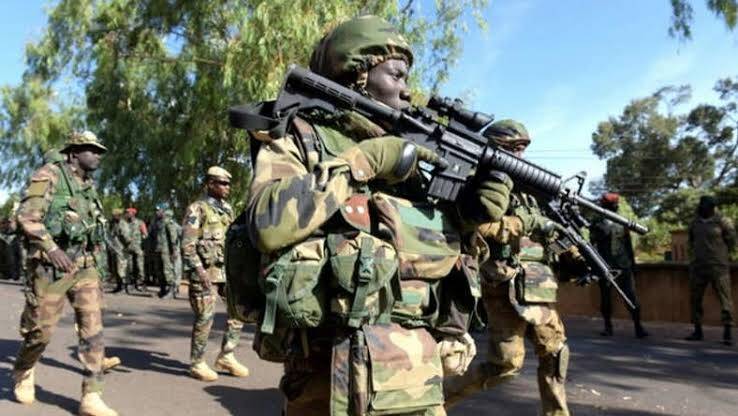
Security operatives in northern Nigeria have arrested two men caught wearing full military camouflage while walking the streets of Kafanchan, a bustling town in Kaduna State’s Jema’a Local Government Area. The takedown occurred around 8:30 p.m. on May 1 along Bauchi Street, a normally busy thoroughfare that was quieting down for the night. Troops from Sector 7 of Operation Safe Haven, a long‑standing military task force responsible for stabilising parts of Plateau, Bauchi and southern Kaduna, were on routine patrol when they spotted the pair. What immediately raised suspicion was not just the uniforms, but the way the men carried themselves. At first glance, they appeared to be soldiers going about their business, but something in their demeanour did not align with military discipline. The troops moved in swiftly, detaining both individuals before any confrontation could escalate. According to security sources who spoke with regional counter‑insurgency expert Zagazola Makama, the suspects have since been taken into custody for extensive questioning. Investigators now face two urgent tasks: confirming the real identities of the detained men and determining whether they were preparing to commit a crime or had already done so while hidden behind the nation’s uniform.
Preliminary findings have already produced a worrying lead. Security sources disclosed that the camouflage outfits worn by the suspects may have belonged to an actual serving soldier who is currently on authorised leave. If confirmed, that detail would transform the case from simple impersonation into a deeper security breach, one that suggests military‑grade gear can leak from within the ranks into unauthorised hands. The two suspects are currently being held by the Kaduna State Police Command while investigators work to uncover their true identities, their immediate intentions, and any possible links to existing criminal networks. Authorities have stated that investigations remain active and that no potential connection, whether to banditry, armed robbery or a wider impersonation ring, is being ruled out at this stage.
This arrest, however, is not an isolated event. It is the latest in a string of similar apprehensions that reveal a troubling pattern across Nigeria. In March of this year, the Nigerian Navy handed over two fake officers to the police in Calabar after they were found dressed in military camouflage and carrying counterfeit identification cards. In that case, one suspect had been impersonating a Navy Lieutenant while the other posed as a Midshipman. The two men even claimed to be serving on a fictional naval vessel. Both later confessed to purchasing their uniforms on the open market and fabricating their ID cards themselves. Weeks earlier, in a separate operation, police in Kaduna State had arrested three individuals, including a dismissed soldier, for impersonating military personnel while leading a robbery gang. Each of these cases points to a supply chain of deception that extends far beyond a few isolated criminals.
The problem has become so widespread that security analysts now describe the proliferation of military attire among non‑state actors as a direct threat to public trust. A report published by The Guardian Nigeria in April 2024 warned that the trend of impostors presenting themselves as security personnel, causing disturbances, engaging in theft through deception, and at times resorting to violent crime while wearing official garb, is increasing and compounding the nation’s security challenges. When criminals dress like the people meant to protect civilians, they do more than evade detection; they sever the bond of trust between the military and the communities they serve. A local security source cited in an earlier investigation put it bluntly: this tactic is not just about firepower, but about psychological warfare. It makes the public fearful of everyone in uniform, which only helps bandits and kidnappers operate with greater impunity.
Residents in Kaduna State have repeatedly borne the consequences. In August 2024, police operatives arrested a suspect who was caught on the Birnin Gwari‑Kaduna highway with fifteen pieces of unsewn military camouflage material. The suspect admitted under questioning that he had been hired to deliver the materials to someone who would then hand them over to armed bandits operating in the Chukuba area of Niger State. In another incident that same year, security forces arrested a dismissed soldier accused of supplying military uniforms to a notorious bandit leader in Zamfara State. These cases reveal a chilling reality: the uniform that is supposed to represent protection and order has become a commodity, traded and abused by those who seek to inflict harm.
For the Kafanchan community and the wider southern Kaduna region, the arrest of the two impostors on Bauchi Street has brought a small measure of relief but also renewed anxiety. Locals have long complained about suspicious individuals dressed in military gear who appear in their neighbourhoods without proper identification, often just before an attack or a kidnapping. Security forces have responded by intensifying patrols along the Kafanchan‑Zonkwa axis, hunting for possible collaborators who might still be operating under the cover of stolen uniforms. The message from authorities has been clear: citizens are urged to remain vigilant and to verify the identity of any security personnel through official channels whenever an operation seems unusual.
For now, the two suspects remain in police custody, their faces and their fates still unknown to the public. What is known is that they were caught wearing the uniform of the Nigerian military on a quiet Friday night, and that simple discovery has now opened a much larger investigation into how deep the rot really goes. Whether they were planning a robbery, a kidnapping, or something far worse is a question that investigators are racing to answer. But the broader question, the one that hangs over every checkpoint and every village in troubled northern Nigeria, is this: how many more impostors are still walking free, hidden in plain sight, wearing the camouflage of those sworn to protect?
📩 Stone Reporters News | 🌍 stonereportersnews.com
✉️ info@stonereportersnews.com | 📘 Facebook: Stone Reporters News | 🐦 X (Twitter): @StoneReportNew | 📸 Instagram: @stonereportersnewsv
Add comment
Comments