

Reported by: Ijeoma G | Edited by: Oravbiere Osayomore Promise.
The Nigerian Navy has delivered a significant blow to economic saboteurs in the Niger Delta, announcing the successful dismantling of illegal refining camps and the disruption of sophisticated oil theft networks across Rivers and Bayelsa states. The operation, executed by the Nigerian Navy Ship (NNS) Pathfinder and NNS Soroh, led to the recovery of approximately 163,000 litres of suspected crude oil and illegally refined Automotive Gas Oil. Announcing the breakthrough on Sunday, the Director of Naval Information, Navy Captain Abiodun Folorunsho, said the operation was the result of coordinated, intelligence-driven missions aimed at crippling the illegal oil trade that has long plagued the region.
The raids, which took place on May 1, 2026, saw the Anti-Crude Oil Theft patrol team of NNS Pathfinder targeting the Ahoada West area of Rivers State. There, around the Egboama-Ogbogolo community, they uncovered and destroyed five illegal refining sites comprising roughly 15 dug-out pits, storage facilities, and reservoirs. The sites, which appeared to be in active use, were found to contain an estimated 85,000 litres of suspected crude oil and 78,000 litres of suspected illegally refined AGO. Initial investigations by the navy indicate the stolen products were likely being tapped from a nearby wellhead, though the operating company could not be immediately identified. The illegal infrastructure was destroyed on the spot, but naval personnel confirmed that the suspects, who have long treated the creeks as home, managed to flee into the surrounding forests upon sighting the approaching troops.
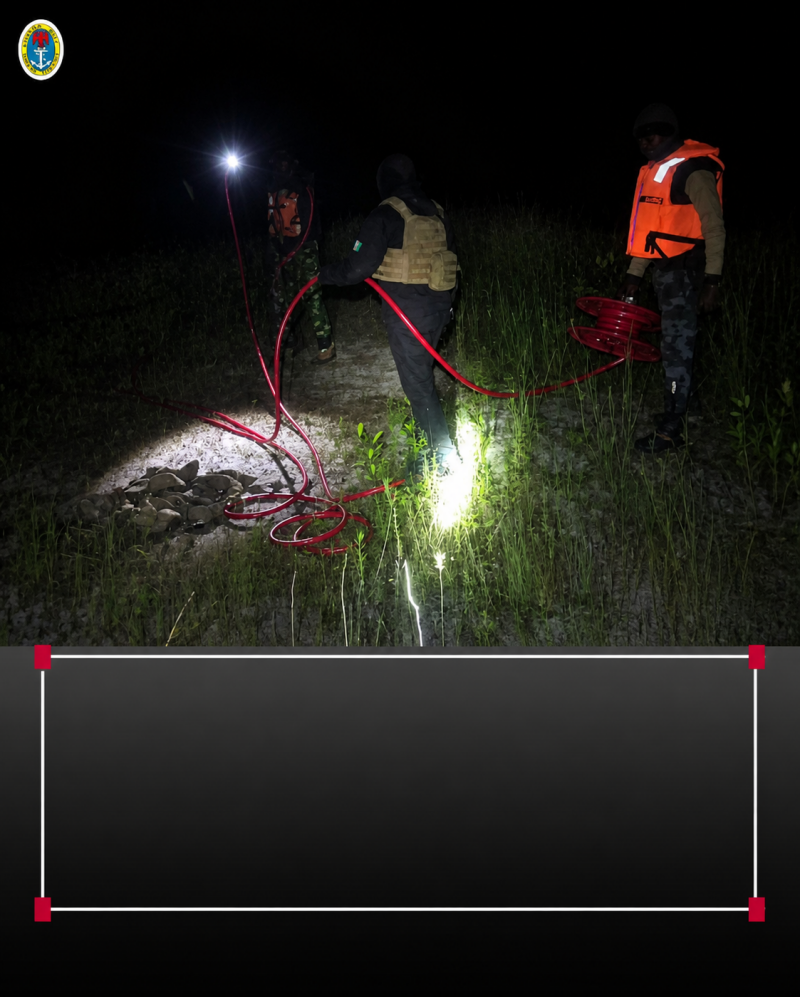
In a parallel operation in Bayelsa State, personnel of NNS Soroh acted on intelligence regarding oil thieves operating near the critical Soku Gas Plant pipeline corridor. A thorough search of the area led to the discovery of a significant cache of equipment used for illegal pipeline connections. Among the items recovered were 10 jerry cans, a 300-metre 3-inch hose, a 200-metre 4-inch hose, and a 20-metre pipe, all of which were concealed in nearby bushes. As was the case in Rivers State, no arrests were made in Bayelsa, as the suspects reportedly abandoned their gear and fled before operatives could corner them. Despite this, navy officials described the operation as a success in degrading the logistical capacity of the criminals.
The recent operations are not isolated efforts but part of a sustained and aggressive campaign known as Operation Delta Sentinel. This initiative, which replaced Operation Delta Sanity II in January 2026, has already chalked up impressive numbers. According to data released by the navy, between January and March 2026, security forces conducted over 183 successful operations across the Niger Delta creeks and waterways. This resulted in the recovery of 531,500 litres of illegally refined petroleum products, the dismantling of 22 illegal refineries, and the arrest of 18 suspects directly linked to the illicit economy. During this period, naval operatives also uncovered a massive 96,000-litre illegal wellhead in Bayelsa State, which officials described as a central feeding point for a cluster of smaller refining camps.
The economic cost of oil theft has become a primary driver for the military’s renewed vigour. The Senate Ad Hoc Committee investigating the crisis has revealed that Nigeria may have lost over $300 billion in crude oil proceeds over the past decade to theft, leakages, and corruption. The navy has also placed a direct price tag on its recent victories. In mid-April, naval units destroyed illegal refining infrastructure spanning Rivers, Bayelsa and Delta, seizing products estimated to be worth over ₦600 million. This haul included roughly 103,000 litres of crude oil and 190,000 litres of AGO in Rivers State alone, with the AGO alone estimated to be worth over ₦342 million. In Delta State, an additional 78,000 litres of stolen crude oil were found concealed at a site linked to a buried pipeline on Bennett Island.
Experts, however, caution that a purely kinetic approach, while necessary, is not a complete solution. Following the April 2026 successes, energy analysts noted that destroying refineries, though disruptive, may not permanently end the practice if the underlying economic drivers are not addressed. These makeshift operations are often deeply embedded in local communities and represent a significant source of income for a desperate population. There is a growing consensus among security scholars that lasting progress will require a robust combination of intensified military pressure, advanced technological surveillance such as drones and satellite tracking, and the provision of viable economic alternatives for the millions living in the creeks.
The navy has also been actively forging alliances to extend its reach. This includes synergy with the private pipeline security firm Tantita Security Services, which has been lauded for helping to restore the coastal ecosystem and reduce oil theft incidents. However, even with these combined forces, the navy concedes that the fight is a long one. In the recent May Day raids, the destruction of infrastructure clearly outpaced the number of arrests, a pattern that suggests that while the camps can be burned, the individuals who set them up are able to rebuild quickly if law enforcement does not follow them into their hideouts. As the military continues to press its advantage under Operation Delta Sentinel, which has recently been extended by an additional 90 days, the message from the high command remains clear: the fight against economic sabotage will not relent until the country’s critical oil assets are fully secured.
📩 Stone Reporters News | 🌍 stonereportersnews.com
✉️ info@stonereportersnews.com | 📘 Facebook: Stone Reporters News | 🐦 X (Twitter): @StoneReportNew | 📸 Instagram: @stonereportersnewsv
Add comment
Comments