

Reported by: Ijeoma G | Edited by: Oravbiere Osayomore Promise.
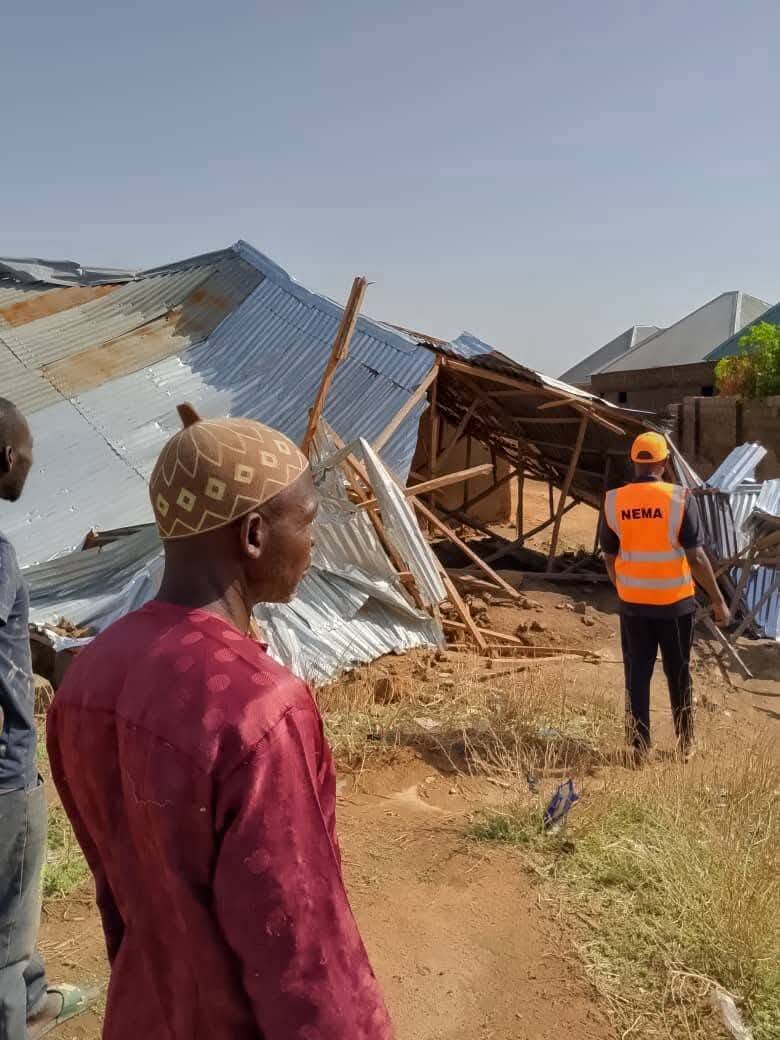
The sky turned dark long before the rain began, but no one expected the fury that followed. On Monday evening, a severe rainstorm accompanied by violent winds tore through Dokan Mai-Jama’a, a rural community in Chikun Local Government Area of Kaduna State, killing two residents and flattening more than 50 houses within forty minutes. The storm, which started at approximately 6:41 p.m., swept through the community with terrifying speed. Roofs were ripped off, walls collapsed, and families who had been preparing for the night found themselves running for their lives in the rain and darkness.
By Tuesday morning, the sun rose on a scene of devastation. Mud bricks lay in heaps where bedrooms once stood. Sheets of corrugated iron were twisted into metal ribbons. The village head, Alhaji Hamisu Tukur, walked through the debris counting the ruins. “Over 50 houses were destroyed,” he told reporters. “Two of my people are dead. Many more are injured. We have never seen a storm like this in our lifetime.”
The victims, a 45‑year‑old man and a 32‑year‑old woman, were killed when the walls of their separate homes collapsed on them. Several others sustained injuries, ranging from broken limbs to deep cuts from flying debris. Emergency responders arrived on the scene late Monday night but were hampered by blocked roads and fallen trees. The National Emergency Management Agency (NEMA), Kaduna State Office, confirmed the incident and acknowledged the displacement of many families. Officials have already swung into action for damage assessment and necessary interventions, including shelter, food, and medical supplies.
The destruction was not limited to Dokan Mai-Jama’a. The rainstorm extended to Sabon Gyero in Millennium City, also within Chikun LGA, where several houses were damaged and two schools lost their roofs. In Dokan Mai-Jama’a, the community’s primary health clinic was also affected, with water seeping into the drug storage room. Local volunteers helped move medicines to higher ground before they were ruined. A community leader reported that over 200 people have been rendered homeless, with many now seeking refuge in a local primary school that survived the storm largely intact.
Chikun Local Government Area, which lies along the Kaduna‑Abuja highway, has experienced a series of environmental and security challenges in recent years. The area is known for its hilly terrain and poor drainage systems, which often exacerbate the impact of heavy rainfall. While rainstorms are not uncommon in Kaduna State during this time of the year, the intensity of Monday’s wind was exceptional. The Nigerian Meteorological Agency (NiMet) had issued a warning earlier in the day, predicting thunderstorms and high winds across parts of the North‑West, but the warning did not specify the severity that would hit Chikun.
For the families of the deceased, the grief is compounded by the suddenness of the loss. One victim, a father of four, had just returned from his farm when the storm began. His wife told neighbours she heard a loud crack, then saw the wall cave in. By the time neighbours dug through the rubble, he was gone. The other victim, a mother of three, was cooking dinner when the storm tore through her kitchen. Her children survived because they were playing in a different room. She was buried on Tuesday morning according to Islamic rites, the rain still falling lightly over the fresh grave.
The Kaduna State Government has not yet issued an official statement, but the State Emergency Management Agency (SEMA) is coordinating with NEMA to provide relief materials. “We are working to ensure that those displaced receive tarpaulins, blankets, and food,” a NEMA official told Stone Reporters News. “We are also registering the names of those who lost houses so that rebuilding assistance can be prioritized.” However, residents said the government’s response has been too slow. “We have been sleeping outside since Monday,” said Malam Sani, a farmer who lost his home. “No one has brought us anything. Only the neighbours are helping.”
The rainstorm also exposed the vulnerability of rural housing in Kaduna State. Most of the destroyed buildings were mud houses with thatched or corrugated iron roofs, structures that are highly susceptible to wind damage. Experts have long called for a shift to more resilient building materials, but poverty and limited access to cement and blocks keep most rural families stuck with traditional methods. Climate change is also making storms more unpredictable. NiMet data shows an increase in the frequency of extreme weather events across northern Nigeria over the past decade.
In Dokan Mai-Jama’a, community leaders are now calling on the state and federal governments to declare a state of emergency on housing. “We need help to rebuild. Not just with tarpaulins, but with proper houses that can withstand the next storm,” the village head said. For now, NEMA has promised to return with relief items within 48 hours. But for the two families burying their dead, the damage is already permanent. For the 50 households without roofs, the coming nights will be cold and long. And for everyone in Chikun, Monday’s storm is a terrifying preview of what the rainy season still holds.
📩 Stone Reporters News | 🌍 stonereportersnews.com
✉️ info@stonereportersnews.com | 📘 Facebook: Stone Reporters News | 🐦 X (Twitter): @StoneReportNew | 📸 Instagram: @stonereportersnews
Add comment
Comments