

Reported by: Ijeoma G | Edited by: Oravbiere Osayomore Promise.
Nigerian authorities have repatriated a Chinese national accused of orchestrating a massive $245 million Ponzi scheme, marking a significant breakthrough in cross-border law enforcement cooperation and highlighting Nigeria’s evolving role in tackling transnational financial crime.
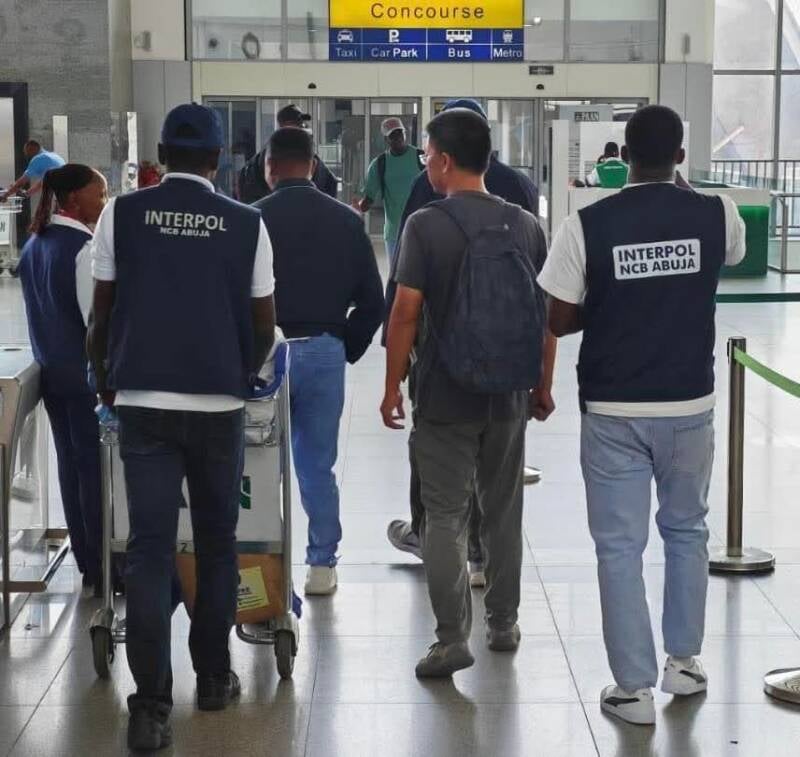
The suspect, identified as Xu Qing, was arrested by operatives of the Nigeria Police Force through its INTERPOL National Central Bureau in Abuja after months of intelligence gathering and surveillance. He was subsequently handed over to Chinese authorities to face prosecution for alleged large-scale financial fraud involving the illegal absorption of public deposits.
Police officials confirmed that Xu had been declared wanted in China, specifically in Beijing, where authorities accuse him of masterminding a fraudulent investment operation that amassed over $245 million from unsuspecting victims. The scheme, described as a classic Ponzi structure, allegedly promised high returns to investors while using funds from new participants to pay earlier investors, eventually collapsing under its own weight.
According to investigators, Xu fled China on November 5, 2024, shortly after scrutiny of his financial activities intensified. His departure is believed to have been a calculated attempt to evade arrest as Chinese law enforcement agencies began closing in on his operations. A formal arrest warrant was later issued on November 12, 2025, by the Shinan Sub-Bureau of Qingdao Public Security, triggering an international manhunt.
The case was escalated through INTERPOL channels, leading to a formal request for cooperation from Chinese authorities to their Nigerian counterparts. Acting on this request, INTERPOL NCB Abuja initiated a coordinated operation that combined intelligence analysis, field surveillance, and collaboration with local security networks.
After tracking the suspect’s movements over several weeks, Nigerian operatives located Xu at a factory in Olowotedo, a community in Siun Village within Obafemi Owode Local Government Area of Ogun State. Authorities say the suspect had been living under the radar, possibly attempting to establish business ties while maintaining a low profile to avoid detection.
On April 24, 2026, police officers moved in and arrested Xu without incident. Officials described the operation as precise and intelligence-driven, emphasizing that it reflected improved capabilities in identifying and apprehending high-value fugitives within Nigeria’s borders.
Following his arrest, arrangements were swiftly made for his repatriation. On April 28, 2026, Xu was formally handed over to Chinese authorities under established bilateral agreements governing international police cooperation. The transfer was conducted in line with global legal frameworks that facilitate the return of fugitives to face justice in their home countries.
The Nigeria Police Force stated that the successful operation underscores its commitment to ensuring that Nigeria does not become a refuge for individuals fleeing justice abroad. Officials also noted that the case demonstrates the effectiveness of INTERPOL mechanisms in addressing crimes that transcend national boundaries.
Inspector-General of Police Olatunji Rilwan Disu reaffirmed the agency’s resolve to strengthen international partnerships in combating organized crime. He stressed that financial crimes, particularly those involving cross-border networks, require sustained collaboration between countries to ensure perpetrators are held accountable.
The police chief also issued a caution to Nigerian businesses and employers, urging them to exercise due diligence when engaging foreign nationals. He advised that background checks should be conducted through appropriate law enforcement channels to prevent individuals with criminal histories from exploiting local opportunities as cover.
Financial analysts say the case highlights the persistent global threat posed by Ponzi schemes, which continue to evolve in scale and sophistication. Such schemes often exploit gaps in regulatory oversight and rely heavily on trust, social networks, and aggressive marketing tactics to lure investors.
In recent years, authorities worldwide have intensified efforts to dismantle fraudulent investment networks, particularly those leveraging international mobility to evade prosecution. The movement of suspects across borders has made it increasingly necessary for countries to cooperate closely through intelligence sharing and coordinated enforcement actions.
Nigeria, as one of Africa’s largest economies and a hub for international business, has faced scrutiny in the past over its ability to monitor and regulate financial activities involving foreign nationals. However, recent operations such as the arrest and repatriation of Xu are being seen as evidence of progress in strengthening institutional responses to complex financial crimes.
Security experts note that fugitives often choose destinations where they believe enforcement may be less stringent or where they can blend into local economic activities. The ability of Nigerian authorities to track and apprehend a suspect in such circumstances suggests improvements in surveillance capabilities and inter-agency coordination.
The role of INTERPOL in this case was central, providing a platform for communication and legal cooperation between Nigeria and China. Through its global network, INTERPOL facilitates the circulation of notices and intelligence that enable member countries to identify and locate suspects wanted in other jurisdictions.
While details of Xu’s alleged operations in China remain under investigation, authorities there are expected to pursue charges related to financial fraud, illegal fundraising, and other economic crimes. If convicted, he could face significant penalties under Chinese law, reflecting the severity of the alleged offenses.
For victims of the scheme, the arrest represents a step toward accountability, although recovery of lost funds in Ponzi cases is often complex and uncertain. Investigators typically face challenges tracing assets that may have been moved across multiple jurisdictions or concealed through layered financial transactions.
The Nigeria Police Force has reiterated that it will continue to collaborate with international partners to combat crimes that threaten economic stability and public trust. Officials emphasized that maintaining the integrity of financial systems is essential not only for national security but also for fostering investor confidence.
As global financial networks become more interconnected, cases like this underscore the importance of vigilance, transparency, and cooperation in addressing the risks posed by fraudulent schemes. Authorities in both Nigeria and China are expected to continue working together as the legal process unfolds.
The successful repatriation of Xu Qing stands as a reminder that even in an increasingly complex global landscape, coordinated law enforcement efforts can bridge distances and bring alleged offenders to justice.
📩 Stone Reporters News | 🌍 stonereportersnews.com
✉️ info@stonereportersnews.com | 📘 Facebook: Stone Reporters News | 🐦 X (Twitter): @StoneReportNew | 📸 Instagram: @stonereportersnews
Add comment
Comments