

Reported by: Ijeoma G | Edited by: Oravbiere Osayomore Promise.
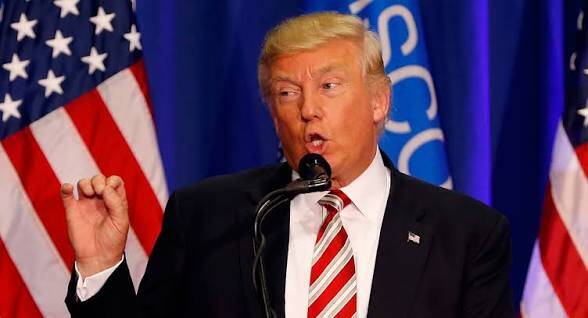
President Donald Trump has warned Iran that the United States will resume bombing “at a much higher level and intensity” than before if Tehran refuses to finalise a peace deal, dramatically raising the stakes just hours after American officials reported progress toward a diplomatic breakthrough. In a post on his Truth Social platform on Wednesday, the US president left no room for ambiguity. “If they don’t agree, the bombing starts, and it will be, sadly, at a much higher level and intensity than it was before,” Trump wrote. His ultimatum came as the White House and Iranian representatives, with Pakistan acting as a mediator, reportedly closed in on a one‑page memorandum of understanding to end the conflict that began in late February.
Trump explicitly linked the fate of the negotiations to the reopening of the Strait of Hormuz, a vital waterway through which about one‑fifth of global oil supply normally passes. “Assuming Iran agrees to give what has been agreed to, which is, perhaps, a big assumption, the already legendary Epic Fury will be at an end, and the highly effective Blockade will allow the Hormuz Strait to be OPEN TO ALL, including Iran,” he wrote. Operation Epic Fury, the code name for the US military campaign against Iranian targets, was launched after a prolonged standoff over Tehran’s nuclear programme and its support for regional proxies. American officials have said the campaign has significantly degraded Iran’s military infrastructure, but the fighting has also sent energy prices soaring and disrupted global shipping lanes.
Earlier on Tuesday, Trump had announced a pause in “Project Freedom”, a mission to escort commercial vessels through the Gulf, saying that “great progress” had been made toward a comprehensive agreement. During a White House news briefing, US Secretary of State Marco Rubio confirmed that Operation Epic Fury had ended. “The operation is over. Epic Fury, as the president notified Congress, we’re done with that stage of it,” Rubio told reporters. He added that the US would maintain its blockade of Iranian ports until a final deal was struck, warning that any violation of the terms would meet with a swift military response.
The Axios news outlet reported that a 14‑point framework was nearing completion. According to the report, Iran would commit to a moratorium on nuclear enrichment, while the United States would agree to lift economic sanctions. Both sides would also lift restrictions on transit through the Strait of Hormuz. Israeli journalist Barak Ravid, citing US officials and other sources, said the draft memorandum was the closest the two adversaries had come to a formal end of hostilities since the war erupted on February 28. A Pakistani source familiar with the talks confirmed the accuracy of the report to Reuters, saying, “We will close this very soon. We are getting close.”
The negotiations have been mediated by Pakistan, which hosted direct talks between American and Iranian envoys last month. US representatives Steve Witkoff and Jared Kushner have been directly involved, while Iranian officials have participated through intermediaries. The talks have centred on three core issues: Iran’s nuclear programme, its influence over the Strait of Hormuz, and the lifting of international sanctions. Despite the optimism expressed by American and Pakistani officials, Trump tempered expectations in a separate exchange with reporters, telling the New York Post that it was “too soon” to think about face‑to‑face peace talks between Washington and Tehran.
Iran has not formally responded to Trump’s latest ultimatum, but senior officials in Tehran have previously dismissed the American military campaign as ineffective. On Wednesday, Iranian state media quoted a foreign ministry spokesman who questioned Washington’s sincerity, saying that a genuine peace deal could only be achieved if the United States ended its blockade and withdrew its naval forces from the Gulf. “Threats of more bombing do not create an atmosphere of trust,” the spokesman said. Despite the tough rhetoric, Iranian representatives have remained at the negotiating table, suggesting that both sides see a deal as preferable to an endless cycle of escalation.
The military situation on the ground has been static since a ceasefire took effect on April 8. The truce, mediated by Pakistan and Qatar, has been extended multiple times, but it has not led to a permanent resolution. Joint Chiefs of Staff Chairman General Dan Caine said earlier this week that more than 22,500 mariners were still trapped aboard over 1,550 commercial vessels in the Persian Gulf, unable to navigate through waters made dangerous by Iranian naval patrols and the threat of missile attacks. Efforts by the US Navy to reopen the shipping lanes have been only partially successful. The humanitarian and economic costs of the standoff are mounting, with global fuel prices remaining elevated and insurance rates for ships in the region spiking.
Trump’s ultimatum has drawn a sharp response from the international community. The United Nations Secretary General called for restraint, urging both parties to finalise the draft agreement without further delay. European allies, while expressing support for the US negotiating position, have privately voiced concern that a renewed bombing campaign could spread the conflict across the Middle East, drawing in Hezbollah and other Iranian‑backed militias. China and Russia, which have maintained relatively good relations with Iran, reiterated their calls for a diplomatic solution. Both countries have benefited from discounted Iranian oil during the crisis.
Inside the United States, the president’s threat has divided opinion. Republican allies praised Trump for taking a hard line, arguing that only the credible threat of force brought Iran to the bargaining table. Democratic critics accused the president of recklessly escalating tensions after the military campaign had already achieved its objectives. “We are told a deal is close. If that is true, threatening to bomb Iran again does not help seal it,” said a senior Democratic senator.
For now, the world waits. The draft memorandum is said to be on the desk of Supreme Leader Ayatollah Ali Khamenei, awaiting final approval. If he signs, the Strait of Hormuz could reopen within days, and the war would end. If he does not, the bombing will resume, and the region may face an even bloodier chapter. Trump has made his position clear. “Thank you for your attention to this matter,” he wrote at the end of his Truth Social post, signing off as only he would. The ball is now in Tehran’s court.
📩 Stone Reporters News | 🌍 stonereportersnews.com
✉️ info@stonereportersnews.com | 📘 Facebook: Stone Reporters News | 🐦 X (Twitter): @StoneReportNew | 📸 Instagram: @stonereportersnews
Add comment
Comments