

Reported by: Oahimire Omone Precious | Edited by: Oravbiere Osayomore Promise.
Operating from a maze of hidden concrete caves, drug dealers built a self-contained underworld with furnished bedrooms, food storage and secret tunnels spanning several kilometres. Now the NDLEA has broken it up.
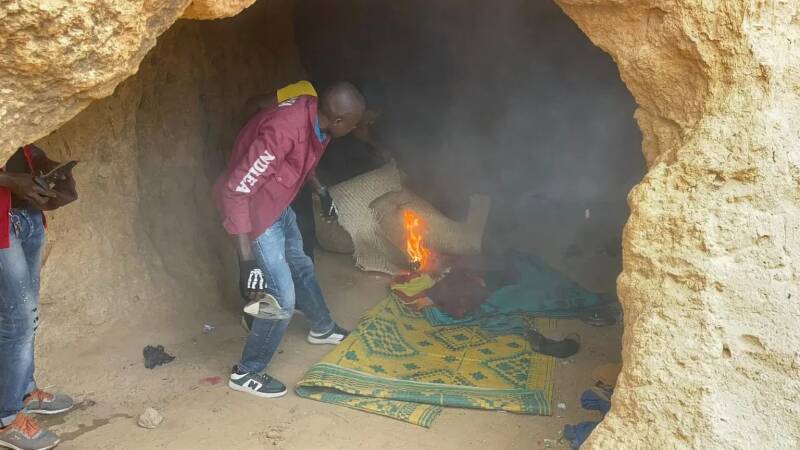
The Kano State Strategic Command of the National Drug Law Enforcement Agency (NDLEA) announced Wednesday it has dismantled a network of caves and underground tunnels used as a drug distribution and storage hub in the Rimin Kebe area of the state capital. The operation, which took place on 4 May under the codename “Operation Sharar Mafaka” — a Hausa phrase that translates loosely to “sweeping the bad elements” — was the culmination of weeks of surveillance, according to a statement issued by NDLEA spokesman Sadiq Muhammad-Maigatari. The raid hit a sprawling, multi-chamber complex that had been secretly dug into the earth and reinforced by suspected drug dealers to house their illegal trade
NDLEA Commander in Kano, Dahiru Yahaya Lawal, disclosed that the discovery followed credible intelligence and sustained monitoring of the Rimin Kebe area, a neighbourhood that had previously flown under the official radar but turned out to host a fully functional illicit underground settlement.
When operatives stormed the enclave on 4 May, they found not scattered makeshift holes but properly constructed dry stone and concrete chambers, some of which had been adapted as living quarters. Sources familiar with the operation told reporters on background that certain chambers appeared to have been dug deep into the natural rock face and then lined with blocks to prevent collapse, indicating that the drug lords had invested considerable sums into the underground infrastructure. Crews from the command and supporting counter-narcotics units also uncovered an underground construction zone, suggesting that the syndicate had been actively trying to expand the warren even as the NDLEA closed in.
Inside the captured hideouts, operatives discovered the everyday detritus of people who clearly lived on the site for extended periods. According to the spokesman, tables were set with cutlery; food flasks and cooking utensils were stacked in corners; blankets and pillows were found on sleeping surfaces; and small stashes of money were found hidden in cigarette boxes and plastic bags. “Some of the caves were furnished with household items, including mats, pillows, food flasks, plates and cutlery, indicating regular occupation and organised drug activities,” Maigatari said. “Other caves and tunnels observed appear to be under construction and may provide underground links between hideouts,” the spokesman added.
This search did not yield a single large arrest of a kingpin. Instead, the operation uncovered the physical infrastructure that supports Kano’s drug networks: a hidden subterranean chain of supply rooms and emergency bolts holes, presumably built to allow dealers to move contraband between locations without emerging at street level. The discovery of tunnels under active construction implies an intention to create an entire underground logistics ring, making future tracking far harder than traditional street sweeping.
The haul comes close on the heels of “Operation Sharar Mafaka,” launched on 27 April 2026, as an aggressive state‑wide crackdown on drug hotspots. In an ongoing two‑week offensive, NDLEA units have simultaneously swept several other locations across Kano, including Bayero University’s old campus, where six suspects were arrested and illicit substances and paraphernalia destroyed. The overarching campaign has already extended beyond street hotspots to industrial‑scale hideouts in the metropolis.
The strategic significance of the bust was not lost on Commander Lawal. In his statement Wednesday, he made it clear that mere discovery is not enough and that the agency is actively obliterating the locations. “Several of the caves and tunnels have been dislodged and plans are underway to demolish and secure the remaining structures,” he told the press. “Our commitment is unwavering. Those who remain in the illicit trade should consider exiting now. We have come to stay until Kano is free from illicit drug use and trade”.
The NDLEA chairman and chief executive, retired Brigadier‑General Mohamed Buba Marwa, has issued a strategic directive in recent months to dismantle drug networks at the structural level rather than simply arresting small‑time peddlers. The Rimin Kebe discovery aligns precisely with that new posture: instead of street buys, the command systematically identified a safe house for large‑scale storage and dealer congregation, then moved to crush both its capacity and any ability to restore it.
Witness accounts from the compound before the raid, which investigators collected from local residents and former minor dealers, suggest that the Rimin Kebe network had been operating for at least 18 months. According to sources speaking on condition of anonymity, the core leadership reportedly imported illicit substances — including cannabis, opioids and prescription psychotropics — via a chain reaching to south‑south states and then warehoused them in the caves for redistribution to street corners and university environments throughout the metropolitan area.
The sophistication of the captured network is reflected in the variety of narcotics that the command had previously been seizing across the state. In February 2026, NDLEA conducted a raid on Kano drug joints that netted a cocktail of substances including cannabis sativa, diazepam, Exol‑5, the street product known as “suck and die,” rubber solution and pregabalin tablets. The same month, the agency conducted a major dislodgement of drug dens that swept up 52 suspects across the city.
The alliance between physical infrastructure and well‑sourced supply represents a worrying escalation for anti‑narcotics campaigns in the semi‑arid north. Numerous communities in Kano outskirts have reported an uptick in substance abuse among youth, particularly mood‑altering prescription pills and low‑cost street powders. Those drugs — coming from networks such as the one operating the Rimin Kebe cave city — are destroying cohesion and incentivising petty crime.
The command has now issued a public call for further collaboration. “We urge members of the public to report suspicious activities to the nearest NDLEA office,” Maigatari said, stressing that “timely information remains crucial in curbing substance abuse in the state”.
For the command, the Rimin Kebe underground dismantlement is not merely a news event but a strategic turning point. “We will continue to pursue these unscrupulous elements wherever they hide,” Yahaya‑Lawal said.
The demolition teams are expected to complete the destruction of the remaining ruins by the end of May. Any surviving underground structure will be collapsed and the ground resealed to prevent reconstruction. For the drug lords who once used them, the network of tunnels is now a buried ruin rather than a working artery. And for neighbourhoods in Kano, a hidden source of supply has been abruptly shut off.
📩 Stone Reporters News | 🌍 stonereportersnews.com
✉️ info@stonereportersnews.com | 📘 Facebook: Stone Reporters News | 🐦 X (Twitter): @StoneReportNew | 📸 Instagram: @stonereportersnews
Add comment
Comments