

Reported by: Oahimire Omone Precious | Edited by: Oravbiere Osayomore Promise.
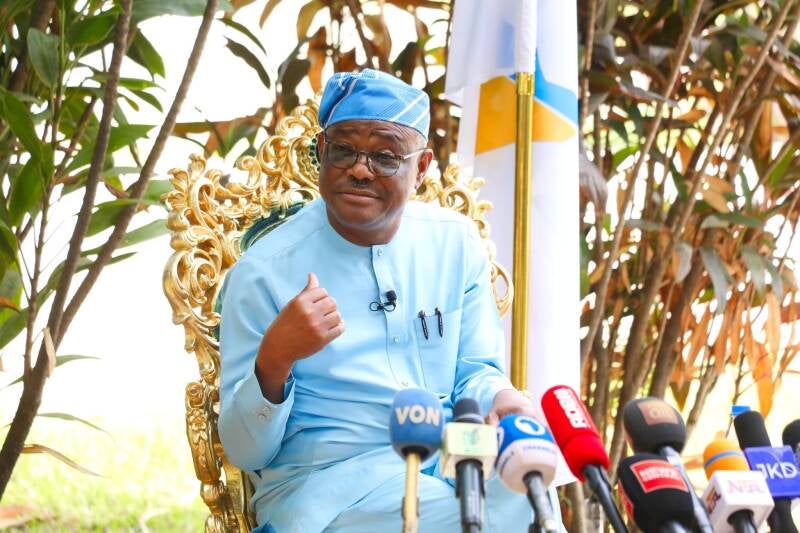
The Minister of the Federal Capital Territory, Nyesom Wike, has offered a blunt defence of his administration’s decision to withhold ten percent of the Internally Generated Revenue (IGR) that was meant to be remitted to the six area councils of the territory, insisting that the funds are being used to clear the backlog of salary arrears owed to primary school teachers and that any criticism of the policy is simply ignoring the suffering of children who have been kept out of school. Speaking during a media parley with journalists in Abuja on Wednesday, May 6, 2026, Wike dismissed accusations that the FCT Administration was illegally diverting council funds, arguing instead that the intervention was a necessary emergency measure to resolve recurring strikes and stabilise a collapsing education system.
“Nobody is complaining because those affected understand what is going on. We are collecting 10 per cent for a defined period to solve a problem that has kept our children at home,” Wike declared. He explained that the funds are being channelled directly towards clearing outstanding entitlements owed to primary school teachers, a crisis that has triggered repeated industrial actions and forced parents to keep their wards at home for weeks on end. The minister did not provide the exact quantum of arrears, but he confirmed that the situation was so dire that teachers had abandoned classrooms across the six area councils, leaving thousands of pupils without instruction.
Wike’s defence came after weeks of quiet grumbling from some council chairmen and civil society groups who argued that the FCTA was overstepping its bounds. Under the FCT statutory allocation formula, a portion of the territory’s IGR is meant to flow to the area councils to fund primary education, healthcare, and other local services. However, Wike said the councils had proven incapable of managing the crisis, and that the FCT Administration had a duty to step in. “Our children have been at home because teachers are not paid. That is unacceptable. We have to step in and ensure that these obligations are met,” he added. He stressed that the arrangement includes structured monthly payments aimed at settling accumulated liabilities, and that the FCT Administration would not allow the situation to deteriorate further.
The minister rejected claims that the deductions would undermine infrastructure development or deprive contractors of funds, arguing that human capital development must take priority. “What is the use of building infrastructure when children are not in school? Education is critical, and we must fix it first,” Wike stated. He insisted that the measure is temporary and targeted, not a permanent reallocation of revenue. “We are paying a fixed amount every month until the arrears are cleared. If we return that money without solving the problem, the strikes will continue. We will not allow that.”
Wike also took aim at what he described as the gross mismanagement of council resources by some area council chairmen. “Some of these councils cannot handle the burden. That is why we stepped in. The goal is simple: get the teachers back to the classrooms and stabilise the system,” he said. While he did not name specific councils, his remarks pointed to a broader lack of fiscal discipline that has left many local governments unable to meet their primary obligations. He said the FCTA had conducted an audit of the education sector and found that teachers’ salaries were in arrears for months, in some cases more than a year, a situation he described as “a national embarrassment”.
The minister’s media parley was his most extensive public engagement since assuming office, and he used the opportunity to address not only the education crisis but also the overall governance of the FCT. He said the FCT Administration had also faced challenges with contractor payments, land administration, and urban waste management, but that these would be tackled systematically. On the issue of the primary school teachers, he urged the public to view the withholding of IGR as temporary life support, not a permanent arrangement. “This is not forever. It is a solution to a specific problem, and once it is resolved, normal processes will continue,” he added.
Reactions from the area councils have been muted. Some council chairmen, speaking on condition of anonymity, acknowledged that their teacher salary crisis was indeed severe and that they lacked the funds to resolve it on their own. However, they expressed concern that the FCTA’s intervention could set a precedent for future federal takeovers of local government functions. One chairman told Stone Reporters News, “We don’t mind the help, but this should not become a habit. The law is clear on revenue sharing.”
Civil society groups have also been split. The FCT chapter of the National Union of Teachers (NUT) praised Wike for prioritising education, noting that many of their members had gone months without pay and were forced to take second jobs. “Our children were suffering. If the minister had not acted, the damage would have taken years to repair,” a union official said. On the other hand, the Abuja chapter of the Socio-Economic Rights and Accountability Project (SERAP) warned that the FCTA must follow due process and not arbitrarily withhold statutory allocations, even if the goal is laudable. The group threatened legal action if the policy is not formally regularised through gazetted guidelines.
Wike appeared unmoved by the criticisms. He ended his remarks with a characteristically blunt summary. “Some people will complain. That is their job. Our job is to solve problems. The teachers have been paid, and the children are going back to school. That is the only result that matters.” As the FCT continues to navigate the delicate balance between federal oversight and local government autonomy, the Wike administration has drawn a clear line: when it comes to keeping classrooms open, the ministry will not wait for permission.
📩 Stone Reporters News | 🌍 stonereportersnews.com
✉️ info@stonereportersnews.com | 📘 Facebook: Stone Reporters News | 🐦 X (Twitter): @StoneReportNew | 📸 Instagram: @stonereportersnews
Add comment
Comments