

Reported by: Oahimire Omone Precious | Edited by: Pierre Antoine
Fresh controversy has erupted over the Nigerian National Petroleum Company Limited’s newly announced partnership with two Chinese firms for the rehabilitation and operation of the Port Harcourt and Warri refineries, with critics questioning the technical competence and financial credibility of the companies involved.
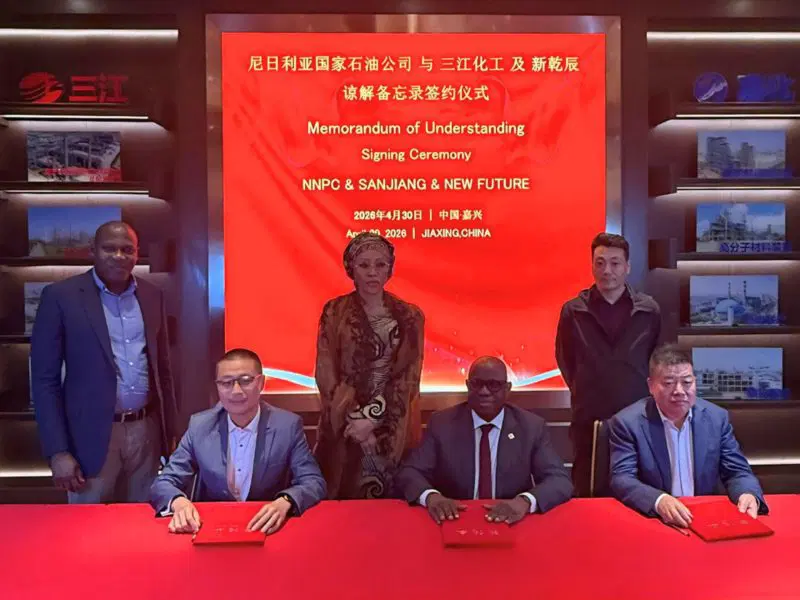
The dispute followed the signing of a Memorandum of Understanding between Nigerian National Petroleum Company Limited and two Chinese firms — Sanjiang Chemical Company Limited and Xingcheng (Fuzhou) Industrial Park Operation and Management Co. Ltd — under what NNPC described as a “technical equity partnership” aimed at reviving Nigeria’s troubled state-owned refineries.
However, the arrangement has attracted sharp criticism from opposition politicians, energy experts and civil society groups who argue that the selected firms lack verifiable experience in operating or rehabilitating large-scale crude oil refineries.
Former Vice President Atiku Abubakar led the criticism, describing the deal as “another dangerous gamble with Nigeria’s economic future.” In a statement issued through his media aide, Phrank Shaibu, Atiku demanded the immediate suspension and public scrutiny of the agreement.
Atiku argued that despite Sanjiang Chemical being a legitimate petrochemical company, there is no publicly available evidence showing that the company has ever built, managed or operated a full-scale crude oil refinery comparable to the Port Harcourt or Warri refineries.
He also questioned the involvement of Xingcheng (Fuzhou) Industrial Park Operation and Management Co. Ltd, claiming the company appears to have little or no verifiable background in refinery engineering, hydrocarbon processing or petroleum operations.
The criticism intensified after Dele Oye, former President of the Organised Private Sector of Nigeria, publicly stated that the two Chinese firms “have nothing to offer Nigeria” in terms of refinery expertise. Speaking during an interview monitored on Arise News, Oye claimed neither company possesses engineering credentials or operational history linked to refineries of such scale and complexity.
Oye further alleged that Sanjiang Chemical is mainly involved in chemical and downstream operations rather than refinery construction or rehabilitation. He also questioned the financial stability of the company, alleging it carries substantial short-term borrowing obligations.
NNPC, however, defended the partnership, insisting that modern refining operations are increasingly integrated with petrochemical and industrial processing systems. The company stated that Sanjiang’s experience in converting refinery by-products into high-value petrochemicals made it a suitable strategic partner.
According to NNPC Group Chief Executive Officer Bashir Bayo Ojulari, the partnership represents a shift away from purely contractor-based rehabilitation toward operational and equity collaboration intended to make the refineries commercially sustainable.
Nigeria’s state-owned refineries have remained a major national controversy for decades due to repeated shutdowns, underperformance and billions of dollars spent on rehabilitation projects with limited results. The Port Harcourt refineries have a combined capacity of about 210,000 barrels per day, while the Warri refinery has a capacity of about 125,000 barrels daily.
Despite several government-backed rehabilitation programmes, the facilities have struggled to maintain sustainable production. NNPC itself admitted in 2025 that earlier decisions to restart operations before completing full rehabilitation were “ill-informed and sub-commercial.”
Civil society organisations and energy sector reform advocates have also joined the criticism. The Centre for Energy Sector Transparency accused NNPC of repeating failed policies without fully accounting for previous refinery rehabilitation spending estimated at billions of dollars.
Critics are now demanding public disclosure of the full terms of the agreement, technical due diligence reports on the Chinese firms, and a comprehensive audit of past refinery rehabilitation expenditures before any fresh partnership proceeds.
The controversy comes as Nigeria continues efforts to reduce dependence on imported fuel while the privately owned Dangote Refinery expands domestic refining capacity. Analysts say the success or failure of the latest NNPC partnership could significantly influence Nigeria’s future energy security and refining strategy.
📩 Stone Reporters News | 🌍 stonereportersnews.com
✉️ info@stonereportersnews.com | 📘 Facebook: Stone Reporters News | 🐦 X (Twitter): @StoneReportNew | 📸 Instagram: @stonereportersnews
Add comment
Comments