

Reported by: Ijeoma G | Edited by: Oravbiere Osayomore Promise.
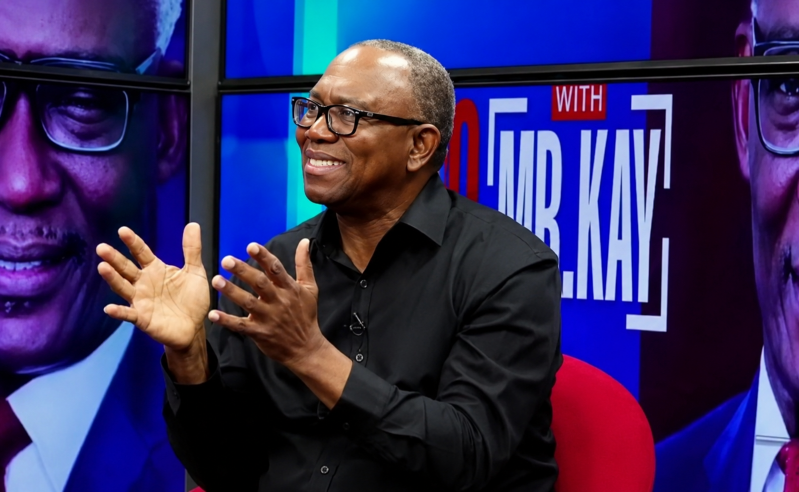
Former Anambra State Governor and 2023 Labour Party presidential candidate, Peter Obi, has made one of the clearest and most forceful declarations of his political career: if elected president in 2027, he will serve only one term of four years and will not stay a day longer. In an interview on 60 Minutes with Mr Kay, Obi, who is now a chieftain of the opposition Nigeria Democratic Congress (NDC), was unequivocal about his commitment. “I want to be a one-term president because of stability. I would not stay a day longer than four years… even with a gun to my head,” he declared. The pledge, which Obi has repeated at various times since the 2023 election campaign, has become a defining feature of his 2027 presidential aspiration. According to Obi, a single-term presidency would allow a leader to focus on delivering results without the distraction of preparing for re‑election, helping to create the steady progress Nigeria needs after years of economic hardship, insecurity and institutional decay.
Obi has consistently justified his one‑term vow by citing global leaders who achieved lasting impact in short tenures. He has pointed to former United States Presidents Abraham Lincoln, who served only four years, and John F. Kennedy, who did not even complete a full term, as well as South Africa’s Nelson Mandela, who served only one term despite immense public pressure to remain. “One of the greatest American Presidents, Abraham Lincoln, served only four years, yet his legacy endures. John F. Kennedy did not even complete a full term, yet his vision continues to inspire generations. In Africa, Nelson Mandela chose to serve only one term,” Obi said in a past statement on his official X handle. He argues that purposeful leadership is measured by impact, not by the length of time in office.
Obi has also addressed the deep skepticism that many Nigerians feel toward political promises. In a statement from August 2025, he acknowledged that trust has become one of the scarcest commodities in the country. “I am fully aware that the decay in our society has made trust one of the most sceptically viewed commodities. Many Nigerians, understandably, no longer take politicians at their word,” he said. However, he insisted that he is different from the typical politician. “They are judging me by their own standards – where political promises are made to be broken. But Peter Obi is not cut from that cloth. I have a verifiable track record that speaks louder than speculation.” He pointed to his tenure as governor of Anambra State, where he said he fulfilled campaign promises on education, healthcare, rural infrastructure, and financial prudence.
Obi’s one‑term pledge has not been without controversy. Governor Chukwuma Soludo of Anambra State, a former economic adviser to Obi, mocked the promise, suggesting that any politician who makes such a commitment should be sent for psychiatric evaluation. Obi responded with a pointed rebuttal, stating that the Nigerian constitution itself provides for a four‑year renewable term and that choosing not to renew it should not be treated as madness. “If making such a promise qualifies me for psychiatric evaluation, then we may as well question the mental fitness of those who framed our constitution,” he said. Some political analysts have also argued that the one‑term promise is a strategic tool rather than a principled stance, designed to reassure Northern voters about power rotation. Kenneth Okonkwo, a former spokesperson for the Labour Party Presidential Campaign Council, claimed that Obi borrowed the idea from former Vice President Atiku Abubakar, who had made a similar pledge in past campaigns. Others have questioned the feasibility of a single term given the scale of Nigeria’s challenges; Governor Abdullahi Sule of Nasarawa State warned that powerful interests would pressure Obi to stay longer.
Obi’s one‑term pledge has become a crucial bargaining chip in the emerging opposition coalition. The NDC has officially zoned its 2027 presidential ticket to the South, a decision that puts Obi, a Southerner, in prime position to become the party’s flag‑bearer. The party’s leadership has adopted a single‑term ticket strategy, a move designed to appeal to various geopolitical blocs seeking a transition of power. According to reports, the single‑term promise is the key to winning over Northern power brokers who are wary of a long Southern tenure. The alliance between Obi and former Kano State Governor Rabiu Kwankwaso has further solidified this framework. Kwankwaso, who leads the Kwankwasiyya movement with a strong grassroots base in the North‑West, has declared his readiness to serve as Obi’s running mate. “I am willing to work with Peter Obi as his running mate. We have agreed that the South should hold the presidency for a single four‑year term, after which the ticket will flip to the North,” Kwankwaso said. The Obidient Movement has also rallied behind the pledge, with its national coordinator, Yunusa Tanko, stating that Obi is a trustworthy leader whose word is his bond. “He did not only promise Obidients, he also said it to the whole world that if elected, he would serve only one term. For us, that is one of the virtues of a credible and trustworthy leader,” Tanko said.
Obi has outlined an ambitious agenda for a single term, focusing on rebuilding trust in public institutions, tackling insecurity through efficient deployment of national resources, revamping the education and healthcare sectors, catalysing small businesses, and fighting corruption with unwavering resolve. He believes that forty‑eight months is sufficient for any focused leader to make a meaningful difference. “My goal is to transform Nigeria from a consuming nation into a productive one, anchored on agriculture, technology, and manufacturing. Service should be impactful, not eternal,” he said. As the 2027 election cycle gathers momentum, Obi’s one‑term pledge stands as both a promise of limited tenure and a demand for trust. Whether voters will see it as a sign of sincerity or a risky gamble remains to be seen, but Obi has made his position unmistakably clear: he will not stay a day longer than four years, no matter the pressure.
📩 Stone Reporters News | 🌍 stonereportersnews.com
✉️ info@stonereportersnews.com | 📘 Facebook: Stone Reporters News | 🐦 X (Twitter): @StoneReportNew | 📸 Instagram: @stonereportersnews
Add comment
Comments