

Reported by: Oahimire Omone Precious | Edited by: Oravbiere Osayomore Promise.
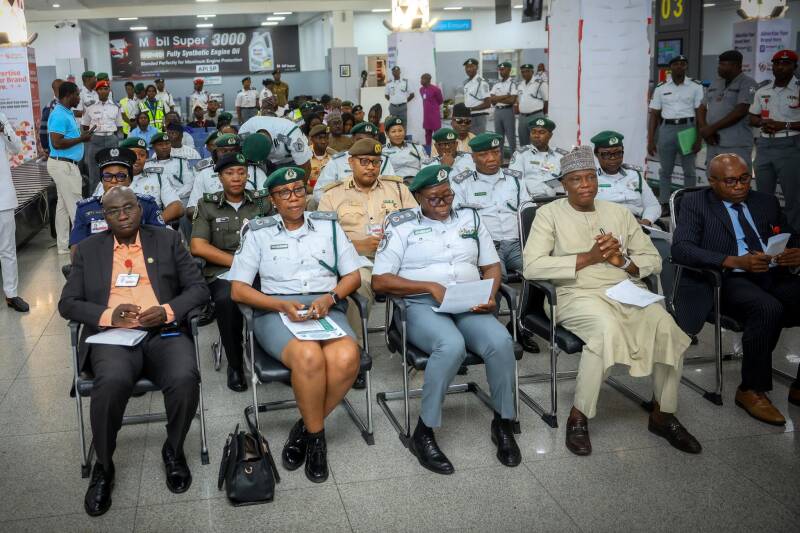
The Nigeria Customs Service (NCS) has officially launched a digital baggage declaration platform designed to eliminate the notorious delays that have long plagued inbound passengers at the Nnamdi Azikiwe International Airport, Abuja, marking a significant milestone in the Service’s ongoing digital transformation agenda. The Simplified Customs Advanced Declaration System (SCADS) was unveiled on Monday, May 18, 2026, at the International Wing of the Abuja airport, with senior Customs officials describing it as a direct response to operational failures that crippled the Service’s previous passenger declaration platform earlier this year. Instead of retreating from those setbacks, the Customs leadership chose to build a stronger, more efficient alternative that integrates passenger baggage and e-commerce declarations into a single digital framework aligned with global best practices. For travelers who have endured hours of queuing, manual paperwork, and inconsistent duty assessments, the new system promises faster clearance, easier compliance, and a smoother movement through one of the nation’s busiest points of entry.
Speaking at the official launch, the Deputy Comptroller-General of Customs in charge of ICT and Modernisation, Oluyomi Adebakin, explained that the initiative was born from the lessons of failure. “When the earlier platform experienced operational challenges, we chose not to see it as a setback. We saw it as an opportunity to build something better, stronger and more efficient,” she told the gathering of senior Customs officers, officials of the Federal Airports Authority of Nigeria (FAAN), partner government agencies, technical teams, and key stakeholders in Nigeria’s aviation and border management ecosystem. Adebakin, who has been at the forefront of the Service’s digital push under the leadership of Comptroller-General of Customs, Adewale Adeniyi, stressed that the new platform addresses the core pain points that have frustrated passengers and compromised revenue integrity for years.
The SCADS platform allows inbound international passengers to declare their accompanied baggage and items before arrival, a feature that shifts much of the clearance process from the airport terminal to the traveler’s mobile device or computer. By making advance declaration possible, the system reduces the time passengers spend at Customs checkpoints, minimises physical inspections for low-risk travelers, and allows officers to focus on high-risk consignments. For passengers, this means stepping off a long-haul flight and moving through baggage clearance in minutes rather than hours, a transformation that could significantly improve the travel experience for the millions of Nigerians and foreigners who pass through Abuja annually. Adebakin noted that the system also promotes voluntary compliance by making it easier for passengers to honestly declare dutiable items without fear of arbitrary or subjective assessments.
One of the most significant changes introduced by SCADS is the elimination of subjective revenue assessment. Under the old manual system, Customs officers often exercised wide discretion in determining the duties owed on items, leading to inconsistencies, allegations of corruption, and frequent disputes. The new platform automatically generates duties based on declared items, their quantities, and their actual market values, using a data-driven algorithm. “When we talk about revenue collection, it is not about collecting more or less. It is about collecting the right revenue. With this system, assessment will now be more objective, accurate and driven by data,” Adebakin stated. This move aligns the Nigeria Customs Service with international standards set by the World Customs Organization, which has long advocated for the use of automated declaration systems to enhance both trade facilitation and revenue assurance.
The FCT Area Command of the Customs Service was selected for the pilot phase of the SCADS deployment, a decision that the Area Controller, Comptroller Victoria Alibo, described as a vote of confidence in the Command’s operational capacity. Alibo explained that the new platform integrates two previously separate streams, passenger baggage declarations and e-commerce declarations, into a unified digital framework. “SCADS is designed to simplify declarations, reduce clearance time, eliminate manual bottlenecks and align our operations with international standards,” Comptroller Alibo said. She disclosed that the pilot phase will run for five days, from Monday, May 18 to Friday, May 22, 2026, during which officers will evaluate the system in a live operational environment, identifying any glitches or user experience issues ahead of a planned nationwide deployment to all international airports in Nigeria.
The launch of SCADS comes at a critical time for Nigeria’s aviation sector. For years, international travelers have complained about the inefficiency of baggage clearance at Nigerian airports, with stories of hours-long waits, missing luggage, and demands for unofficial payments becoming commonplace. The problem has been particularly acute at the Murtala Muhammed International Airport in Lagos and the Nnamdi Azikiwe International Airport in Abuja, which together handle the vast majority of Nigeria’s international passenger traffic. The COVID-19 pandemic exacerbated these challenges, as health screening protocols added additional layers of delay. With international travel now fully recovered and passenger volumes returning to pre-pandemic levels, the pressure on airport infrastructure has intensified, making digital solutions like SCADS not just desirable but essential.
The Nigeria Customs Service has been pursuing an aggressive modernisation agenda under Comptroller-General Adewale Adeniyi, who assumed office in 2023. Adeniyi has prioritised the use of technology to combat smuggling, improve revenue collection, and enhance trade facilitation. The deployment of SCADS follows other recent digital initiatives, including the introduction of the e-Customs platform for cargo clearance and the expansion of non-intrusive inspection technologies at ports and borders. However, the Service has faced significant challenges, including resistance from some officers accustomed to manual processes and the technical difficulties that plagued the earlier passenger declaration platform, which was deployed but quickly became unstable. Adebakin’s acknowledgment of those setbacks and the decision to rebuild rather than abandon the project reflects a pragmatic approach that has won praise from industry observers.
The pilot phase at Abuja will be closely watched by stakeholders across the aviation and logistics sectors. If successful, SCADS could be rolled out to Lagos, Kano, Port Harcourt, and other international airports within months. The system’s ability to handle both passenger baggage and e-commerce declarations is particularly timely, as cross-border online shopping continues to grow among Nigerian consumers, leading to a surge in small parcels and personal shipments that often get stuck in Customs clearance for weeks. By providing a unified digital declaration channel, SCADS could reduce the backlog of personal imports and speed up delivery times, benefiting both consumers and logistics companies.
For now, passengers arriving at the Abuja airport are being encouraged to use the SCADS platform, with Customs officers on hand to assist travelers unfamiliar with the digital declaration process. The Service has also launched a public awareness campaign, including instructional videos and a dedicated helpline, to ensure that the transition is as smooth as possible. The five-day pilot will generate data on system performance, user compliance, and average clearance times, which will inform any necessary adjustments before full deployment. As Comptroller Alibo noted, the ultimate goal is to create an airport experience where passengers are no longer held hostage by inefficient processes, and where Customs officers can focus on genuine security risks rather than routine paperwork. With the launch of SCADS, that vision has taken a major step toward reality.
📩 Stone Reporters News | 🌍 stonereportersnews.com
✉️ info@stonereportersnews.com | 📘 Facebook: Stone Reporters News | 🐦 X (Twitter): @StoneReportNew | 📸 Instagram: @stonereportersnews
Add comment
Comments