

Reported by: Ijeoma G | Edited by: Oravbiere Osayomore Promise.
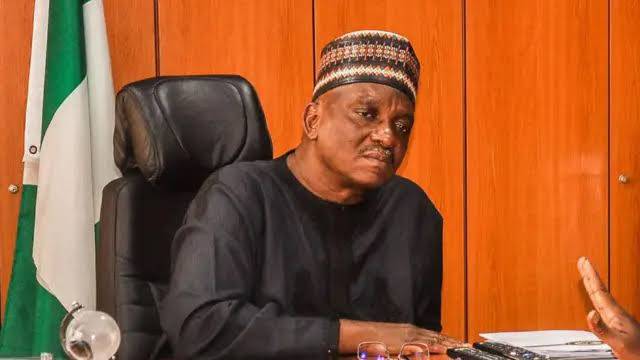
The Economic and Financial Crimes Commission (EFCC) has arrested Saleh Mamman, a former Minister of Power who was recently convicted and sentenced to 75 years in prison for money laundering involving ₦33.8 billion in public funds, ending a dramatic manhunt that lasted nearly two weeks after he went into hiding to avoid justice. EFCC Chairman Ola Olukoyede confirmed that Mamman was arrested at approximately 3:30 a.m. on Tuesday, May 19, 2026, in Kaduna, along with two other individuals who were shielding him from law enforcement. The house where he was found is currently being investigated by the commission, with Olukoyede suggesting that the property may have been acquired with proceeds of corruption. The arrest brings to a close one of the most high-profile anti-corruption sagas in Nigeria’s recent history, a case that has reignited public anger over the systemic looting of funds meant for critical power infrastructure.
Mamman, a 68-year-old engineer and businessman from Taraba State who served as Minister of Power under former President Muhammadu Buhari from August 2019 until his dismissal in September 2021, was initially arraigned by the EFCC in July 2024 on a 12-count charge bordering on conspiracy to commit money laundering and the unlawful diversion of public funds. The charges, which drew immediate national attention, alleged that Mamman had illegally diverted approximately ₦33.8 billion intended for the Mambilla and Zungeru hydroelectric power projects, two strategically vital initiatives meant to address Nigeria’s chronic electricity shortages. Prosecutors presented evidence that the funds were moved through private companies and Bureau de Change operators, converted into foreign currencies and cash payments, and used to acquire luxury properties, including a ₦200 million landed property in Abuja paid for in cash without recourse to any financial institution.
On May 7, 2026, Justice James Omotosho of the Federal High Court in Abuja convicted Mamman in absentia on all 12 counts, holding that the EFCC had proven its case beyond reasonable doubt. The judge noted that the prosecution’s evidence was overwhelming while the defence offered no credible rebuttal. “The evidence of the prosecution is overwhelming as against the scanty and almost absent defence of the defendant. The defendant did not offer any credible evidence to rebut the prosecution’s case,” Justice Omotosho held in his judgment. However, because Mamman was not physically present in court, the judge deferred sentencing until May 13 and issued a bench warrant for his arrest. The following week, on May 13, Justice Omotosho proceeded with sentencing, handing down a total of 75 years imprisonment, ordering that the sentence run consecutively and commence from the date of his arrest. The judge also ordered the final forfeiture of two properties belonging to Mamman in choice areas of Abuja, as well as monies in different currencies recovered by the anti-graft agency, and directed that the differential amount between recovered assets and the sum the prosecution was able to establish be refunded by the convict.
Mamman had also been facing a separate trial at the FCT High Court in Maitama, Abuja, alongside seven others on a nine-count charge involving an additional N31 billion in alleged conspiracy, obtaining by false pretence, and intent to defraud. On May 11, 2026, Justice Maryann Anenih revoked his bail in that case and issued another bench warrant for his arrest after he failed to appear in court. The judge also ruled that the trial could continue in his absence under the provisions of the Administration of Criminal Justice Act. At that hearing, Mamman’s lawyer, Femi Atteh (SAN), told the court that he did not know his client’s whereabouts. “I do not know where he is,” Atteh said, adding that the prosecution had earlier declared that Mamman was now “the state’s property” following the existing arrest order. Despite attempts by the defence to explain his absence on grounds of ill health, both courts rejected the excuse and proceeded to issue arrest warrants and continue legal proceedings without him.
As the days passed after his conviction and sentencing, Mamman remained at large, prompting speculation about whether he had fled Nigeria. The EFCC had confirmed that he was “out of circulation” and “without trace.” Meanwhile, his lawyers insisted they did not know where he was. However, the early morning arrest in Kaduna on Tuesday revealed that he had never left the country but was instead being sheltered by associates, with two other individuals arrested alongside him for allegedly protecting him from law enforcement. The EFCC has not yet released the identities of those two individuals, but Olukoyede indicated that the commission is investigating their role in harbouring a convicted fugitive.
The case has been widely described as one of the most significant corruption convictions in Nigeria’s power sector in recent years. The Mambilla Hydroelectric Power Project, a 3,050-megawatt project first conceived in 1982, has become a symbol of Nigeria’s inability to translate grand infrastructure plans into reality, repeatedly stalled by legal disputes, contractual breaches, and allegations of corruption. The Zungeru project, while closer to completion, has also been plagued by cost overruns and financial irregularities. Prosecutors alleged that Mamman exploited the complex web of contractors and consultants associated with these projects to siphon billions of naira through proxies, private companies, and Bureau de Change operators. In one count, the EFCC alleged that Mamman “conspired with other officials of your Ministry and some private companies to indirectly convert the total sum of ₦33,804,830,503.73 through various private companies in relation to the funds released for the Mambilla and Zungeru Hydroelectric Power Plant Projects by the Federal Government of Nigeria.”
The arrest has drawn a mixed reaction from the Nigerian public. While many have expressed satisfaction that a high-profile convict was finally apprehended, others have questioned how a man sentenced to 75 years in prison was able to remain free for nearly two weeks despite multiple bench warrants and active efforts by law enforcement. Some have also pointed to the irony that Mamman had, just weeks before his conviction, announced his intention to contest the 2027 governorship election in Taraba State on the platform of the All Progressives Congress (APC), having reportedly obtained expression of interest and nomination forms. “Today marks a defining moment in my journey of service to our dear state. With a deep sense of responsibility and unwavering commitment, I have officially obtained the Expression of Interest and Nomination Forms under the All Progressives Congress (APC) to contest for the governorship of Taraba State,” he had written on social media. Those political ambitions are now extinguished as he awaits transfer to a correctional facility to begin serving his sentence.
The EFCC has not yet disclosed when Mamman will be handed over to the Nigerian Correctional Service. His legal team is expected to pursue an appeal against both the conviction and the sentence, which would likely prolong the legal battle. However, for now, the man who once oversaw Nigeria’s power sector is in custody, arrested before dawn in a safe house in Kaduna. For millions of Nigerians who endure daily blackouts while watching billions in public funds disappear into private pockets, the arrest offers a rare moment of vindication. Yet, as the Mambilla project remains unbuilt and the lights remain off in most homes, many will wonder whether one man’s arrest will change a system that has long rewarded impunity.
📩 Stone Reporters News | 🌍 stonereportersnews.com
✉️ info@stonereportersnews.com | 📘 Facebook: Stone Reporters News | 🐦 X (Twitter): @StoneReportNew | 📸 Instagram: @stonereportersnews
Add comment
Comments