

Reported by: Oahimire Omone Precious | Edited by: Oravbiere Osayomore Promise.
The ongoing trial of Ahmed Kuru, former Managing Director of the Asset Management Corporation of Nigeria (AMCON), and four others recorded a seismic shift on Tuesday, May 19, 2026, when a Lagos special offences court admitted evidence that the defendants acted strictly within the mandate of AMCON's board resolutions, effectively challenging the foundation of a multi-billion naira fraud case that has gripped the nation for nearly two years. Presiding over the proceedings at the Special Offences Court in Ikeja, Justice Mojisola Dada ruled to admit a pivotal letter from AMCON to the Economic and Financial Crimes Commission (EFCC) as an exhibit, after which she adjourned the case to June 25 and July 7, 2026, for continuation of cross-examination of the prosecution's fourth witness. The letter, dated November 28, 2024, and addressed to the Chairman of the EFCC, unequivocally stated that all actions taken by the defendants concerning Arik Air were official corporate decisions carried out under the lawful authority of AMCON's Board of Directors and its officers, warning that criminal charges against the defendants would "undermine the Corporation's debt recovery mandate and discourage its officers from carrying out lawful responsibilities."
Kuru is standing trial alongside Kamilu Alaba Omokide, the former Receiver-Manager of Arik Air; Captain Roy Ilegbodu, the airline's Chief Executive Officer; Union Bank of Nigeria Plc; and Super Bravo Limited, following a petition filed by human rights lawyer Femi Falana, SAN, on behalf of Arik Air promoter, Sir Johnson Arumemi-Ikide. The defendants face a six-count charge bordering on conspiracy, stealing, abuse of office, and making false statements relating to the alleged diversion and unlawful conversion of Arik Air assets valued at approximately N76 billion and $31.5 million. One of the counts accuses Union Bank of making false statements to AMCON regarding Arik Air's performing loans, following which the bank allegedly transferred a bogus figure of N71 billion to AMCON. Another count specifically charges Kuru, Omokide, and Ilegbodu with fraudulently converting N4.9 billion, property of Arik Air Limited, to the use of NG Eagle Limited in 2022.
The day's proceedings took a dramatic turn when defence counsel, Prof. Taiwo Osipitan, SAN, leading the defence for the first and third defendants, tendered the November 28, 2024, letter from AMCON to the EFCC. The prosecution, led by Wahab Shittu, SAN, initially objected to its admissibility on the grounds that the document was a photocopy and lacked proper certification. However, Justice Dada ruled that since the original copies were with the EFCC and had been identified by the witness, they should be produced whenever necessary. She consequently admitted the documents into evidence and marked them as Exhibit P53. Osipitan then prompted the fourth prosecution witness, Bawa Usman Kaltungo, an Assistant Director of the EFCC, to read portions of the letter aloud in open court. The witness reluctantly confirmed that the letter stated that all actions taken by AMCON and its receiver managers were decisions of the corporation's Board of Directors arising from official meetings.
Under intense cross-examination, Kaltungo made a series of stunning admissions that appeared to unravel the prosecution's case. He admitted that the activities carried out by the Receiver-Manager and the management of Arik Air were sanctioned by the Board of AMCON. He confirmed that the defendants acted in their capacities as agents, privies, representatives, or subsidiaries of AMCON in relation to the affairs of Arik Air under receivership. The witness further conceded that Omokide, who held only a nominee share in NG Eagle, did not personally benefit from the sale of the special purpose vehicle established by AMCON to exit its aviation toxic assets portfolio. He also confirmed that proceeds from the sale of NG Eagle went directly to AMCON, not to any of the defendants.
Perhaps most damaging to the prosecution was Kaltungo's admission regarding the lack of direct financial evidence against the defendants. When asked by Osipitan whether he had personally traced any financial proceeds or direct benefit to Kuru, the witness replied, "I did not trace it." When pressed to identify any concrete evidence showing that Kuru personally received money from the transactions under investigation, Kaltungo maintained that he only believed the former AMCON boss benefited "through shares," but admitted he had no direct proof linking him to personal financial gain. The EFCC witness also acknowledged that investigators did not obtain direct authority regarding the seizure or grounding of Arik Air aircraft, and that some documents relied upon by the commission were supplied by third parties and not independently verified. He further admitted that some individuals linked to these documents either denied knowledge of them or were never confronted with them during the investigation.
In a pointed exchange, Prof. Osipitan questioned why the EFCC proceeded with criminal charges against the defendants despite AMCON's written clarification that the actions complained about were authorised corporate decisions and despite the absence of evidence showing personal enrichment by any of the accused persons. The defence maintained that the defendants merely acted in furtherance of AMCON's statutory mandate under the AMCON Act 2010 (as amended), which empowers the Corporation to recover non-performing loans, enforce collateral rights, and stabilise distressed assets acquired by the Corporation. AMCON had warned in its letter to the EFCC that the issues in dispute were commercial matters already before the courts, not criminal offences, and that there was "nothing in the Charge indicating ANY personal benefits to AMCON and its officers."
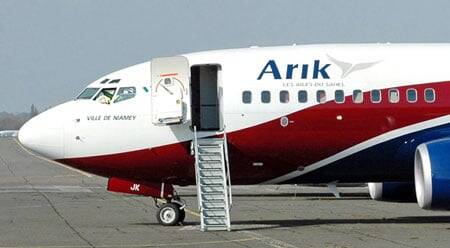
It would be recalled that AMCON's intervention in Arik Air Limited was initiated by the Federal Government of Nigeria in the overall national interest. In February 2017, the airline was taken over by the federal government through AMCON due to the company's huge debt profile, which was over N300 billion. The decision to place the airline under receivership was part of broader efforts to stabilise the aviation sector and recover toxic loans that threatened the stability of Nigeria's banking system.
Throughout the proceedings, the prosecution, led by Wahab Shittu, SAN, consistently opposed the admissibility of several letters sought to be tendered by the defence, arguing that the documents were photocopies and had not been certified. The prosecution also maintained its stance that the defendants' actions had far exceeded the bounds of their mandates and constituted criminal misconduct. However, Justice Dada, in her various rulings, demonstrated a commitment to ensuring that all relevant evidence, including documents from AMCON and the Central Bank of Nigeria, was properly evaluated before the court.
The court's decision to admit the AMCON letter and the EFCC witness's admissions have significantly bolstered the defence's argument that the criminal charges amount to an attempt to criminalise the lawful exercise of statutory powers. The defence has consistently argued that AMCON itself was not charged in the case, despite allegedly authorising the actions now forming the basis of the prosecution, and that the defendants, who were representing the Federal Government of Nigeria in their various capacities, should not be prosecuted for carrying out government-approved policies.
As the courtroom in Ikeja emptied and lawyers for both sides packed their files, it became evident that the case had entered a critical phase. Justice Dada's decision to admit the AMCON letter into evidence has opened the door for the defence to argue more forcefully that the defendants were merely implementers of board-approved corporate strategies, not criminals who enriched themselves from their positions. The adjournment until June 25, 2026, provides both parties time to prepare for what promises to be a fierce continuation of cross-examination.
The outcome of this case could have profound implications not only for the defendants but for how Nigeria treats corporate officials who execute government-mandated interventions in distressed sectors. If the court ultimately accepts the defence's argument that the AMCON board's authorisation shields the defendants from criminal liability, it could set a precedent that prioritises corporate governance protections over individual prosecutions in complex debt recovery cases. However, if the prosecution can successfully argue that even board-sanctioned actions can constitute criminal conduct when they cross certain thresholds, the defendants will face an uphill battle to avoid conviction. For now, the case of the former AMCON boss and his co-defendants remains one of Nigeria's most closely watched fraud trials, with each adjourned date bringing new revelations and further clarity on where the line between corporate authority and criminal excess truly lies.
📩 Stone Reporters News | 🌍 stonereportersnews.com
✉️ info@stonereportersnews.com | 📘 Facebook: Stone Reporters News | 🐦 X (Twitter): @StoneReportNew | 📸 Instagram: @stonereportersnews
Add comment
Comments