

Reported by: Oahimire Omone Precious | Edited by: Oravbiere Osayomore Promise.
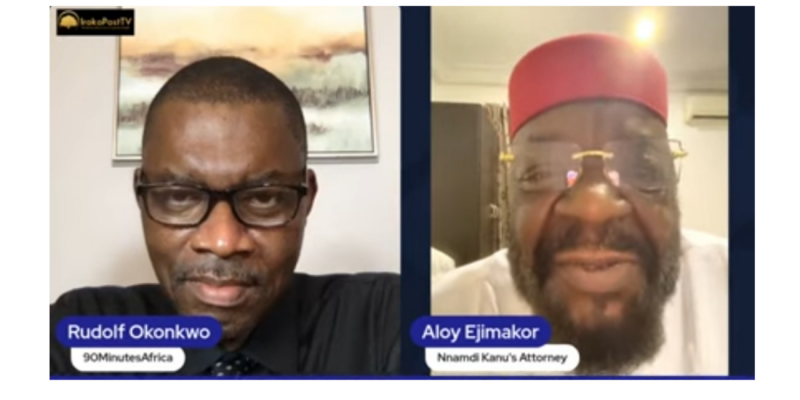
Barrister Aloy Ejimakor, the Special Counsel to the detained leader of the Indigenous People of Biafra (IPOB), Mazi Nnamdi Kanu, has declared that the long-running agitation for a separate state of Biafra can only be effectively resolved through dialogue, and that the continued use of arrests, prosecutions, and other law enforcement measures will never bring an end to the crisis. Ejimakor made the remarks during an exclusive interview with Rudolf Okonkwo on 90MinutesAfrica, a programme hosted by SaharaReporters, in which he described the Biafran struggle as a political issue rooted in the inalienable right of a people to self-determination.
The lawyer, who has been at the forefront of the legal battle to secure Kanu’s freedom, insisted that those agitating for self-determination are not seeking a violent confrontation with the Nigerian state. “When people engage in agitations for self-determination, they are actually asking to come to the table,” Ejimakor said. “The best answer to such agitations is not the use of law enforcement but dialogue.” He argued that the persistent instability in the South-East, despite years of military deployments, clampdowns and prosecutions, is proof that a security-led approach has failed. The only way forward, he said, is for the Federal Government to invite the proponents of self-determination to discuss their grievances and aspirations, a practice that is common in democratic societies around the world.
Ejimakor anchored his argument on Article 20 of the African Charter on Human and Peoples’ Rights, which recognises the right of all peoples to existence and self-determination. He acknowledged that the Nigerian state has the sovereign authority to reject demands for secession, but he stressed that such a decision must be the product of meaningful engagement rather than coercive measures. “The state may refuse self-determination, but it must do so across the table through dialogue and negotiation,” the legal luminary stated, offering a clear path away from the current stalemate.
The lawyer expressed deep concern over what he described as a growing and dangerous frustration among the people of the South-East, warning that certain policies and actions appear designed to provoke widespread resentment and alienation. He pointed out that despite the palpable dissatisfaction with the present political situation, a majority of Igbos continue to participate in Nigeria’s democratic process. “They still consider themselves part of the country,” he said. However, Ejimakor noted that the unresolved detention of Nnamdi Kanu remains the single greatest source of that discontent. Regardless of political affiliation, he argued, ordinary people in the region view Kanu’s continued incarceration as a powerful symbol of the state’s failure to address fundamental questions of justice and equity.
The senior advocate placed the ultimate responsibility for solving the crisis squarely on the desk of President Bola Tinubu. Rejecting speculation that some South-East political leaders were hindering efforts to secure Kanu’s release, Ejimakor insisted that the case is a federal matter and only the Presidency has the constitutional and political authority to make a decisive intervention. “The buck stops at the President’s table,” he declared. “Any narrative suggesting that South-East governors are responsible for Kanu’s continued detention is merely an attempt to shift responsibility away from the Presidency.” He warned that blaming regional leaders only serves to divide the Igbo people and distract attention from the Federal Government’s primary role in resolving the issue.
Ejimakor’s interview is the latest in a long line of calls for a political resolution to the IPOB crisis. He has previously invoked the examples of Nelson Mandela in South Africa and John Kerry in the United States, citing the release of political prisoners as a prerequisite for successful dialogue. On this occasion, he concluded by reiterating his core position: the government must engage in sincere negotiations over the grievances driving the Biafra agitation and address the controversy surrounding Kanu’s detention in the interest of national stability. “Dialogue remains the most effective path toward lasting peace and national unity,” he said, urging the government to choose the table over the courtroom.
📩 Stone Reporters News | 🌍 stonereportersnews.com ✉️ info@stonereportersnews.com | 📘 Facebook: Stone Reporters News | 🐦 X (Twitter): @StoneReportNew | 📸 Instagram: @stonereportersnews
Add comment
Comments