

Reported by: Ijeoma G | Edited by: Oravbiere Osayomore Promise.
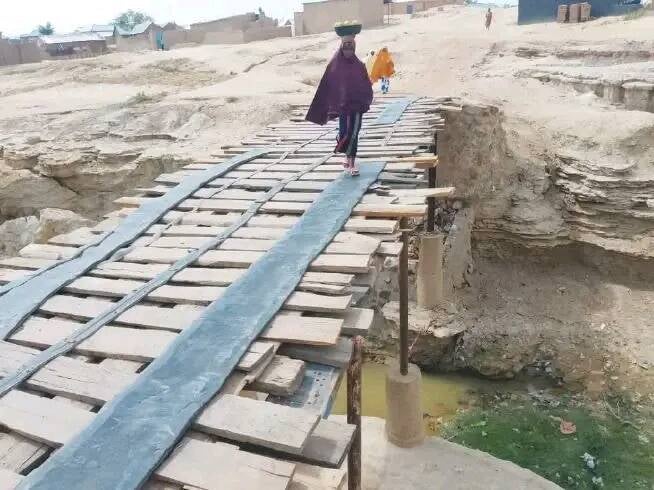
A single wooden bridge, cracked and held together by community labour, is all that stands between more than 4,000 people and the nearest hospital. In Afghanistan Community, Garko Ward of Akko Local Government Area, lives are lost in slow motion every rainy season, none more brutally than that of 25-year-old Hajiya Fatima, a mother of two who bled to death in her home because the bridge had disappeared under floodwater.
On the evening Fatima went into labour, rain was lashing the community. Her contractions were strong and close together. She knew the bridge was already submerged. She sent her older children to fetch neighbours, delivered her baby at home after a prolonged labour, and then the bleeding would not stop. Hours later, when the water level finally dropped enough for a crossing, it was too late. Fatima was dead. Her newborn baby also died. According to a community leader, Ishaq Afghanistan, who narrated the incident to PUNCH Healthwise in June 2026, the tragedy occurred in 2024. “Her labour started as it was raining. The wooden bridge was flooded, and nobody could pass due to the current. Before it could drain off, Hajiya passed because she could not access the health facility on time. The baby, too, didn’t make it,” he said.
The 2026 rainy season has arrived again, and nothing has changed. A single wooden bridge, built by the community itself, remains the only link to the outside world. When water rises, the road to the hospital in a neighbouring town vanishes, and a village of more than 4,000 people is cut off from healthcare, schools, markets, and even basic supplies. Pregnant women, sick children, injured farmers, all are stranded on the wrong side of the water. Women in labour have to decide whether to risk crossing the bridge or stay home and hope they survive. Many do not.
A village head, Muhammad Banbulasta, told PUNCH Healthwise that women in the community are forced to stay with relatives in the nearby town that has a hospital for weeks before their delivery dates because they cannot risk being isolated when labour starts. Even then, getting to the town for antenatal checkups is a gamble. “When roads are good, people focus on treatment. Here, people first struggle to reach treatment,” Banbulasta said.
Nigeria accounts for nearly 34 percent of the global burden of maternal mortality, and postpartum bleeding, hypertensive disorders, sepsis, and unsafe abortions are major killers. Professor Ernest Orji, an Obstetrics and Gynaecology expert at Obafemi Awolowo University, Ile-Ife, told PUNCH Healthwise that the "three delays" model explains why preventable deaths continue to happen. The first delay occurs when a pregnant woman fails to recognise the seriousness of her condition; the second delay is when she cannot reach a hospital because roads are bad or transport is lacking; the third delay is when she arrives at a health facility but cannot receive timely care because supplies or staff are missing. Fatima’s death belongs to the second category, and it is a delay that could have been eliminated with a single concrete bridge.
The community is not only losing mothers but children. The nearest hospital is accessible only through that wooden bridge, and during heavy rains, even routine childhood illnesses can become fatal. A mother of five, Hauwa Musa, told PUNCH Healthwise that she spends hours searching for motorcycle riders willing to cross the bridge when she needs to take her children to the clinic. “When my youngest child became sick during the rainy season last year, we spent hours looking for transport. The motorcycle rider was afraid of crossing because the bridge was slippery,” she said. She recalled holding her child tightly while praying throughout the ride, as if crossing a river in a storm.
The isolation also cripples education. Schoolchildren frequently miss classes when rain cuts off the road. Teachers sometimes cannot reach the school. Examinations become stressful because students worry about transportation. A secondary school student, Abubakar Ismail, told PUNCH Healthwise: “Sometimes you wake up ready for school and discover there is no way to leave the community. You watch other students continue learning while you remain at home.” The long-term damage to children's futures is incalculable.
Even the dead are not spared. During the rainy season, it is sometimes impossible for vehicles to enter the community to collect corpses for burial. Residents have had to carry the dead on foot, a traumatic experience that adds insult to injury. “Nobody should have to carry a corpse because there is no road,” one resident told PUNCH Healthwise. “It is painful.” No family should have to choose between drowning a loved one in grief and risking their own lives on a slippery plank to bury them.
The bridge has been a death trap for nearly a decade. Residents have repeatedly repaired it themselves, pouring their own savings into carpenters and timber, only to watch floodwaters tear it apart again. Community leaders estimate that millions of naira have been spent over the years maintaining a structure that the government was expected to provide. The irony is that the Afghanistan Community is growing. New homes are rising, young families are settling, economic activity is increasing, but the infrastructure has not kept pace.
When contacted, the Information Officer for Water, Environment and Forest Resources, Amos Fabulous, described the community’s situation as a “death trap” but told PUNCH Healthwise that the community must write a formal request to the ministry and also to the Ministry of Works. No senior government official from Gombe State has visited the site. No emergency funds have been released. The Ministry of Health has not responded to inquiries about what steps are being taken to bring healthcare closer to the Afghanistan Community to prevent the next maternal death.
As another rainy season gains momentum, the Afghanistan Community is waiting again. Waiting for repairs, waiting for recognition, waiting for promises to become projects, and waiting for authorities to remember that more than 4,000 citizens depend on a bridge they built themselves. For now, the wooden structure still stands, residents continue crossing it, farmers continue using it, schoolchildren continue walking over it, and mothers continue praying on it. But every rainfall serves as a reminder that hope alone cannot replace infrastructure, and that until meaningful intervention arrives, a community named after a country torn apart by war will remain connected to the outside world not by modern roads, but by determination, endurance, and the unwavering belief that someday, somebody in authority will listen.
Above is the photograph of the collapsed bridge and the Afghanistan Community.
📩 Stone Reporters News | 🌍 stonereportersnews.com ✉️ info@stonereportersnews.com | 📘 Facebook: Stone Reporters News | 🐦 X (Twitter): @StoneReportNew | 📸 Instagram: @stonereportersnews
Add comment
Comments