

Reported by: Oahimire Omone Precious | Edited by: Oravbiere Osayomore Promise.
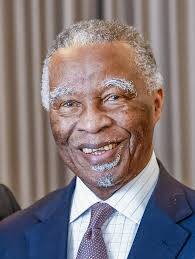
ABUJA, Nigeria – Former South African President Thabo Mbeki has squarely blamed the continent’s persistent insecurity on a failure of leadership, insisting that Africa can no longer evade responsibility for the armed conflicts, mass displacements and collapsing governance structures that continue to claim lives across its regions. Speaking virtually at a book launch in honour of former Nigerian military head of state General Abdulsalami Abubakar on Saturday, June 13, 2026, Mbeki said the protracted conflicts in parts of Africa could be attributed to the failure of leadership, but he also stressed that this should not be a justification for Africa’s failure to maintain democratic governance.
The event, held at the Presidential Villa in Abuja, was a public presentation of three books celebrating Abdulsalami’s 84th birthday: Call of Duty: An Autobiography of Gen. Abdulsalami Alhaji Abubakar, Nigeria’s Grand Patriot: Gen. Abdulsalami Alhaji Abubakar, and Mediating for Peace in Africa: A Festschrift in Honour of Gen. Abdulsalami Abubakar. In a keynote address on democratic governance and peacebuilding, Mbeki urged Africans to discard the things that retard the progress of the continent. His remarks came amid a backdrop of escalating insecurity in Nigeria and other parts of Africa, including the Sahel, the Horn of Africa and the Great Lakes region, where armed groups, bandits and terrorists have displaced millions and killed thousands in recent years.
Mbeki’s critique was not directed only at national governments; it implicitly questioned the efficacy of regional bodies and continental institutions that have struggled to prevent or resolve crises. The African Union has been repeatedly criticised for its perceived silence or inaction on conflicts ranging from the civil war in Sudan to the insurgencies in Mozambique’s Cabo Delgado province and the jihadist expansion across the Sahel. On Saturday, Mbeki positioned himself firmly on the side of accountability: while external factors such as economic inequality, climate stress and illicit financial flows undoubtedly contribute to instability, he said, the primary responsibility for peace lies with Africa’s own leaders.
Mbeki’s intervention comes as Nigeria itself grapples with a deteriorating security environment. On the same weekend, news emerged that retired Major General Rabe Abubakar, a former Director of Defence Information, had died in bandit captivity after more than three weeks in the hands of kidnappers in Katsina State. Across the North‑West and North‑Central regions, bandits and terrorists have continued to abduct schoolchildren, attack rural communities and ambush travellers with impunity. In Oyo State, 46 pupils and teachers remain in captivity more than four weeks after they were seized from three schools in Oriire Local Government Area. The Federal Government has deployed aerial surveillance and ground troops, but the victims have not been freed.
Beyond Nigeria, the West African Sahel is in the grip of a deepening crisis. Burkina Faso, Mali and Niger – all ruled by military juntas that seized power in coups between 2020 and 2023 – have lost control of vast territories to jihadist groups affiliated with al‑Qaeda and the Islamic State. In the Lake Chad Basin, Boko Haram and Islamic State West Africa Province (ISWAP) continue to carry out deadly raids against military and civilian targets. In the Horn of Africa, the civil war in Ethiopia’s Tigray region has killed hundreds of thousands and displaced millions, while Sudan is mired in a brutal conflict between the army and paramilitary forces. In eastern Democratic Republic of Congo, armed groups have terrorised civilians for decades with little effective intervention from regional or continental bodies.
At the same event, Mbeki praised Abdulsalami Abubakar for resisting the “temptation and allure of power” and returning Nigeria to democratic rule within 11 months of assuming office following the sudden death of General Sani Abacha in June 1998. “Following his appointment as head of state by the Provisional Ruling Council, he recognized the urgent need for stability and democratic governance and hence chose to commit to a short transition period,” Mbeki said. He described Abdulsalami’s conduct as a rare example of military leadership serving the national interest rather than personal ambition, a lesson for the continent’s current leaders. Abdulsalami’s response to the political uncertainties that followed Abacha’s death, Mbeki added, “demonstrated great wisdom, foresight and statesmanship”.
But Mbeki’s broader indictment was unmistakably darker. “Protracted conflicts in parts of Africa could be attributed to failure of leadership,” he said, using the plural deliberately. The statement was not merely an observation; it was a charge sheet. It named the wars that have no end, the displaced who never return, and the children who grow up knowing only flight and gunfire. And it placed the blame not on colonialism, not on neo‑imperialism, but on the men and women who hold power on the continent today.
As African leaders gather at the African Union summit later this year, Mbeki’s words will be difficult to ignore. He did not offer a remedy; he offered a diagnosis. The cure, he seemed to say, lies not in foreign intervention or resource windfalls, but in a revolution of accountability, in leaders who choose service over survival, and in populations that refuse to accept failure as fate. “The world is watching,” one diplomat remarked after the speech. “And now, so is history.”
📩 Stone Reporters News | 🌍 stonereportersnews.com ✉️ info@stonereportersnews.com | 📘 Facebook: Stone Reporters News | 🐦 X (Twitter): @StoneReportNew | 📸 Instagram: @stonereportersnews
Add comment
Comments