

Reported by: Oahimire Omone Precious | Edited by: Oravbiere Osayomore Promise.
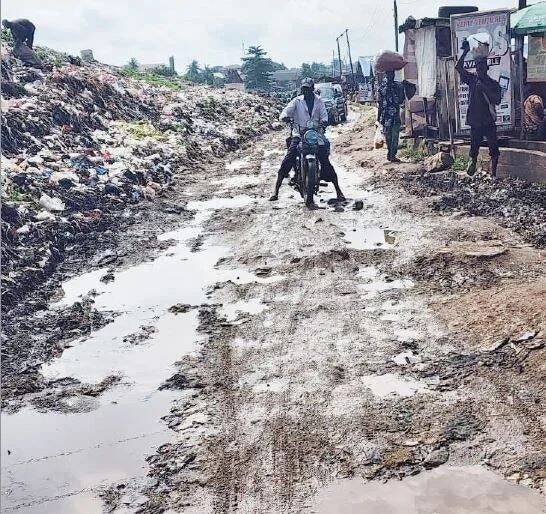
The suffocating stench hits visitors long before they reach the Oja Agbe Market. A towering mountain of refuse greets them like an unwelcome gatekeeper, its nauseating fumes mixing with the odour of fresh farm produce sold directly opposite it. Separating the market from the dumpsite is a narrow, heavily damaged road riddled with deep potholes and flanked by fetid, stagnant water that turns every journey into a gamble with death.
For the residents of Ifo Local Government Area and the more than 80 communities that rely on this road, life has become a daily battle between neglect and survival. The Sholu-Kajola Road, which links the Lagos-Abeokuta Expressway to a vast network of villages, has been all but swallowed by an abandoned dumpsite that has existed for over 35 years. It is a grim irony: a market built to sustain life is slowly being choked by the waste of those who pass through it, creating a public health time bomb that officials have repeatedly promised to defuse but have failed to contain.
The statistics are as stark as the smell. In the first quarter of 2026 alone, the Federal Road Safety Corps (FRSC) recorded 80 fatalities across Ogun State, with many accidents linked to potholes, poor visibility, and flooded roads – conditions that residents say are a direct consequence of the encroaching refuse pile. Just last month, a pregnant woman fell off a motorcycle into stagnant floodwater on this very stretch. Passersby rescued her, but according to a pepper seller, Adeola Afolabi, “schoolchildren and pregnant women regularly fall off motorcycles at this spot, especially when leaves and debris cover the road.” Some have lost their pregnancies; others have died before reaching medical help.
The health crisis unfolding alongside the road is equally alarming. With the onset of the rainy season, waste materials are being washed into water sources and residential areas, raising the risk of waterborne diseases. A garri seller in the market, Mrs. Akinola, warned, “What we have here, if left unattended, is a disaster waiting to happen. This can trigger a cholera outbreak, especially through the contaminated water and the flies.” Despite these fears, the market operates daily, with food items such as watermelon, garri, and vegetables sold within metres of the decomposing pile, as flies swarm over the produce.
Community leaders have documented decades of government inaction. The Emilajulo Okepata Community Development Committee chairperson, Esther Adelakun, noted that residents have repeatedly contributed money to grade the road themselves. “We have more than 80 Community Development Associations, and we have repeatedly graded the road ourselves. We even went to Ewekoro to get granite to fill parts of the road, but people are already tired because the problem keeps returning.” A local businessman, Olatunde Badru, added that the dumpsite has almost taken over the road completely, making it “the major road leading to Sholu Road, Kajola Activity Village and several other communities.”
On June 12, 2026, hundreds of residents from the affected communities staged a protest at the Ifo Local Government Secretariat, rejecting assurances from the council chairman, Olamilekan Kushimo, that the site's evacuation would take time. The convener of the Make Ogun State Great Again Movement, Olawoye Kayode, reminded officials that the dumpsite has existed for over 35 years, and residents fear a possible outbreak of diseases like cholera if urgent action is not taken. The chairman, for his part, explained that the major obstacle was securing a suitable alternative location for the waste, as proposed relocation sites had been rejected by other host communities.
The reality for the residents is that words mean little when their children cannot breathe fresh air and their loved ones risk death on the way to market. “The government tells us to be patient and keep hope alive, but there is no peace of mind here,” a community leader said. “Some residents are even leaving their communities because of the smell. If the government can assist us, we will be grateful.”
As the sun sets over the towering dumpsite, the shanties of the market cast long shadows over the broken road. The promise of a cleaner, safer environment remains elusive. For the people of Ifo, the battle between living beside death and the hope for a new dawn is far from over.
📩 Stone Reporters News | 🌍 stonereportersnews.com ✉️ info@stonereportersnews.com | 📘 Facebook: Stone Reporters News | 🐦 X (Twitter): @StoneReportNew | 📸 Instagram: @stonereportersnews
Add comment
Comments