

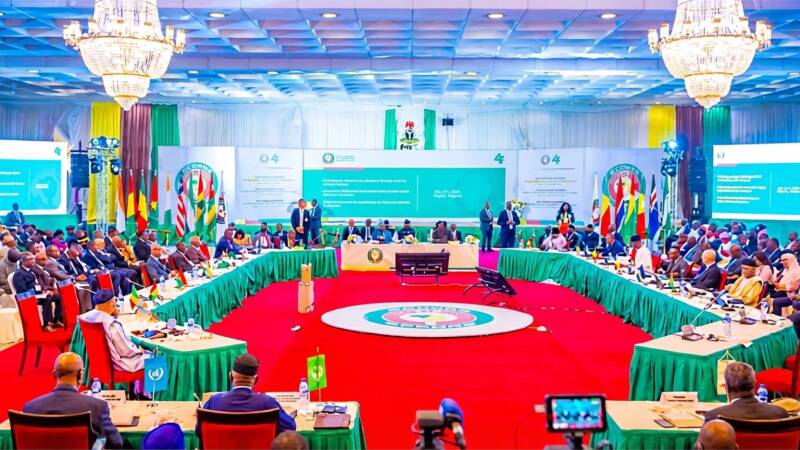
The ECOWAS Community Court of Justice has awarded ₦10 million in general damages against the Federal Republic of Nigeria over the assault, unlawful arrest, detention, and seizure of property belonging to journalist Jide Oyekunle, ruling that his fundamental human rights were violated by Nigerian security operatives while carrying out his professional duties.
On June 22, 2026, the ECOWAS Court sitting in Abuja, Nigeria, delivered judgment in Suit No. ECW/CCJ/APP/29/25, filed by Jide Oyekunle, a journalist with Independent Newspaper, against the Federal Republic of Nigeria. The court ruled that Nigerian security personnel violated Oyekunle’s rights to dignity, liberty, and property after assaulting and arresting him during the #EndBadGovernanceInNigeria protest at Eagle Square, Abuja, on August 1, 2024.
According to court records, Oyekunle had gone to Eagle Square on August 1, 2024, to report on the nationwide anti-hardship protest tagged #EndBadGovernanceInNigeria. The protest was organized by civil society groups and youth activists demanding urgent action over inflation, food insecurity, rising fuel costs, and worsening economic hardship across Nigeria.
The protest in Abuja drew large crowds to strategic public locations including Eagle Square, one of the country’s major civic grounds used for state ceremonies and public gatherings. Security presence at the venue was heavy, with officers from multiple agencies deployed to monitor crowd movement and maintain order.
Court filings showed that while covering the demonstration in his capacity as a journalist, Oyekunle identified himself as a media professional. He was reportedly carrying his press tools, including a mobile phone and camera equipment used for documenting developments at the protest ground.
Despite this, the applicant told the court that he was confronted by security operatives who allegedly assaulted him physically. He stated that he was beaten while attempting to perform his journalistic responsibilities.
The court heard that Oyekunle suffered physical injuries during the confrontation. His legal team argued that the force used against him was excessive and lacked lawful justification.
The journalist further told the court that after the assault, he was arrested and detained by security personnel. According to his testimony, he was neither informed of a lawful reason for his arrest nor formally charged with any offence.
His lawyers argued that the detention amounted to arbitrary deprivation of liberty, contrary to protections guaranteed under regional and international human rights law. They maintained that there was no legal basis for holding him.
The case also involved allegations of property seizure and destruction. Oyekunle told the court that his mobile phone was confiscated during the incident.
He further alleged that his camera, which he used for professional reporting, was damaged during the assault. The destruction of work equipment, his lawyers argued, caused financial loss and disrupted his ability to work.
The applicant’s legal team, supported by , argued that the assault and seizure of equipment were not isolated acts but direct interference with press freedom. They told the court that journalists must be allowed to report public events without intimidation or violence.
They further argued that attacks on journalists undermine democratic accountability because the media serve as a public watchdog during major national events such as protests and elections.
Nigeria, as respondent in the suit, was accused of failing to uphold obligations under the African Charter on Human and Peoples’ Rights and other international human rights instruments to which it is a party.
The ECOWAS Court examined evidence presented by both sides, including witness statements and submissions regarding the conduct of security operatives at the protest ground.
In its judgment, the court held that the physical assault on Oyekunle constituted a violation of his right to dignity. The judges stated that state agents are prohibited from subjecting civilians to degrading or inhuman treatment.
The court emphasized that the prohibition of physical abuse by law enforcement applies regardless of the circumstances, including during crowd-control operations or protest monitoring.
On the issue of arrest and detention, the court found that Oyekunle’s liberty had been unlawfully violated. It ruled that his arrest lacked sufficient legal justification.
The judges stated that security agencies must act within the boundaries of law and due process. Arrest without lawful basis, the court noted, cannot be justified merely by the existence of a public protest.
Regarding the confiscation of his phone and damage to his camera, the court held that Oyekunle’s property rights had also been breached. The judges found no lawful basis for the seizure and damage of his belongings.
The court noted that journalistic equipment is essential to news gathering. Interference with such equipment directly affects freedom of expression and public access to information.
In awarding ₦10 million, the court said compensation was necessary to address the physical, emotional, professional, and financial harm suffered by the journalist.
The damages were awarded as general compensation for the rights violations established before the court. The ruling did not merely address physical injury but also broader harm arising from unlawful treatment.
The judgment represents a significant ruling on press freedom in West Africa. Media rights advocates say it reinforces legal protection for journalists covering protests and politically sensitive events.
The ruling also comes amid continued concern over attacks on journalists in Nigeria. Press freedom groups have repeatedly documented incidents involving intimidation, harassment, detention, and physical assault of media workers.
The #EndBadGovernanceInNigeria protest itself became one of the most closely watched demonstrations in Nigeria in 2024. It emerged as a response to worsening economic conditions following subsidy removal and currency instability.
During the protests, several journalists and protesters reported confrontations with security personnel in different parts of the country. Rights groups called for investigations into alleged abuses.
The ECOWAS Court’s judgment places renewed focus on state accountability during public protests. It affirms that security operations must respect fundamental rights even during tense public gatherings.
Legal analysts say the judgment strengthens ECOWAS Court jurisprudence on unlawful detention and abuse by state agents. The court has increasingly ruled against member states in human-rights-related cases.
The ruling also serves as a reminder that journalists enjoy protected rights while carrying out lawful reporting activities. Courts have repeatedly recognized the press as central to democratic governance.
For Jide Oyekunle, the judgment represents judicial vindication after nearly two years of legal proceedings. The ruling formally acknowledges that his treatment violated established human rights protections.
For Nigeria, the judgment adds to growing regional scrutiny over treatment of journalists and civilians by security forces. Compliance with the court’s order will now be closely watched by legal and media observers.
The broader significance of the ruling lies in its message to security institutions: professional journalism is not a crime, and violence against reporters can attract legal consequences at both national and regional levels.
📩 Stone Reporters News | 🌍 stonereportersnews.com
✉️ info@stonereportersnews.com | 📘 Facebook: Stone Reporters News | 🐦 X (Twitter): @StoneReportNew | 📸 Instagram: @stonereportersnews
Add comment
Comments