

Reported by: Ijeoma G | Edited by: Oravbiere Osayomore Promise.
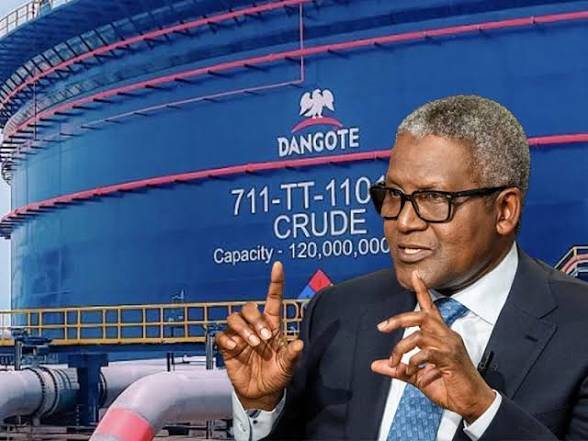
The management of Dangote Petroleum Refinery and Petrochemicals has vehemently denied recent claims by global energy analysts S&P Global that Nigerian fuel marketers are re-importing its refined petroleum products through the offshore ship-to-ship trading hub in Lomé, Togo, dismissing the allegations as "unfounded," "misleading," and commercially illogical.
The controversy erupted following a webinar organized by the Major Energies Marketers Association of Nigeria (MEMAN) on June 19, 2026, where Matthew Tracey-Cook, an analyst at S&P Global Commodity Insights, disclosed that between March and May 2026, an estimated 70 to 80 per cent of waterborne fuel imports into Nigeria originated from Dangote products that had been exported to the Lomé hub and subsequently shipped back into the country. Tracey-Cook noted that a similar trend had emerged in diesel supplies, underlining the refinery's growing influence in Nigeria's fuel market. However, he did not suggest that Dangote Refinery was aware of or facilitating the practice.
In a robust statement issued on Tuesday, June 24, 2026, the refinery described the S&P Global claims as "ill-motivated" and "a web of falsehoods". The company argued that the allegations were not supported by available trade data, commercial logic, or the operational realities of the refinery. "A core mandate of the refinery is to strengthen domestic supply and remain a leading provider of petroleum products in Nigeria," the company stated. "Any practice that enables imports to compete directly with its own production clearly contradicts this objective".
To counter the allegations, Dangote Refinery outlined several key arguments. First, it noted that all sales contracts and tender agreements expressly prohibit the resale or re-importation of its products into Nigeria. Second, the company argued that the economics of such a trade route are fundamentally flawed. Estimated logistics costs for transporting products from the refinery to Lomé and back into Nigeria range between $82 and $90 per metric tonne, costs that would significantly erode margins and render the transaction commercially unviable. "Simply put, no rational producer would incur additional shipping, storage, financing, and handling costs only for products to re-enter and compete in its primary market," the refinery clarified.
The company further emphasised its stringent product traceability protocols, including detailed records of lifting points, nominated vessels, counterparties, and declared destinations, which ensure full visibility and accountability across the supply chain. "Any claim suggesting that the refinery facilitates or tolerates re-importation is inconsistent with its contractual safeguards and established compliance standards," the statement insisted. The refinery also pointed to its longstanding public advocacy for reducing Nigeria's dependence on imported petroleum products, arguing that encouraging re-importation would undermine local refining efforts, strain foreign exchange reserves, and weaken national industrial growth.
The latest dispute is rooted in a pricing controversy that has simmered for months. In November 2025, Nigerian fuel marketers, including the Depot and Petroleum Products Marketers Association of Nigeria (DAPPMAN) and the Petroleum Products Retail Outlet Owners Association of Nigeria (PETROAN), alleged that Dangote Refinery sold petrol to international traders at approximately N65 per litre cheaper than the price offered to domestic marketers. According to MEMAN data, imported fuel cost 1,117 naira ($0.81) per litre in early June 2026, compared with 1,250 naira at the refinery, a difference of 133 naira. This price gap has made it commercially attractive for marketers to route Dangote fuel through Lomé and re-import it, capitalising on the arbitrage opportunity.
The controversy has also exposed an ironic twist in the narrative. In late 2024, Aliko Dangote, President of the Dangote Group, had publicly criticised the emergence of "blending centers for lower-quality fuel" at hubs such as Malta and Lomé, accusing them of competing with his gasoline. The refinery now cites that position in its defence, arguing that facilitating re-importation would contradict its long-held stance.
Lomé serves as a strategic transshipment hub where large tankers unload cargoes onto smaller vessels capable of calling at West African ports with limited capacity. However, its role is shrinking, with West African fuel imports falling 23 per cent in May 2026 to 765,000 barrels per day, according to S&P Global. The Baltic and International Maritime Council (BIMCO) has suggested that Lomé may never regain the Nigerian volumes it once handled. The future of the debate, analysts say, will depend on fuel prices. If locally produced gasoline becomes competitive again with imports, shipments routed through Togo will cease. Otherwise, the controversy over Dangote fuel returning by sea is likely to persist.
S&P Global data also revealed that Dangote has become a major global exporter, with record exports to destinations outside West Africa between April and June 2026, including shipments to the United Kingdom, the Netherlands, and South Africa. The refinery also became the world's largest single exporter of jet fuel in May 2026.
Despite the heated exchange, industry observers note that the allegation does not necessarily imply Dangote Refinery's complicity. Once fuel is sold for export, it is no longer under the refinery's control. Marketers, acting independently, may be exploiting pricing differentials to maximise profits. Nevertheless, Dangote Refinery has drawn a firm line, insisting that it does not facilitate or tolerate such practices. "There is neither a strategic rationale nor a commercial incentive for Dangote Refinery to facilitate exports to neighbouring markets for subsequent re-importation into Nigeria," the company concluded.
📩 Stone Reporters News | 🌍 stonereportersnews.com
✉️ info@stonereportersnews.com | 📘 Facebook: Stone Reporters News | 🐦 X (Twitter): @StoneReportNew | 📸 Instagram: @stonereportersnews
Add comment
Comments