

Reported by: Oahimire Omone Precious | Edited by: Oravbiere Osayomore Promise.
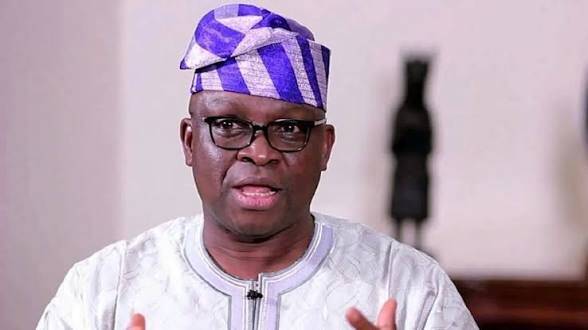
Ayodele Fayose, the former Ekiti State governor who was inaugurated on Friday as Chairman of the Governing Board of the Rural Electrification Agency (REA), has ignited a fierce national conversation with his blunt assessment of how chronic power shortages are reshaping family life in off-grid communities. Speaking in Abuja moments after receiving his appointment from Power Minister Joseph Tegbe, Fayose declared that the lack of electricity leaves rural residents with little choice but to retreat indoors after sunset, a reality he claims has effectively doubled population growth across the country.
“Why don’t you address this issue of electricity? The people at that level have no alternative attraction. Nothing else matters to them,” Fayose said in remarks that were later broadcast by ARISE News. “After 7 o’clock, it gets dark there. Everybody is engaging their wives. And the population simply becomes double. The simple problem is because there is a lack of electricity.” The new REA chairman argued that rural communities without reliable power become inactive after nightfall, leaving couples with limited options for evening recreation. He maintained that providing electricity would transform these dynamics entirely. “People go to bed early. Their mind is simply prepared that, well, if this is the only available recreation, let me remain here,” Fayose explained. “But when we address this electricity, there will be nightlife. There will be recreation outside your wife.”
The comments, delivered with characteristic bluntness by the outspoken politician, have drawn both criticism and support across Nigeria’s media landscape. Some social commentators dismissed the remarks as an oversimplification of a deeply complex demographic challenge. Others, however, acknowledged the uncomfortable truth at the heart of his observation: in communities where economic opportunities are scarce and entertainment options nonexistent after dark, large families remain a cultural and practical reality. The debate comes at a time when Nigeria’s population is surging at an extraordinary rate. According to the latest United Nations data compiled by Worldometer, Nigeria’s population is estimated at 237.5 million as of mid-2025, with projections suggesting the figure will cross 242.4 million by 2026. The World Bank estimated the country’s annual population growth rate at approximately 2.1 per cent in 2025, a pace that adds the equivalent of a mid-sized nation to the population every year. With a birth rate of 35.34 per 1,000 people in 2025 and a total fertility rate of 4.28 children per woman, Nigeria remains the most populous country in Africa and the sixth most populous in the world.
Against this backdrop, Fayose’s remarks have taken on a significance that extends beyond mere political provocation. They underscore the profound social consequences of Nigeria’s electricity crisis, which remains one of the most persistent challenges facing Africa’s largest economy. Despite installed capacity of approximately 13,625 megawatts, the country generates only a fraction of that, leaving an estimated 70 to 90 million Nigerians without access to reliable electricity. Only about 55 per cent of Nigerians have access to the national grid, and over 80 million people remain entirely off-grid. The electrification rate is growing at just 1.1 per cent annually, far slower than the population growth rate of approximately 3 per cent, meaning the electricity access deficit is actually widening. According to energy analysts, Nigeria requires between 30,000 and 100,000 megawatts of generated power to sustain a stable electricity supply nationwide, a target that remains distant given current infrastructure and investment levels.
Fayose’s appointment itself has been a subject of considerable controversy. The former governor, a prominent chieftain of the Peoples Democratic Party (PDP), had repeatedly insisted he would never accept any position under the administration of President Bola Tinubu of the All Progressives Congress (APC). His decision to accept the REA chairmanship sparked widespread debate, with his younger brother, businessman Isaac Fayose, publicly urging him to reject what he described as a disrespectful offer that did not reflect his political standing. Despite the familial opposition, Fayose was inaugurated alongside other board members, including Ahmadu Abubakar, Ilyasu Makinta, and three non-executive directors, while Abba Aliyu was formally installed as the agency’s Managing Director. Speaking after the ceremony, Fayose thanked President Tinubu for the confidence reposed in him and pledged to mobilise the political will required to expand electricity access across underserved communities. “Work has started in earnest; we are reaching out very fast and appealing to people to ensure the work is done,” he said. “I want to use this window to assure Nigerians that your expectation about my appointment and my colleagues will not be dashed.”
Minister of Power Joseph Tegbe, who administered the oath of office, framed the REA’s mandate in expansive terms, describing the agency as a bridge between national electricity policy and grassroots development. “We are moving from just counting kilowatts and megawatts to how many communities and people were powered in the country,” Tegbe said. “Every mini-grid inaugurated, every solar home system deployed, every market, school, primary healthcare centre, farm, or productive enterprise electrified represents an investment in human capital, economic inclusion, and national prosperity.” The REA has already deployed over 200 mini-grids across underserved communities in 2025 as part of the Nigeria Electrification Project, with plans to expand to 1,350 mini-grids nationwide. The agency has signed over 30 grant agreements covering more than 390 communities, accelerating off-grid energy deployment across rural Nigeria.
Yet for millions of Nigerians living without power, these efforts remain distant promises. Fayose’s provocative framing of the population challenge has at least succeeded in focusing national attention on the human dimension of the electricity crisis. Whether his prescription—that electrification will naturally curb population growth by providing alternative recreations—holds up to demographic scrutiny remains an open question. What is undeniable, however, is that Nigeria’s energy deficit and its demographic trajectory are intertwined in ways that demand urgent, sustained intervention. As Fayose himself put it, the agency’s responsibility extends beyond simply supplying power to ensuring that the growing population actually feels the impact of energy access. For now, his words have ensured that the conversation about Nigeria’s future will be conducted not in darkness, but in the full glare of public debate.
📩 Stone Reporters News | 🌍 stonereportersnews.com
✉️ info@stonereportersnews.com | 📘 Facebook: Stone Reporters News | 🐦 X (Twitter): @StoneReportNew | 📸 Instagram: @stonereportersnews
Add comment
Comments