

Reported by: Ijeoma G | Edited by: Oravbiere Osayomore Promise.
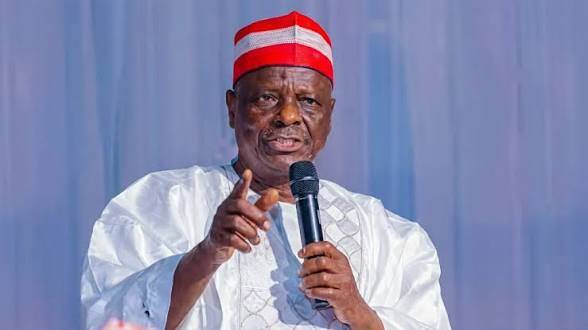
A fierce political and religious storm has erupted in Nigeria after former Kano State Governor and Vice Presidential candidate of the Nigeria Democratic Congress (NDC), Senator Rabiu Musa Kwankwaso, forcefully rejected comments by prominent Islamic cleric Sheikh Sani Yahaya Jingir, who had advocated for a continued Muslim-Muslim presidential ticket ahead of the 2027 general elections while referring to Christians as “infidels.” Kwankwaso, in a statement posted on his official X (formerly Twitter) account on Monday, August 10, 2026, described Jingir’s rhetoric as deeply divisive and insisted that the people of Kano State do not endorse such inflammatory remarks.
The controversy erupted over the weekend when a video surfaced showing Jingir speaking at a political gathering in Kano that was attended by some All Progressives Congress (APC) governors, including Kano State Governor Abba Yusuf and his Jigawa State counterpart, Umar Namadi. In the video, the cleric praised President Bola Tinubu for adopting the Muslim-Muslim ticket in the 2023 presidential election and declared his unwavering support for the arrangement. He also urged Muslims to obtain their Permanent Voter Cards ahead of the 2027 elections, claiming that Christians were lying about being more populous and calling on his followers to “show the infidels their limit.”
Kwankwaso, who is widely regarded as one of the most influential political figures from northern Nigeria, did not mince words in his response. “I am deeply concerned by the comments made by Sheikh Sani Yahaya Jingir at an event in Kano this weekend. At this critical moment in our nation’s history, statements that promote division and disunity must be firmly discouraged,” he said. The former governor expressed particular dismay that such rhetoric came from a religious leader of Jingir’s stature and influence. He then delivered a sharp rebuke: “Let it be clearly stated: the good people of Kano do not endorse or support these divisive remarks.”
Kwankwaso’s condemnation extended beyond Jingir’s specific comments to the broader issue of using religion as a political weapon. He urged political and religious leaders across the country to exercise responsibility in their public statements, stressing the need to promote truth, unity and reconciliation rather than utterances capable of undermining the very foundation of Nigeria’s nationhood. “Political and religious leaders alike carry a solemn responsibility to uphold truth, foster unity, and advance reconciliation,” he said. He added that “we must not lend our voices to utterances capable of undermining the very foundation of our nationhood.”
The former governor also linked the controversy to the broader political landscape ahead of the 2027 elections. He said Nigerians would have the opportunity at the polls to assess the performance of the current administration and determine its fate. “The 2027 general elections will be an opportunity for Nigerians to reward good governance with resounding support and to reject poor performance at the polls. This administration has earned the latter,” Kwankwaso declared. This pointed remark was widely interpreted as a direct critique of President Tinubu’s APC-led government, which Kwankwaso believes has failed to deliver on its promises.
Kwankwaso’s rejection of Jingir’s stance did not occur in isolation. The cleric’s comments have drawn widespread condemnation from across the religious and political spectrum. The Chairman of the Northern Christian Association, Rev. Joseph Hayab, accused Jingir of exposing what he described as the “pretence” surrounding claims of religious persecution in Nigeria. Human rights lawyer Deji Adeyanju also warned that such rhetoric could deepen religious divisions and threaten national unity. The Nigerian Bar Association and several civil society groups have similarly called for restraint and urged security agencies to investigate the cleric’s statements for potential incitement.
The Muslim-Muslim ticket has been a contentious issue in Nigerian politics since President Tinubu and Vice President Kashim Shettima, both Muslims, ran on the same ticket in the 2023 presidential election. While the ticket won the election, it violated the country’s unwritten policy of religious balance in presidential tickets and drew sharp criticism from Christian leaders who argued it was insensitive to the country’s religious diversity. The debate has resurfaced with renewed intensity ahead of the 2027 elections, and Jingir’s latest comments have only deepened the polarisation.
Kwankwaso’s decision to publicly distance himself and the people of Kano from Jingir’s rhetoric is significant. As a former governor of Kano State and a presidential candidate in 2023, Kwankwaso commands a substantial political following in the North-West. His rejection of the Muslim-Muslim ticket push signals a potential realignment of political forces in the region, where religious identity has often been a decisive factor in electoral outcomes. It also places him at odds with the APC leadership in Kano, including Governor Abba Yusuf, who was present at the event where Jingir made his remarks.
The controversy underscores the fragility of Nigeria’s religious coexistence and the high stakes of the coming electoral cycle. With the 2027 elections approaching, political actors are increasingly deploying religious and ethnic rhetoric to mobilise support, raising concerns about the potential for violence and further polarisation. Kwankwaso’s call for unity and his insistence that Kano does not support divisive remarks offer a counter-narrative to the growing religious tensions. However, whether his voice will be enough to temper the rising tide of religious nationalism remains to be seen. For now, the former governor has drawn a clear line: in the battle for Nigeria’s soul, there is no room for those who seek to divide the nation along religious lines.
📩 Stone Reporters News | 🌍 stonereportersnews.com
✉️ info@stonereportersnews.com | 📘 Facebook: Stone Reporters News | 🐦 X (Twitter): @StoneReportNew | 📸 Instagram: @stonereportersnews
Add comment
Comments