

Reported by: Ijeoma G | Edited by: Oravbiere Osayomore Promise.
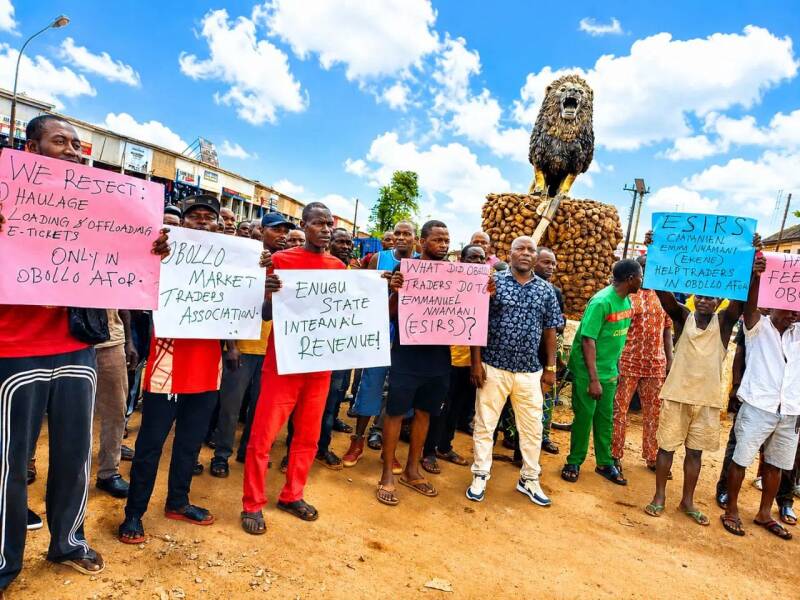
The bustling Obollo-Afor Market in Udenu Local Government Area of Enugu State ground to a halt on Wednesday, August 12, 2026, as traders downed tools and marched to the local government secretariat in protest against what they described as a targeted and unfair haulage levy. The traders, who carried placards with various inscriptions, alleged that the Enugu State Internal Revenue Service (ESIRS) had singled out Obollo-Afor for the collection of a N25,000 haulage levy on trucks loading and offloading goods at the market – a charge they claim is not being imposed at any other market in the state.
The protest, which disrupted commercial activities across the market, has exposed a growing chasm between Governor Peter Mbah's promise of a business-friendly environment and the lived reality of traders who say they are being strangled by selective taxation. According to the traders, the levy has effectively driven truck operators away from Obollo-Afor, forcing them to divert their consignments to Orba, Enugu-Ezike, Nsukka and Orie-Igboeze, where similar charges are not being collected. “The truck owners have diverted our goods to Orba, Enugu-Ezike, Nsukka and Orie-Igboeze, asking us to come and pick our goods there because they don't pay such levies there except in Obollo-Afor,” lamented the Chairman of the Obollo-Afor Market Traders Association, Mr Charles Eze. “We are asking, why Obollo alone?”
The selective enforcement of the haulage levy raises uncomfortable questions about the Mbah administration's commitment to fiscal fairness. While the ESIRS Chairman, Mr Emmanuel Nnamani, has insisted that the levy applies strictly to truck drivers operating on interstate routes and not to traders buying or selling goods, the traders argue that the distinction is meaningless when the practical effect is to cripple their market while leaving others untouched. The traders have appealed to Governor Peter Mbah to intervene, stressing that they are not opposed to paying legitimate taxes and levies, but are demanding equal treatment. “We are not saying that we won't pay levies, but let it be fees that are equally obtained in other places,” Eze said. “We are ready to pay any amount of levy that is obtained in Akwata, Ogbete, Nsukka, Orba or in any other market in the state, but let Obollo-Afor not be an exception or singled out for selective taxation”.
The protest has also cast a shadow over the government's much-touted e-ticketing system, which the traders claim they have been complying with. The selective haulage levy appears to contradict the spirit of the e-ticketing initiative, which was designed to streamline revenue collection and eliminate multiple taxation. Instead, the traders find themselves caught between a government that promises reform and a revenue service that appears to be operating with impunity. The development has been met with anger and frustration among market leaders, including Chief James Odo of the Foodstuff Dealers Association and Chief Damian Nwodo of the Electrical and Electronics Dealers Association, who have expressed concern over the impact of the levy on their businesses.
The protest comes just months after Governor Mbah's market monitoring team arrested two suspected illegal tax collectors at Obollo-Afor Market in January 2026. That crackdown was hailed as a victory against multiple taxation. Yet, traders now find themselves facing what they see as a state-sanctioned levy that is just as punitive and selective. The irony is not lost on the traders, who accuse the government of replacing one form of exploitation with another.
The government's response has been characteristically slow and evasive. The Secretary of the Udenu Local Government Council, Mr Chika Aroh, said a meeting had been scheduled with ESIRS representatives to clarify whether the levy was being collected only in Obollo-Afor, promising to communicate the findings to the traders after the meeting. “But for now, we will tell them to stop the collection. After the Thursday meeting, we will communicate with you. Our promise is that we will remedy the matter,” Aroh said. But for traders who have seen their businesses crumble over the past two months, promises are no longer enough. They have already watched their customers drift to other markets, their livelihoods slipping away with every truck that refuses to come to Obollo-Afor.
The Obollo-Afor market protest is not just about a N25,000 levy; it is about a pattern of neglect and selective enforcement that has become the hallmark of the Mbah administration. The traders have made their position clear: they are willing to pay their fair share, but they will not be singled out for punishment. Whether the government will listen or continue to ignore the cries of its citizens remains to be seen. But one thing is certain: the silence from the Governor's office is speaking louder than any protest.
📩 Stone Reporters News | 🌍 stonereportersnews.com
✉️ info@stonereportersnews.com | 📘 Facebook: Stone Reporters News | 🐦 X (Twitter): @StoneReportNew | 📸 Instagram: @stonereportersnews
Add comment
Comments