

Published by Osasere Edomwonyi Ikpoba
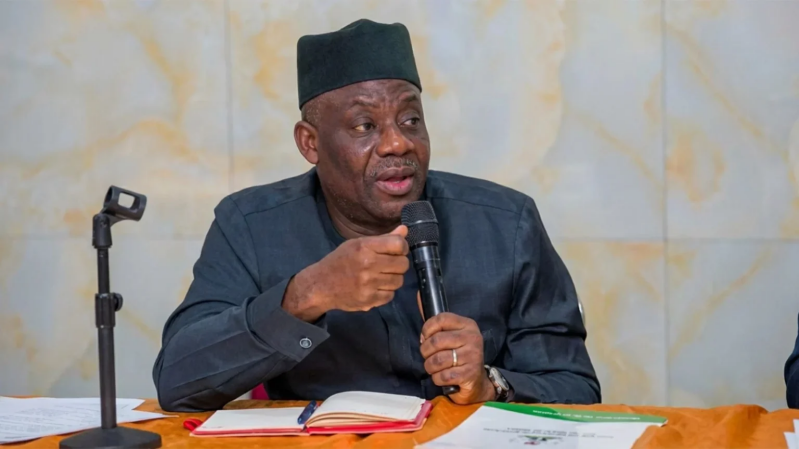
The Minister of Education, Dr Tunji Alausa, has delivered a stunning indictment of Nigeria’s examination system, revealing that National Examinations Council (NECO) question papers were routinely sold for as little as N3,000 before tests were conducted, in a racket so deeply entrenched that it had acquired its own code name within the education sector. Alausa made the revelation on Thursday at a meeting with the National Association of Proprietors of Private Schools and other stakeholders in the education sector, where he warned parents, teachers, proprietors, principals, invigilators and students against practices capable of undermining the integrity of public examinations.
The minister described the level of examination malpractice in the country as “mind-boggling,” recounting how the problem had been tolerated for years, creating an unfair system in which students who prepared genuinely for examinations were disadvantaged by those who gained access to leaked questions. According to him, the situation was particularly dangerous because it could push honest students into malpractice as they sought to compete with candidates who had access to examination materials before the tests. “It’s sad. Before she and I came, the acceptance of examination malpractice, cheating and examination leakages in this country was mind-boggling, and the country accepted it. It was a nightmare,” Alausa said, adding that the “danger was that the good students would also become bad”.
In one of the most striking disclosures, Alausa alleged that examination questions had previously been made available for sale before candidates sat for the examinations, and that the practice had acquired a name—Wushishi—which he said referred to a dark website where the papers were traded. “The Registrar of NECO at the time had a name. His name was Wushishi. You would go to Wushishi… I didn’t know that Wushishi meant going to the dark website. They bought his question for N3,000. That was it. Before the examination. They called him Wushishi and bought the questions for N3,000 before the examination,” Alausa said. The minister’s reference to Wushishi—a name that appears to have been a codeword for the illicit trade—suggests that the malpractice was not only widespread but also organised, with a dedicated infrastructure for the distribution of leaked materials.
Alausa also recalled his experience during the 2025 examination period, saying he was regularly sent examination questions allegedly obtained before candidates sat for the papers. He said the development forced officials to verify the questions with examination authorities, sometimes confirming that the questions being circulated were actually the ones scheduled for the day. “During that examination period, during the hardest time of my life, I was always worried, waking up. I would wake up to her text. She would send questions to me… She would say, ‘I just got this question.’ It could be English or Chemistry. I was always waking up with trepidation every morning, doing work. I would send it to the HNO and ask, ‘HNO, is this correct?’ And the answer I got was, ‘Unfortunately, that’s the question we’re doing today’,” Alausa recounted.
The minister said the revelations demonstrated that examination malpractice was not simply a student problem, insisting that the wider education ecosystem must take responsibility for curbing the practice. He noted that parents, schools, teachers, invigilators and principals all had roles to play in preventing candidates from gaining unfair access to examination materials. “You might be in that isolated school, but the school system is also involved. In fact, I don’t blame the students that much. Any child can be bad. But when we have an ecosystem where parents, schools, teachers, invigilators and principals are in full connivance, the students are the smallest players. The people who should put the deterrents in place are the ones involved,” Alausa said.
The disclosure comes as a dramatic reversal from the minister’s previous public statements. In June 2026, Alausa had announced that the Federal Government had successfully eliminated examination question leakages in both WAEC and NECO examinations through comprehensive education reforms. At the time, he had confidently declared that “the pervasive cheating that characterised” the examinations had been stopped. The revelation that NECO papers were being sold for N3,000 as recently as the 2025 examination cycle suggests that the reforms may not have been as effective as initially claimed, or that the malpractice was far more entrenched than previously acknowledged.
The minister’s comments also align with investigations conducted by the News Agency of Nigeria during the 2025 NECO examinations, which observed that dedicated WhatsApp channels had become marketplaces for leaked exam content, with questions being sold for as little as N500 to N3,500 via fintech platforms, reaching candidates across different states. The persistence of these practices, despite government intervention, has raised serious questions about the effectiveness of measures to curb examination malpractice and the complicity of actors within the education system.
Alausa warned that the Federal Government would strengthen measures to protect the integrity of public examinations and ensure that academic qualifications reflected genuine learning and merit. However, his own testimony—of a system where a codeword like Wushishi could mask a thriving black market in examination papers—suggests that the battle against examination malpractice is far from won. The minister’s decision to speak publicly about the scale of the problem may signal a new phase in the government’s approach, one that acknowledges the depth of the crisis before attempting to solve it. For millions of Nigerian students who sit for NECO examinations each year, the question remains: will the next examination cycle be different, or will the Wushishi network continue to thrive?
📩 Stone Reporters News | 🌍 stonereportersnews.com
✉️ info@stonereportersnews.com | 📘 Facebook: Stone Reporters News | 🐦 X (Twitter): @StoneReportNew | 📸 Instagram: @stonereportersnews
Add comment
Comments