

Published by Osasere Edomwonyi Ikpoba
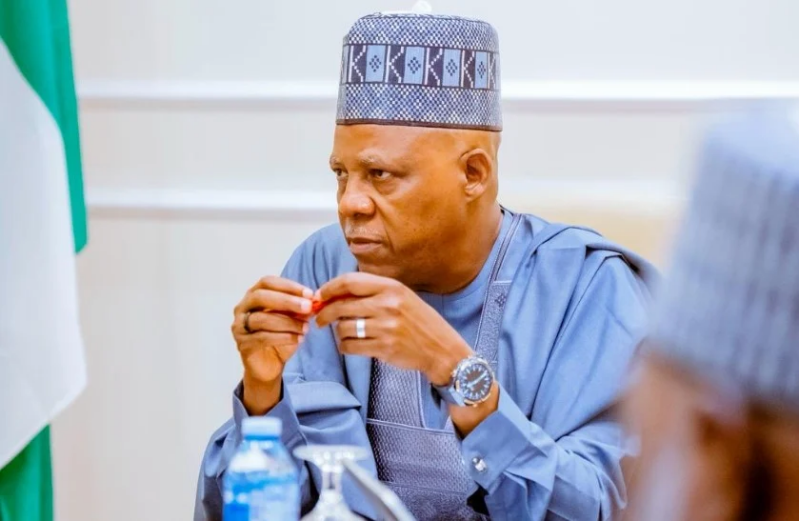
Vice President Kashim Shettima assumed office as Governor of Borno State at the absolute zenith of the Boko Haram insurgency, inheriting a landscape of devastation that would have broken lesser leaders, yet chose the audacity of reconstruction over despair. This was the essence of a stirring tribute delivered on Thursday by Professor Abubakar Sulaiman, former Minister of National Planning and Director-General of the National Institute for Legislative and Democratic Studies (NILDS), to mark Shettima's 60th birthday.
In a statement issued in Abuja, Sulaiman reflected on a journey he described as one of "preparation meeting providence," tracing Shettima's rise from the banking sector through public administration, eight years as governor, a stint in the Senate, and ultimately to the Vice Presidency in 2023. But it was the governor's tenure that formed the emotional core of the tribute. "Shettima inherited a Borno State facing one of the gravest security crises in its history," Sulaiman said. "The Boko Haram insurgency was tearing through communities and disrupting the foundations of social life".
The timing of Shettima's ascension could not have been more perilous. When he took the oath of office on May 29, 2011, the insurgent group was already "well domiciled in Maiduguri" and on the ascendancy. The sect had stepped up bomb and drive-by shootings in the state capital, and Shettima's first months in office were consumed by frantic efforts to restore a semblance of order. He offered amnesty to the insurgents if they laid down their arms, convened emergency security meetings with service chiefs, and appealed for dialogue even as the bloodshed mounted. Yet the violence only intensified, metastasizing into a full-blown insurgency that would kill tens of thousands and displace millions across the North-East.
What makes Shettima's governorship remarkable, Sulaiman argued, was his refusal to allow the circumstances to define the state's destiny. "In the face of devastation, he chose the audacity of reconstruction," the former minister declared. "Schools were built. Healthcare facilities were developed. Agriculture received attention. That decision to continue investing in the future in the middle of crisis remains one of the most compelling aspects of his years in Borno". Shettima himself once lamented that Boko Haram had set Borno back by 50 years, but rather than surrender to that grim calculus, his administration pushed forward with a Ministry of Reconstruction, Rehabilitation and Resettlement to rebuild towns and villages razed by the insurgents. In a striking act of leadership, he even relocated to Bama—one of the communities worst hit—to personally supervise reconstruction efforts.
Those who witnessed Shettima's tenure firsthand recall a governor who wore the weight of his people's suffering on his sleeve. In January 2019, during an interactive session with President Muhammadu Buhari at the Presidential Villa, Shettima broke down in tears as he recounted the devastation wrought on his state. The image of a governor weeping for his people became a defining moment of his leadership, humanizing a crisis that had become numbing in its scale.
Yet Shettima's record is not without its complexities and detractors. His predecessor, Ali Modu Sheriff, who governed Borno from 2003 to 2011, has been embroiled in a bitter war of words with Shettima over the origins of the insurgency. Shettima has blamed Sheriff for mishandling the crisis and allowing Boko Haram's late leader, Mohammed Yusuf, the opening to declare jihad. Sheriff, for his part, has denied claims that he accused Shettima of creating Boko Haram, dismissing such reports as politically motivated fabrications. The acrimony underscores the deep political divisions that have shadowed the conflict, with both men trading accusations over who bears greater responsibility for the catastrophe.
Sulaiman's tribute, however, was not an exercise in score-settling but a celebration of resilience. The former minister, whose own 60th birthday was marked by Shettima's presence in 2025, spoke of a leader whose brand of leadership showed how "mentorship and vision could strengthen governance and national development". "There are birthdays that are marked with celebration, and there are birthdays that invite reflection. The 60th birthday of Vice President Kashim Shettima belongs to both," Sulaiman wrote. It was a moment to contemplate a journey defined by preparation meeting opportunity—a banker who became a wartime governor, a senator who rose to the second-highest office in the land.
The tribute has been echoed by a chorus of political leaders. President Bola Tinubu hailed Shettima as a "trusted ally and valued colleague", while Northern governors praised his service to the nation. The commendations reflect the respect Shettima commands across the political spectrum, even as the scars of the insurgency he confronted remain visible across the North-East.
For the people of Borno, Shettima's governorship remains a subject of enduring debate. Some credit him with laying the groundwork for the relative stability that his successor, Professor Babagana Zulum, has built upon. Others argue that the insurgency's root causes—poverty, illiteracy, and neglect—were never adequately addressed. What is undeniable is that Shettima governed at a time when the very existence of Borno as a functional state was under threat, and he chose to rebuild rather than retreat.
As Vice President, Shettima has continued to engage with the security challenges facing his home region. In March 2026, he visited victims of Boko Haram suicide bombings in Maiduguri that killed 23 people, vowing that those behind the attacks would be decisively confronted. His commitment to the North-East has remained unwavering, a testament to a leader forged in the crucible of crisis.
At 60, Kashim Shettima stands as a symbol of resilience in the face of terror—a man who took the helm of a drowning state and refused to let it sink. As Sulaiman put it, "He chose the audacity of reconstruction". In a region that has known too much destruction, that choice may be his most enduring legacy.
📩 Stone Reporters News | 🌍 stonereportersnews.com
✉️ info@stonereportersnews.com | 📘 Facebook: Stone Reporters News | 🐦 X (Twitter): @StoneReportNew | 📸 Instagram: @stonereportersnews
Add comment
Comments