

Published by Osasere Edomwonyi Ikpoba
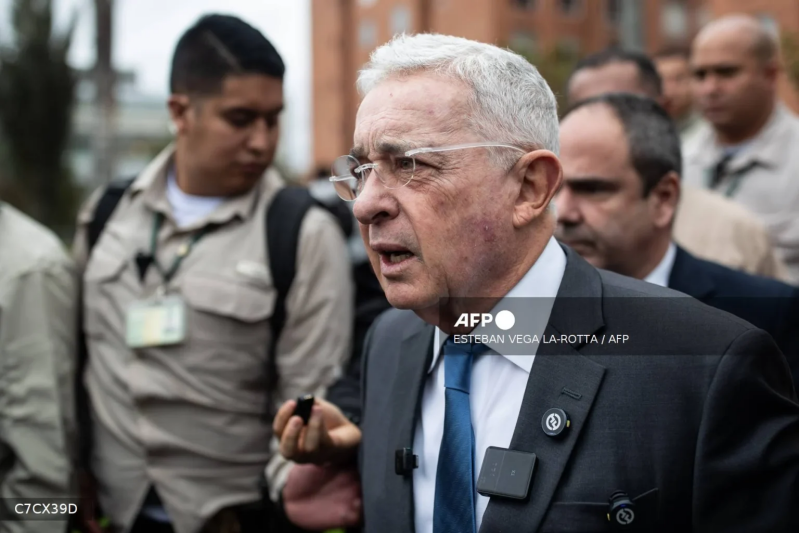
Former Colombian President Álvaro Uribe Vélez has forcefully denied any responsibility for two notorious paramilitary massacres and the killing of a human rights defender in the 1990s, declaring on Friday that he is "not a murderer" as he prepared to face prosecutors in a landmark hearing that could reshape the country's understanding of one of its darkest chapters. The 74-year-old right-wing leader, who governed Colombia between 2002 and 2010 and oversaw a brutal offensive against leftist guerrillas, appeared before the Attorney General's Office in Bogotá to give his account of the paramilitary massacres that occurred in the villages of El Aro in 1997 and La Granja in 1996, when he served as governor of the violence-ravaged Antioquia region.
Surrounded by a heavy security detail of escorts and shields, Uribe told reporters outside the judicial complex: "I thought I had served the nation, but today I come to say that I have not been a murderer". He insisted the investigation was politically motivated, accusing his "adversaries" of waging a campaign of persecution against him. The judicial proceeding went ahead after the Attorney General's Office rejected multiple requests from Uribe's defense team to postpone the hearing, marking a formal procedural step that could determine whether the case proceeds to trial or is dismissed.
The massacres in question devastated rural Antioquia during some of the worst years of Colombia's decades-long armed conflict. In La Granja, on June 11, 1996, approximately 30 members of the Peasant Self-Defense Forces of Cordoba and Uraba entered the township, executed four peasants accused of collaborating with guerrillas, and forced dozens of families to flee. The El Aro massacre, carried out between October 22 and 31, 1997, by paramilitaries of the Miners' Block, was even more brutal. Over more than a week of terror, the far-right forces massacred 15 peasants and Indigenous people, tortured several victims, burned most of the homes in the hamlet, and stole more than 1,000 cattle, triggering a mass exodus and a humanitarian crisis. Victims and witnesses have long testified that a helicopter from the Antioquia governor's office, then headed by Uribe, flew over the area for days during the El Aro massacre, providing cover and protection to the paramilitaries.
Uribe is also being investigated for the 1998 murder of Jesús María Valle, a prominent human rights defender and lawyer who was shot dead in Medellín after publicly denouncing the massacres and exposing the links between state security forces, the Antioquia governor's office, and paramilitary groups. Valle's killing was later condemned by the Inter-American Court of Human Rights, which also found the Colombian state culpable for omission in the massacres.
The investigation has been bolstered by testimony from former paramilitary commanders, including Salvatore Mancuso, the ex-leader of the United Self-Defense Forces of Colombia. Mancuso testified on Thursday that he could not confirm that Uribe had ordered, suggested, or backed the El Aro incursion, stating: "It does not appear to me that it came directly from that gentleman, Governor Uribe". Despite this, prosecutors have gathered significant evidence, accusing Uribe of "facilitating and promoting" paramilitary action in the region. His family ranch, "Las Guacharacas," has been identified as an operational base for the groups. The Attorney General's Office is also investigating Uribe's connection to the formation of a paramilitary structure headquartered at the ranch during the 1990s.
Uribe's legal troubles extend beyond the current investigation. In August 2025, he was sentenced to 12 years of house arrest for bribing imprisoned paramilitaries to prevent them from linking him to their ultra-right squads, though a Bogotá tribunal later overturned the conviction. His brother, Santiago Uribe, was sentenced last year to 28 years in prison for leading a paramilitary squad known as "The 12 Apostles".
For decades, victims and their families have demanded justice for the atrocities committed in El Aro and La Granja. Uribe's defense team has repeatedly attempted to delay or suspend the investigation, but Friday's hearing represents a significant step forward in holding one of Colombia's most powerful political figures accountable. As prosecutors weigh the evidence and Uribe exercises his right to defense under Colombia's justice system, the nation watches closely, awaiting a resolution that could finally address the lingering wounds of a conflict that has haunted the country for generations.
📩 Stone Reporters News | 🌍 stonereportersnews.com
✉️ info@stonereportersnews.com | 📘 Facebook: Stone Reporters News | 🐦 X (Twitter): @StoneReportNew | 📸 Instagram: @stonereportersnews
Add comment
Comments