

Reported by Ariajegbe Sylvia Esezobor
The Central Bank of Nigeria and the Federal Ministry of Finance signed a Memorandum of Understanding on Friday in Abuja to institutionalise coordination between fiscal and monetary authorities, formalising a relationship that has operated for decades largely on the basis of established practice rather than a defined framework.
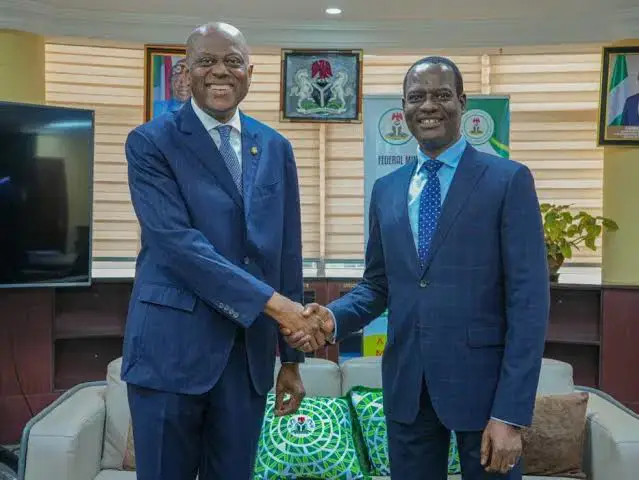
The agreement was signed by the CBN Governor, Olayemi Cardoso, on behalf of the apex bank and the Minister of Finance and Coordinating Minister of the Economy, Taiwo Oyedele, on behalf of the ministry. The MoU provides a structured framework for regular consultation, information exchange and coordinated policy assessments between the two institutions. It will strengthen collaboration in critical areas including government cash management, debt issuance planning, liquidity forecasting, macroeconomic analysis and periodic policy consultations.
Cardoso said the MoU did not establish a new relationship between the CBN and the Ministry of Finance, noting that both institutions had worked together for decades on inflation management, debt sustainability, budget financing, exchange rate stability and responses to economic shocks. “This memorandum provides a structured framework for regular consultation, information exchange and policy coordination,” he said. “It transforms a relationship built on practice into one anchored by clear processes and enduring institutional commitment”.
The CBN governor described the timing of the agreement as particularly noteworthy as the bank advances its transition towards an inflation-targeting framework. He said the success of inflation targeting rests not only on the effectiveness of monetary policy but also on the existence of a supportive fiscal environment. The MoU will provide the foundation for developing the operational framework that will guide its implementation.
Oyedele said the agreement was designed to ensure that coordination between fiscal and monetary authorities is based on clear structures, data and accountability rather than the personalities occupying key offices. “Good economic management requires independent institutions, but independence does not mean isolation. Fiscal and monetary authorities have distinct mandates, but we serve the same economy,” he said. “Government borrowing affects liquidity and interest rates. Monetary policy affects the government's financing costs. Tariffs and exchange rates affect prices and revenue. Spending affects demand. Agricultural productivity affects food inflation. So our mandates are distinct, but our outcomes are interconnected”.
The minister stressed that coordination would not compromise the operational independence of the CBN. “This is independence with coordination. The operational independence of the central bank remains sacrosanct,” he said. He also disclosed that the government was targeting a sustainable reduction in inflation to single digits, arguing that monetary policy alone could not address Nigeria's inflation problem. “Our objective is to bring inflation sustainably into single digits and keep it there, and that cannot be monetary policy's job alone. Fiscal policy must play its part: disciplined, disinflationary spending; sound cash and liquidity management; efficient financing that does not crowd out the private sector”.
Oyedele identified food, imported costs, energy and logistics as structural drivers of inflation, saying the government would pursue stronger grain reserves, improved agricultural yields, irrigation and farm-access roads. He also ruled out a return to fuel subsidy, warning that reversing the policy could destabilise public finances and the naira. “A return to subsidy would create a fiscal collapse, pressure the naira, and ultimately undermine the price affordability it seeks to provide”.
Under the framework, the ministry and the CBN will share data on government cash positions, financing plans, credit growth and foreign-exchange flows more efficiently. The government is working with the National Bureau of Statistics to expand the information available for policy decisions, including a producer price index alongside the consumer price index, as well as employment and productivity data. “We cannot manage this economy well on incomplete, delayed or outdated data,” Oyedele said.
The MoU is the latest step in a broader effort to strengthen Nigeria's macroeconomic management framework. The CBN has set a medium-term inflation target of 6 to 9 per cent as it accelerates its transition to a full inflation-targeting regime, with a phased plan targeting 16.5 per cent inflation in 2026 and 13 per cent in 2027. The bank expects to conclude the transition by 2028.
The coordination framework builds on existing structures including the Economic Management Team and the National Economic Council. The NEC, chaired by Vice President Kashim Shettima, has repeatedly urged unity in the drive to build a one-trillion-dollar economy and called for no policy reversals ahead of the 2027 elections. The CBN Deputy Governor, Corporate Services Directorate, Muhammad Abdullahi, said the MoU had become more important amid global economic uncertainty and geopolitical tensions. He cited developments in the Middle East, noting that disruptions to energy and shipping routes could simultaneously affect oil prices, government revenue, inflation, capital flows and financing conditions. “This is why coordination matters. Coordination does not mean blurring respective mandates or compromising the independence of the central bank,” he said.
Nigeria's macroeconomic indicators have shown improvement in recent months. Gross foreign exchange reserves rose by 12.76 billion dollars year-on-year to 54.61 billion dollars as of September 14, 2026, strengthening the country's external liquidity position. The country recorded a balance-of-payments surplus of more than five billion dollars in 2025, while non-oil exports outpaced oil exports in the third quarter of 2026 for the first time. Inflation has declined from 34.8 per cent in December 2024 to around 15 per cent in early 2026.
The challenge ahead lies in translating these gains into tangible improvements for Nigerian households. The CBN's Monetary Policy Rate remained at 26.5 per cent as of May 2026, reflecting the bank's cautious stance as it navigates the transition to inflation targeting. The government's stated goal goes beyond short-term portfolio flows to attracting long-term investment in infrastructure, technology and job creation. “Capital follows trust before returns,” Oyedele said. “That is why policy consistency matters”. The MoU is designed to provide that consistency, by embedding coordination in institutional processes that outlast individual officeholders. Whether it delivers on that promise will be measured in the inflation figures, borrowing costs and investment flows of the coming years.
📩 Stone Reporters News | 🌍 stonereportersnews.com
✉️ info@stonereportersnews.com | 📘 Facebook: Stone Reporters News | 🐦 X (Twitter): @StoneReportNew | 📸 Instagram: @stonereportersnews
Add comment
Comments