

Reported by Ariajegbe Sylvia Esezobor
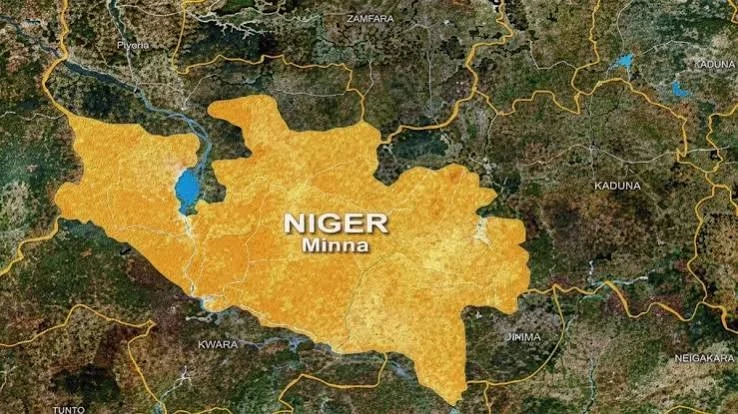
A surviving suspected illegal miner detained by the Nigeria Security and Civil Defence Corps in Niger State has alleged that an unidentified substance was sprayed inside an overcrowded cell shortly before detainees began collapsing, adding a disturbing new dimension to an incident that has already claimed 37 lives and triggered violent protests across Minna. The survivor, who spoke in Hausa during a televised address on Friday, told Governor Mohammed Umaru Bago and Interior Minister Olubunmi Tunji-Ojo that seventeen people were initially held in the cell before more detainees were brought in. He said the detainees complained that the room was too small and hot, but more people were subsequently added. “They locked us in a very small room. We were 17 in number. Then they added more people. And we started complaining that the room was small. The room was very hot,” he said. According to the survivor, the detainees were later ordered to stand up as the officers prepared to lock the room. He alleged that a substance that looked like perfume was then sprayed inside the cell. “As they were about to lock the room, they sprayed something that looked like perfume, and the smell started disturbing everyone in the room, and that’s how people started falling down,” he said. The survivor further alleged that the heat inside the cell became unbearable and that the detainees pleaded for water. “The room became extremely hot. We pleaded with them to give us water, but they said no one would open the door for us that same night,” he said.
The allegation, first reported by Channels Television and subsequently carried by several Nigerian newspapers, has intensified scrutiny of the deaths and deepened the crisis facing the NSCDC. The miners were arrested during enforcement operations in the M.I. Wushishi and Lukoto areas of Minna on September 15 and 16, 2026. They were held in a cell at the NSCDC facility before their bodies were discovered in the early hours of Thursday, September 17. Governor Bago confirmed on Friday that 67 artisanal and suspected illegal miners had been detained in the cell before 37 died. The NSCDC initially attributed the deaths to a suspected outbreak of diphtheria, a claim that was met with immediate scepticism from survivors and their families. The agency later said the exact cause of death had not been established and that medical and laboratory examinations would determine what happened.
The survivor’s account directly contradicts the disease explanation. If a substance was sprayed into the cell and detainees began collapsing shortly afterwards, the deaths may have resulted from acute exposure to a toxic chemical rather than an infectious disease. Governor Bago said authorities were investigating two primary possibilities: suffocation from overcrowding and exposure to hazardous substances associated with mining activities. He disclosed that preliminary forensic findings indicated the presence of foam mixed with bloodstains in the mouths of some victims and peeling skin, raising questions about possible exposure to methane, cyanide, or lead poisoning. Experts had been deployed to examine the possibility of radiological exposure at the mining site. “Even at times of war, if you kill 37 people, it is not a small number,” Bago said. “So there is need for us to expedite action in the autopsies that are being done, in the samples that are being taken at the scene and also by the Nigerian Security and Civil Defence Corps on the actions of their men who made the arrest.”
The federal government has responded with a multi-layered investigation. President Bola Tinubu ordered a full and transparent probe into the circumstances of the arrests, the condition of the detainees, the conditions under which they were detained, the number of persons held in the facility, the medical attention provided, and the events leading to their deaths. He directed that any official found to have contributed to the tragedy through negligence, abuse, or dereliction of duty must be arrested and prosecuted. “The sanctity of life is non-negotiable,” the President said. The Minister of Interior, Olubunmi Tunji-Ojo, suspended the Niger State NSCDC Commandant, Suberu Siyaka Aniviye, and ordered a full investigation. The NSCDC Commandant-General, Ahmed Abubakar, constituted a high-powered investigative team led by the Deputy Commandant-General in charge of intelligence and investigation. The Niger State Government established its own committee of inquiry, while police launched a parallel investigation.
The deaths have also drawn widespread condemnation from political parties, civil society organisations, and human rights groups. The Human Rights Writers Association of Nigeria called for an independent investigation, arguing that the NSCDC should not be solely responsible for investigating an incident involving its own personnel. “Citizens arrested alive by security agencies should not subsequently die in custody without a prompt, transparent and independent explanation,” HURIWA said, demanding full autopsies, independent toxicological examinations, and compensation of ₦100 million for each deceased victim. The African Democratic Congress demanded an immediate, independent, and transparent investigation, the publication of autopsies and victims’ identities, and the prosecution of every official responsible. “Poverty is not a capital offence,” the party said, adding that the incident “speaks more about the value of a Nigerian life”.
The tragedy has also exposed the dangerous conditions under which artisanal miners operate in Niger State, a region rich in gold, tantalite, copper, and lithium. Thousands of young men are drawn to the state by the hope of striking gold, but the scramble for these reserves has also fuelled violence by criminal gangs known locally as bandits, who tax the miners and demand a cut of the extracted ore as a levy for access to the pits. The miners arrested in M.I. Wushishi and Lukoto were part of this informal, dangerous economy. They were not violent criminals. They were young men, many of them teenagers, trying to make a living. They died in a cell that was never meant to hold them, for a crime that amounts to participating in an unregulated sector that the state has failed to formalise.
For the families of the 37 deceased miners, the survivor’s account has added a new layer of anguish. The question of why a substance was sprayed into an overcrowded cell, and what that substance was, must be answered by the investigations now underway. The toxicology reports, the autopsies, and the testimonies of survivors will determine whether the deaths were the result of disease, neglect, exposure to mining chemicals, or something deliberately sprayed by officials. The NSCDC has said it will cooperate fully with the investigation. The survivors remain in the custody of the Department of State Services, where they have been interviewed by the Interior Minister. For now, Minna remains under a 24-hour curfew, and the people of Niger State are waiting for answers that may take weeks or months to emerge. The 37 miners who died in NSCDC custody deserve more than a suspended commandant and a committee of inquiry. They deserve accountability, and they deserve justice.
📩 Stone Reporters News | 🌍 stonereportersnews.com
✉️ info@stonereportersnews.com | 📘 Facebook: Stone Reporters News | 🐦 X (Twitter): @StoneReportNew | 📸 Instagram: @stonereportersnews
Add comment
Comments