

Reported by Ariajegbe Sylvia Esezobor
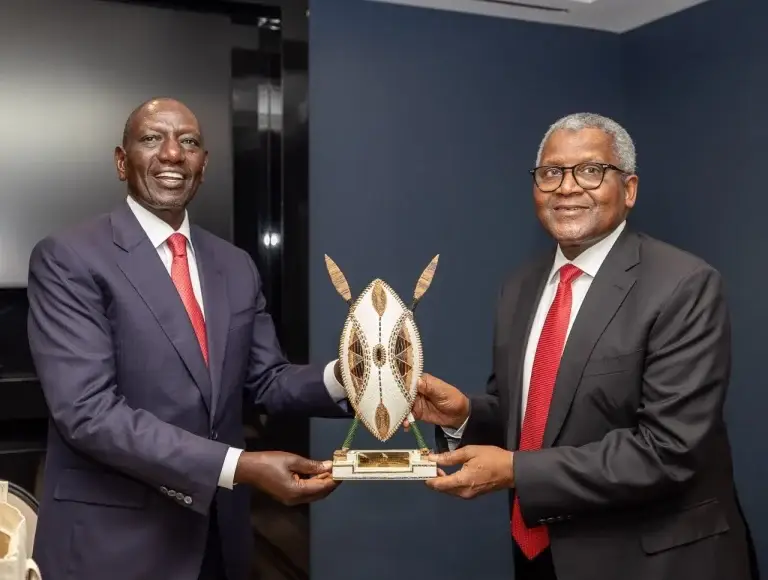
Kenyan President William Ruto has declared that his country is ready to break ground on the proposed East Africa Refinery in Lamu, a $17 billion project being developed with Nigerian industrialist Aliko Dangote, with construction scheduled to commence on September 30, 2026. Ruto made the announcement on Monday after holding talks with Dangote, President and Chief Executive Officer of Dangote Industries, and Samaila Zubairu, Chief Executive Officer of the Africa Finance Corporation, on the sidelines of the 81st United Nations General Assembly in New York.
The discussions focused on financing and final preparations for the commencement of the multibillion-dollar refinery, which is expected to process 700,000 barrels of crude oil per day, making it the largest refinery in East Africa once completed. Ruto said the project would strengthen East Africa’s energy security, create jobs and support industrialisation in the region. “We are ready to break ground on the East Africa refinery in Lamu, a transformative project that will enhance the region’s energy security, deepen local value addition, create jobs and advance our industrialisation agenda,” Ruto said. He added that the refinery would unlock new economic opportunities, strengthen regional supply chains and position East Africa as a competitive energy and industrial hub. “We are focused on turning this landmark project into reality and delivering tangible benefits for the people of the region,” he said.
The project represents Dangote’s biggest refining investment outside Nigeria, following the establishment of his 650,000-barrel-per-day refinery in Lagos. The Lamu facility is intended to replicate the scale of Dangote’s Nigerian downstream investment while positioning Kenya as a regional hub for petroleum processing and fuel supply. The refinery will serve markets across East and Central Africa and form part of Kenya’s wider plans to develop the Lamu area into an energy, industrial and logistics hub.
The financial architecture of the project has been taking shape in recent months. Dangote has offered East African countries a combined 30 per cent equity stake in the refinery and associated projects. Kenya has been offered a 10 per cent stake valued at about $500 million, equivalent to Sh64.74 billion. Rwanda and Ethiopia have also expressed interest in participating in the regional shareholding. The project is expected to cost between $15 billion and $17 billion, with construction projected to take up to three years. If work begins this month, the refinery could be ready around early 2029.
The Kenyan government has moved to fast-track the project’s implementation. In July 2026, Ruto appointed Deputy President Kithure Kindiki to chair a government committee tasked with coordinating engagement with private investors and other stakeholders ahead of the project’s commencement. The government is also planning supporting infrastructure around the refinery, including a 1,000-megawatt power plant and a special economic zone intended to support manufacturing and other industries. Lamu was selected as the site after Dangote Industries considered other locations in East Africa, including Tanzania. Preliminary work, including site selection, soil testing and engineering and design, had already begun by July.
The refinery project has also attracted attention in Nigeria, where Dangote’s Lagos refinery has reshaped the downstream sector. The Lamu project is expected to reduce East Africa’s dependence on imported fuel, a vulnerability that has been exposed by rising global energy prices driven by conflict in the Middle East and disruptions caused by the closure of the Strait of Hormuz. Kenya and the wider region have grappled with rising fuel costs, and the refinery is positioned as a long-term solution to supply insecurity.
However, the project faces significant hurdles, not least concerning crude supply. Landlocked East African nations have no domestic crude production, and the refinery will require a reliable and cost-effective supply of feedstock. Analysts have noted that financing, crude-supply arrangements and supporting infrastructure remain key challenges that must be resolved for the project to proceed as planned. Environmental and community concerns have also emerged. Activists have demanded a pause on the project, citing potential ecological and social impacts on Lamu, a UNESCO World Heritage site. Local leaders have demanded priority for local youth in employment opportunities once construction begins, reflecting anxieties about whether the economic benefits will reach the communities hosting the refinery.
Despite these challenges, the political momentum behind the project is considerable. Ruto has made the refinery a centrepiece of his investment agenda, using the UN General Assembly platform to court global investors and promote Kenya as a destination for capital. He co-chaired investment roundtables organised by the Africa Finance Corporation and the Global Africa Business Initiative alongside Dangote, and the meetings were designed to provide an opportunity for Kenya to promote the Lamu refinery project ahead of its planned groundbreaking. The discussions also covered partnerships in artificial intelligence, digital infrastructure, manufacturing, agriculture and health, as Kenya seeks to position itself as a regional technology, trade and finance hub.
For Dangote, the Lamu refinery represents the next phase of his continental expansion strategy. Having built one of the world’s largest single-train refineries in Nigeria, he is now seeking to replicate that model in East Africa, where demand for refined products continues to grow. The project is expected to create more than 60,000 jobs and strengthen energy security across the region, according to government projections. For Kenya, the refinery is an opportunity to shift from being a net importer of refined petroleum products to a regional supplier, capturing value that currently flows to refineries in the Middle East and Asia. The coming weeks will determine whether the groundbreaking proceeds as scheduled and whether the financing and crude-supply arrangements that have been under negotiation are finalised in time. For now, Ruto’s message is one of readiness: Kenya is prepared to break ground, and the project that has been discussed for months is poised to move from planning to implementation.
📩 Stone Reporters News | 🌍 stonereportersnews.com
✉️ info@stonereportersnews.com | 📘 Facebook: Stone Reporters News | 🐦 X (Twitter): @StoneReportNew | 📸 Instagram: @stonereportersnews
Add comment
Comments