

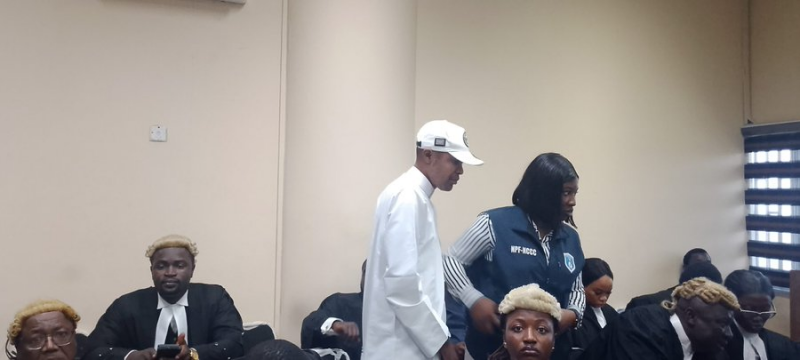
Adeniyi Adeyemi, the man accused of operating a purported federal government agency known as the Presidential Foreign Intervention Promotion Council, has finally appeared before the Federal High Court in Abuja for his long-delayed arraignment over allegations of forgery, conspiracy and impersonation.
Adeyemi appeared before Justice Mohammed Umar on Wednesday, September 30, 2026, following months of delays, previous absences from court and a bench warrant that ultimately led to his arrest. The criminal case is marked FHC/ABJ/CR/562/2025.
The Nigeria Police Force filed eight counts against Adeyemi and two other persons identified in court documents only as Femi and Anu, whose surnames are unknown and who were reported to be at large.
The charges centre on the creation and operation of the Presidential Foreign Intervention Promotion Council, commonly referred to as PFIPC, which authorities maintain was not legally established as an agency of the Federal Government.
Adeyemi had presented himself as Director-General of the organisation.
The Presidency has denied appointing him to that position and has maintained that the PFIPC was not created or authorised by President Bola Tinubu’s administration.
The criminal charges were filed on November 27, 2025, by police prosecutor Wisdom Madaki.
Police allege that Adeyemi and the other defendants conspired to forge official documents that gave the purported organisation the appearance of a legitimate presidential agency.
Among the documents at the centre of the prosecution is an alleged appointment letter purporting to have been issued by President Tinubu and signed by the President’s Chief of Staff, Femi Gbajabiamila.
Investigators also accuse Adeyemi of forging presidential letterheads and documents seeking collaboration with government ministries.
Other allegedly forged documents include requests for office space, approval for staff accounts and a purported conveyance approval concerning the take-off of the Presidential Economic Advisory Council/Presidential Foreign Intervention Promotion Council.
Adeyemi is also accused of falsely presenting himself as Director-General of the PFIPC.
These remain allegations before the court. Adeyemi has maintained his innocence in public statements and interviews, and the prosecution must prove the charges against him beyond reasonable doubt.
The case has attracted considerable public attention partly because the disputed organisation did not operate entirely outside government premises.
Police investigations previously indicated that Adeyemi operated from an office on the second floor of the Federal Secretariat Complex in Abuja.
Investigators also reportedly recovered correspondence exchanged with several Ministries, Departments and Agencies during searches connected with the investigation.
Police traced dozens of bank accounts allegedly associated with Adeyemi and the purported organisation, including accounts reportedly opened in the names of supposed government agencies.
The circumstances raised broader questions about how an organisation subsequently disowned by the Presidency was able to obtain the appearance of official recognition and interact with established government institutions.
The controversy became particularly significant after questions emerged over budgetary provisions connected with the purported agency.
President Tinubu subsequently directed the Independent Corrupt Practices and Other Related Offences Commission to investigate the scandal and submit its findings.
The President's directive included examining whether public officials, private individuals, financial institutions or intermediaries facilitated the activities surrounding the purported organisation and identifying institutional weaknesses that may have allowed it to acquire an appearance of legitimacy.
Adeyemi's eventual appearance before the criminal court follows a lengthy procedural history.
The case initially came up for arraignment before Justice Umar in February.
At the February 3 proceeding, Adeyemi's defence lawyers requested additional time, saying they had only recently received the charges.
Prosecutors disputed that account and maintained that the charges had been served earlier, but the court granted the defence request and adjourned proceedings.
The February 11 date subsequently failed to proceed because Justice Umar was attending a judicial workshop.
The case was then moved to April 14.
Adeyemi did not appear on that occasion, with his lawyer informing the court that he was ill and presenting a letter concerning his condition.
The prosecution opposed another delay, but the court adjourned the matter until June.
Adeyemi appeared on June 16, but the arraignment again failed to proceed after the defence sought an adjournment on health grounds concerning counsel.
Justice Umar subsequently fixed July 14 for another attempt to arraign him.
Adeyemi failed to appear on July 14.
His lawyer, Genesis Francis, told the court that his client stayed away because he feared for his life and had written an open letter to President Tinubu concerning his safety.
The prosecution objected and asked the court to issue a warrant for his arrest.
Justice Umar granted the application.
The judge noted that Adeyemi had repeatedly failed to appear and issued a bench warrant directing security agencies to arrest and produce him before the court. September 30 was then fixed for his arraignment.
Police arrested Adeyemi later that same day.
The arrest was carried out in Osun State by police operatives following the court order. Police authorities subsequently confirmed that he had been taken into custody.
Adeyemi has remained at the centre of another controversial allegation involving Gbajabiamila.
Before his arrest, he publicly alleged that he borrowed ₦400 million which he claimed was connected to securing his purported appointment.
Gbajabiamila has disputed allegations made against him and previously issued Adeyemi a pre-action notice demanding the withdrawal of accusations involving corruption and other wrongdoing.
Adeyemi later modified aspects of his earlier position, saying during an interview with social media activist Martins Otse, popularly known as VeryDarkMan, that he could not state with certainty whether Gbajabiamila was personally involved in issuing the disputed appointment letter.
Those competing claims should remain separate from the criminal charges presently before Justice Umar.
The court is not being asked simply to decide whether the PFIPC controversy is politically embarrassing or whether government institutions made administrative errors.
The criminal prosecution must establish whether Adeyemi committed the specific offences alleged in the eight-count charge.
Prosecutors have prepared a significant list of proposed witnesses.
Court documents previously identified Gbajabiamila among those expected to testify.
Other proposed witnesses include officials from the Office of the Accountant-General of the Federation, police personnel and individuals reportedly connected with Adeyemi's activities at the purported agency.
The scandal has also generated political controversy.
Opposition figures have demanded explanations about how the disputed organisation apparently interacted with government institutions despite the Presidency maintaining that it was never legitimately established.
The Senate, however, rejected attempts to institute a separate investigation, with Senate President Godswill Akpabio arguing that the matter was already before a court and that President Tinubu had directed the ICPC to conduct an investigation.
The controversy therefore involves two distinct questions.
The first concerns Adeyemi's individual criminal liability for the alleged forgery and impersonation.
The second is the wider institutional question of how a purported agency that the Presidency says did not exist was able to obtain an office within the Federal Secretariat, communicate with government bodies and become associated with budgetary processes.
Adeyemi's appearance in court does not resolve either issue.
It represents the beginning of the stage at which the criminal allegations against him can formally proceed through the judicial process after months of delays.
The prosecution will be required to present evidence supporting its accusations, while Adeyemi will have the opportunity to challenge that evidence and present his defence.
The two other individuals named alongside him also remain relevant to the investigation, although they were previously reported to be at large.
For Nigerians following the controversy, the significance of the trial extends beyond the personality of the disputed PFIPC director-general.
The case raises questions about safeguards surrounding presidential appointments, government correspondence, access to federal office space, official documentation and the processes through which organisations obtain recognition when dealing with ministries and other public institutions.
Those institutional questions will require evidence rather than political assumptions.
For now, what has changed is that Adeyemi, after months of unsuccessful attempts to arraign him and a court-ordered arrest, has finally appeared before the Federal High Court.
The allegations against him remain unproven unless established through the judicial process.
His appearance gives the court an opportunity to move beyond repeated adjournments and begin determining, on evidence, what actually happened in one of Nigeria's most unusual recent controversies involving a purported federal government agency.
📩 Stone Reporters News | 🌍 stonereportersnews.com
✉️ info@stonereportersnews.com | 📘 Facebook: Stone Reporters News | 🐦 X (Twitter): @StoneReportNew | 📸 Instagram: @stonereportersnews
Add comment
Comments