

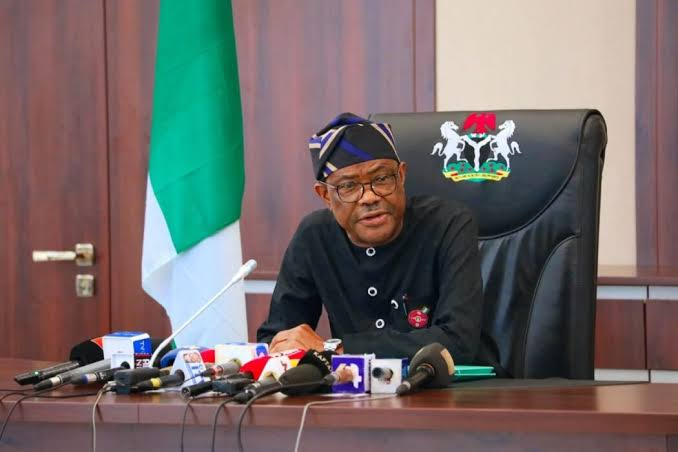
Minister of the Federal Capital Territory, Nyesom Wike, has declared that he will resign from President Bola Tinubu's government if the President fails to win Rivers State and the Federal Capital Territory in the 2027 presidential election, placing his ministerial position behind his promise to deliver the two areas politically.
Wike made the declaration on Wednesday, September 30, 2026, in Abuja while receiving members of the Association of Apo Mechanic Village, who approached the FCT Administration over concerns surrounding the proposed relocation of their businesses. The minister said Rivers State remains his political home while Abuja is where he currently works, arguing that failure to deliver electoral victory in both places would raise questions about his political influence.
“If I cannot deliver where I work, then I’m not worthy to be here,” Wike said.
“If I lose FCT, I’m not supposed to be FCT Minister. By January 17, 2027, I will announce my resignation as FCT Minister should the President lose in Rivers State and the FCT,” he added.
The statement represents one of Wike's strongest public commitments yet concerning President Tinubu's re-election campaign.
Wike has repeatedly said that his principal political responsibilities ahead of the election are Rivers, where he served as governor for eight years, and the FCT, where Tinubu appointed him minister in August 2023.
Although Wike remains a member of the opposition Peoples Democratic Party, he has openly declared his support for Tinubu, a member of the All Progressives Congress, in the 2027 presidential election.
That unusual political arrangement has made Wike an important figure in the developing campaign.
The minister has said he does not need to join the APC to campaign for Tinubu and has instead spoken about building a cross-party coalition of politicians who support the President while remaining members of their respective political parties.
Only days before his latest declaration, Wike announced that he would personally lead Tinubu's campaign structures in Rivers and the FCT.
“Very soon, I will inaugurate the campaign team for Tinubu in the FCT and Rivers State, which I will lead,” he said while inspecting road projects in Abuja on September 25.
Wike said supporters from different political platforms had prepared their machinery for the campaign and were ready to begin mobilisation.
His decision to concentrate on the two areas is not new.
In August, Wike rejected suggestions that he could become Director-General of Tinubu's national presidential campaign, saying such a position could distract him from the political territories where he believes he carries direct responsibility.
“I don't want to lose my state! I will be in my state. I have two states: FCT and Rivers. What is important is that you are able to deliver those two states,” Wike said.
“If you are DG and you don't win your state, what is the essence of the DG?”
Wike cited previous presidential campaign directors-general who failed to deliver their own states as examples of why he preferred concentrating on Rivers and Abuja.
His latest promise to resign therefore represents an escalation of an argument he has been making for several months: that his political relevance should ultimately be measured by electoral results rather than the title he holds within a campaign organisation.
Rivers State carries particular political importance for Wike.
He governed the state from 2015 until 2023 and remains involved in its politics despite the political crisis that developed between him and his successor, Governor Siminalayi Fubara.
Wike has maintained that he retains substantial political influence in Rivers.
During a media interaction in Port Harcourt earlier in September, he described himself as the “General Commander of the Political Infantry” and said he considered himself politically responsible for delivering both Rivers and the FCT to Tinubu.
“I owe the President to give these two,” Wike said.
His confidence will eventually be tested by voters.
In the 2023 presidential election, Tinubu won Rivers State, although the result was relatively close.
According to the official results declared by the Independent National Electoral Commission, Tinubu received 231,591 votes in Rivers, while Labour Party candidate Peter Obi received 175,071 and PDP candidate Atiku Abubakar received 88,468.
The FCT produced a substantially different result.
Obi won Abuja with 281,717 votes, Tinubu received 90,902, and Atiku recorded 74,199 votes.
Consequently, delivering the FCT to Tinubu in 2027 would require reversing the territory's presidential voting pattern from 2023.
Wike believes the Tinubu administration's infrastructure programme in Abuja can help produce that change.
He has repeatedly linked ongoing road construction and other FCT projects with his argument that residents should support the President's re-election.
During recent inspections, Wike pointed particularly to projects in satellite communities, including the Apo-Karshi and Bwari-Kubwa roads.
“This is governance, and this is what people expect. It will translate directly into actual votes,” he said last week.
That remains Wike's political assessment rather than a prediction that can be established before voting takes place.
Infrastructure projects may influence some voters, while others may base their decisions on economic conditions, security, political affiliations, candidates or other considerations.
The ultimate electoral effect will only become clear from the votes cast and officially declared.
Wike's meeting with the Apo traders also demonstrated how governance and election politics are increasingly intersecting in the FCT.
Members of the association had approached the minister seeking government intervention over plans affecting mechanics and traders operating within the Apo Mechanic Village corridor.
Wike assured them that the administration would engage relevant stakeholders to find a workable solution that takes their businesses and livelihoods into consideration.
During the political part of his remarks, Wike also outlined candidates he intends to support in Abuja.
He reiterated his backing for Tinubu for President and former FCT Senator Philip Aduda, while also indicating support for House of Representatives candidates aligned with his coalition.
“In the FCT, we are running a unified coalition across parties to deliver results,” Wike said.
That cross-party approach reflects Wike's complicated political position.
He is serving as a minister in an APC federal government while retaining membership of the PDP.
Wike supported Tinubu rather than the PDP's Atiku Abubakar in the 2023 presidential contest following a prolonged internal disagreement within the PDP.
Ahead of 2027, he has made clear that his support for Tinubu will continue.
The resignation pledge now places a personal consequence on that support.
However, Wike's declaration does not determine how Rivers or FCT residents will vote, and it should not be interpreted as evidence that either territory is guaranteed for Tinubu.
Elections are decided by voters and the official collation process, not by political declarations from ministers or campaign figures.
It is also significant that Wike tied his continued presence in office to political performance.
An FCT minister is appointed by the President and performs administrative responsibilities for the territory rather than holding an elected position.
Wike's statement therefore represents a political commitment he has personally chosen to make, rather than a constitutional requirement that an FCT minister resign if the President loses an election in Abuja.
For Wike, however, the issue is one of political accountability.
His argument is that a minister who claims influence in the territory where he serves should be capable of translating that influence into electoral support for the President who appointed him.
His Rivers connection creates the second part of that challenge.
The former governor has repeatedly maintained that he remains politically influential in his home state despite changes in its leadership and continuing competition among political blocs.
The 2027 presidential election will provide voters with the opportunity to determine whether those claims of influence translate into votes.
Wike has now publicly attached his ministerial position to the outcome.
If Tinubu wins Rivers and the FCT, Wike would likely present the results as evidence of his political strength and the effectiveness of his campaign organisation.
If the President fails to secure the territories covered by his pledge, Wike says he will announce his resignation.
His latest statement therefore turns what had previously been a promise to “deliver” two political territories into a personal political commitment with a stated consequence.
The final decision, however, remains with voters in Rivers State and the Federal Capital Territory when they cast their ballots in the 2027 presidential election.
📩 Stone Reporters News | 🌍 stonereportersnews.com
✉️ info@stonereportersnews.com | 📘 Facebook: Stone Reporters News | 🐦 X (Twitter): @StoneReportNew | 📸 Instagram: @stonereportersnews
Add comment
Comments