

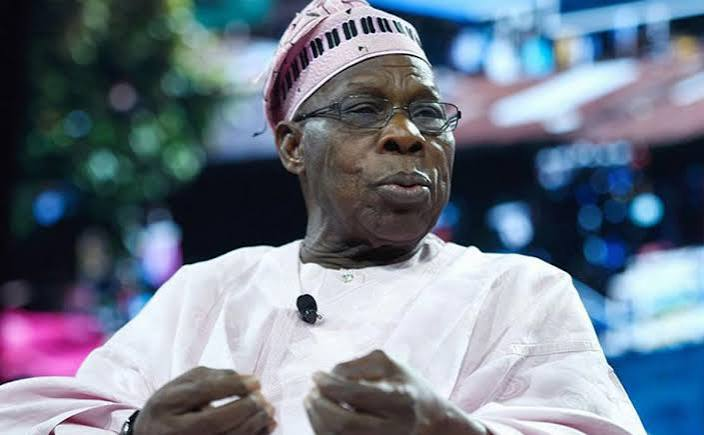
Former Nigerian President Olusegun Obasanjo has praised Nigerian industrialist Aliko Dangote for his role in strengthening economic ties between West and East Africa, describing the $16 billion Dangote East Africa Petroleum Refinery project in Kenya as a significant demonstration of African-led industrial investment.
Obasanjo spoke on Wednesday, September 30, 2026, at Mokowe in Lamu County, Kenya, during the groundbreaking ceremony for the Dangote East Africa Petroleum Refinery and Petrochemicals project, a planned 700,000-barrel-per-day facility being developed by the Dangote Group.
Addressing African leaders and other dignitaries gathered for the ceremony, Obasanjo said he was pleased to witness an investment connecting the two regions of the continent.
“I am happy that I see this day where East Africa and West Africa are being brought together with the commitment of our leaders and with the courage and commitment of one man: Aliko Dangote,” Obasanjo said.
The former Nigerian president credited both African political leadership and Dangote’s investment drive for bringing the project to the East African region.
The groundbreaking ceremony brought together several prominent African leaders.
Kenyan President William Ruto attended alongside Ugandan President Yoweri Museveni, Ethiopian Prime Minister Abiy Ahmed, Benin President Romuald Wadagni and Togo President Jean-Lucien Savi de Tové.
Former President Obasanjo and Dangote Group President and Chief Executive Aliko Dangote were also among the dignitaries present at the ceremony.
The leaders participated in the symbolic groundbreaking, marking the beginning of construction activities for the refinery.
Photographs from the event showed the dignitaries participating in the ceremonial breaking of the ground, while heavy construction equipment, including excavators, graders, rollers and cranes, had been assembled at the project site.
The refinery represents an estimated $16 billion investment and is planned to process 700,000 barrels of crude oil per day when completed.
Dangote has set a construction period of approximately 40 months, putting the expected completion around 2030 if the timetable is maintained.
The development is not limited to petroleum refining.
According to the Kenyan government, the project is designed as an integrated industrial complex that will include a 1,000-megawatt power plant, alongside fertiliser and chemical manufacturing facilities.
The Kenyan government said the development is expected to strengthen the country's industrial base and create employment and skills-development opportunities.
Dangote used the groundbreaking ceremony to argue that African countries need to process more of their resources within the continent instead of exporting raw materials and importing finished products.
“For too long, our continent has actually been rich in resources but poor in value creation and addition,” Dangote said.
He pointed specifically to Africa's practice of exporting crude oil while importing refined petroleum products.
Dangote said such an economic structure meant that employment and economic opportunities that could have remained in Africa were instead created elsewhere.
“Africa cannot build lasting prosperity by exporting what it has and importing what it needs,” he said.
President Ruto described the refinery as an investment in energy security, industrialisation and regional integration.
The Kenyan president said the project would strengthen regional energy security, reduce dependence on imported refined petroleum products and help conserve foreign exchange.
For Obasanjo, however, the ceremony also carried significance because of the relationship between East and West Africa.
Dangote built his industrial business from Nigeria in West Africa, while the new refinery is being established in Kenya and is intended to serve the wider East African market.
Obasanjo therefore presented the development as an example of African capital and entrepreneurship moving beyond national and regional boundaries.
The former Nigerian president also reflected on Dangote's earlier industrial journey.
Obasanjo recalled discussions surrounding Nigeria's heavy dependence on imported cement and Dangote's eventual transition from trading and importing cement into domestic manufacturing.
Dangote subsequently expanded cement manufacturing operations beyond Nigeria into several other African countries.
At the Lamu ceremony, Obasanjo used that industrial history to underline Dangote's transition into a businessman undertaking major manufacturing and infrastructure investments across the continent.
Dangote's petroleum refining operations have similarly expanded from Nigeria.
His refinery in Lagos demonstrated the group's ability to develop a large-scale petroleum processing facility in Africa, and Dangote told the gathering that the Kenyan project would seek to repeat that experience.
“Lekki refinery in Nigeria proved that it is capable, so Lamu must prove that it can be repeated,” Dangote said at the ceremony.
The planned Kenyan refinery is intended to supply petroleum products to markets extending beyond Kenya.
Dangote said the project would contribute to energy self-sufficiency across a region stretching from Ethiopia towards Mozambique by reducing dependence on imported refined petroleum products.
The refinery is also expected to produce jet fuel for possible export to European and British markets.
Dangote has offered governments within the region a combined 30 per cent stake in the refinery.
Plans also exist to eventually list shares in the refinery on the Nairobi Securities Exchange.
The project is expected to have a wider industrial impact around Lamu.
Officials have said associated industries could include petrochemicals, bitumen and base-oil production, while more than 50,000 jobs are expected to be created.
The planned 1,000MW power plant is expected to supply the refinery while making surplus electricity available to other users.
The refinery project is also connected to Kenya's wider development of the Lamu Port and the Lamu Port-South Sudan-Ethiopia Transport corridor.
Lamu Port received its first cargo ships in 2021 and forms part of Kenya's effort to develop a transport corridor linking its northern region and neighbouring countries to the Indian Ocean.
Kenyan authorities expect the refinery to contribute further industrial activity along that corridor.
Despite the high-profile groundbreaking, the refinery has also faced opposition from some local residents and environmental campaigners.
Residents have initiated legal proceedings concerning land rights, arguing that parts of the proposed development area involve ancestral land.
Environmental campaigners have also expressed concern about possible effects on the marine ecosystem surrounding Lamu, including the area around Lamu Old Town, which is a UNESCO World Heritage Site.
Kenya's High Court allowed the groundbreaking ceremony to proceed while legal proceedings involving parts of the site continue.
Dangote has said the court challenges will not stop his commitment to the project.
“We are really not scared about people taking us to court,” he said during the launch.
“Anybody who wants to cause trouble, we are ready for his trouble and we will give him a headache.”
Those remarks have themselves generated political debate in Kenya, where some lawmakers have demanded transparency concerning the refinery agreements and respect for citizens challenging aspects of the project through legal channels.
Beyond those disputes, Wednesday's groundbreaking brought together political leaders from different regions of Africa around one of the continent's largest proposed industrial investments.
Museveni used the ceremony to advocate greater African industrialisation and regional integration, while Dangote argued that the continent must increase local processing and value addition instead of remaining dependent on the export of raw resources.
Obasanjo concentrated his remarks on what the gathering represented for relations between different parts of Africa.
For the former Nigerian president, a Nigerian entrepreneur undertaking a $16 billion industrial project in Kenya showed that African investment could cross the traditional boundaries separating the continent's economic regions.
His notable words captured that message:
“I am happy that I see this day where East Africa and West Africa are being brought together with the commitment of our leaders and with the courage and commitment of one man: Aliko Dangote.”
The groundbreaking on September 30 formally marked the beginning of the planned 40-month construction programme for a refinery that, if completed according to its design, will have capacity to process 700,000 barrels of crude oil every day.
For Obasanjo, the occasion represented more than the beginning of construction of another refinery. His message was that the project demonstrated the possibility of African political leadership and African private capital working across regional boundaries to develop major industries on the continent.
📩 Stone Reporters News | 🌍 stonereportersnews.com
✉️ info@stonereportersnews.com | 📘 Facebook: Stone Reporters News | 🐦 X (Twitter): @StoneReportNew | 📸 Instagram: @stonereportersnews
Add comment
Comments