

Reported by Ariajegbe Sylvia Esezobor
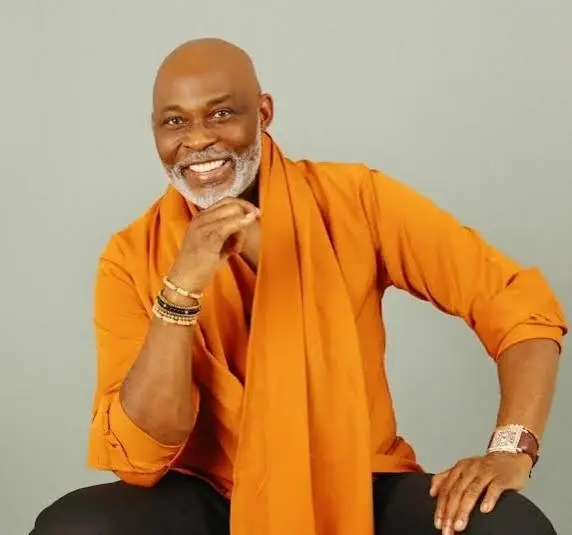
Veteran Nollywood actor and former Delta State Commissioner for Culture and Tourism, Richard Mofe-Damijo, popularly known as RMD, has credited Nobel laureate Professor Wole Soyinka and the late playwright J.P. Clark with instilling in him the discipline and punctuality that have defined his decades-long career, revealing that his encounters with the two literary giants shaped a professional ethic he still lives by today.
Speaking at a recent public event, RMD traced the foundation of his values to his mother, describing her as the primary influence on his character. "Growing up, I was deeply attached to my mother. I do not know if it was because I was an only child, but she constantly reminded me of where I came from and the responsibility that came with it," he said. "She drilled one statement into me: 'Don't forget whose child you are.' That stayed with me. She nurtured me and taught me that, at different points in our lives, we represent different people, families and institutions".
The actor said the discipline he learned at home was reinforced by the schools he attended and the people he worked with early in his career. "I was also fortunate to have been well trained in the schools I attended and by the people I had the opportunity to work with. They taught me the importance of discipline, punctuality and responsibility," he said. RMD described punctuality as a core principle, explaining that he habitually arrives well before scheduled appointments. "Timeliness is important to me. If someone tells you to be somewhere at 8 o'clock, you should get there by 7:30. That way, when they encounter you, you are already prompt and ready to take off," he said.
The actor's formative years in theatre were marked by encounters with two of Nigeria's most consequential literary figures. In 1984, he was a resident actor at the J.K. Randle Centre, working under Professor J.P. Clark. He also worked under Soyinka's direction, an experience he described as transformative in its demands. "If you have encountered Soyinka, you would understand what I mean. If he says 4pm and you get there at 3:30pm, he is already there," RMD said. "Those are the kinds of people I have had the opportunity to work with, and I imbibed that culture. I hope that those who encounter me will also be conscious of what they can learn from me".
The names RMD invoked carry extraordinary weight in Nigerian letters and theatre. Wole Soyinka, born in 1934, is Africa's first Nobel laureate in Literature, awarded in 1986, and a playwright, poet, essayist and director whose career spans more than six decades. His directorial work includes productions of his own plays and adaptations of Bertolt Brecht's Three Penny Opera, staged in 1977 as Opera Wonyosi, and his direction of the 1984 film Blues for a Prodigal. J.P. Clark, who died in October 2020 at the age of 85, was a poet, playwright and scholar whose works explored themes of violence and protest, and who founded the PEC Repertory Theatre in Lagos. The J.K. Randle Centre, where RMD worked as a resident actor, is the John Randle Centre for Yoruba Culture and History in Onikan, Lagos, named after John K. Randle, one of the first doctors from West Africa.
RMD's reflection on his career extended to his time in public service, where he served as Commissioner for Culture and Tourism in Delta State for eight years. He said the experience exposed him to both the potential of governance and its systemic challenges. "I served government for eight years, and during that period, I realised that government has tremendous potential for good. You see that you have the ability to change things for good, but the system is sometimes built in such a way that when good people come into it, if their values are not deeply rooted, the system can suck them in," he said. He recalled his determination to resist the system's corrosive tendencies. "When I came into government, I was determined to fight to change the attitude that some people brought into the system. That experience taught me something important: if you can't fight the system, get out and go build somewhere else".
The actor's remarks on representation and responsibility formed a philosophical thread through his address. "At different stages of our lives, we represent something bigger than ourselves. The question is, what is it that you carry inside you, and who do you represent?" he asked. He said he had always tried to overcompensate by ensuring he was proper in everything he did. The theme of representation connected his mother's admonition, "Don't forget whose child you are," to his professional conduct and his belief that individuals carry the weight of institutions and ideals larger than themselves.
RMD's career spans more than three decades and encompasses acting, writing, producing, law and journalism. Born on July 6, 1961, in Warri, Delta State, he attended Midwest College and studied Theatre Arts at the University of Benin, later studying law at the University of Lagos and graduating in 2004. He won the Africa Movie Academy Award for Best Actor in a Leading Role in 2005 and was honoured with the Industry Merit Award at the 10th Africa Magic Viewers' Choice Awards in 2024. His career has straddled the stage, the screen and public service, a trajectory that makes his reflections on discipline and institutional integrity particularly resonant for younger Nigerians navigating careers in entertainment, politics and public life.
The actor's decision to speak publicly about the formative influence of Soyinka and Clark comes at a time when the Nigerian entertainment industry is grappling with questions of professionalism, mentorship and the sustainability of careers in an increasingly competitive landscape. RMD's testimony offers a counterpoint to narratives of instant success, emphasising instead the slow, disciplined accumulation of values that outlast individual projects and performances. His message to the younger generation was implicit throughout his remarks: the habits you form early, the people you choose to learn from and the values you refuse to compromise will determine the kind of career and the kind of life you build. As he put it, those who encounter him should be conscious of what they can learn from him, a statement that places the responsibility of mentorship on the mentor as much as the mentee.
For Nigerians who grew up watching RMD on screen, his account of the lessons he learned from Soyinka and Clark offers a reminder that the figures they admire were themselves shaped by rigorous, demanding mentors. For aspiring actors and public servants, his story is a case study in how proximity to greatness, combined with humility and discipline, can produce a career of unusual longevity. And for the wider society, his reflection on government and the values required to resist its corrupting pressures carries implications beyond the arts, speaking to the broader challenge of building institutions that reward integrity rather than expediency. As RMD put it, if you cannot fight the system, get out and build somewhere else. The actor's own career suggests he chose to fight, and the values he credits to his mother, Soyinka and Clark are the weapons he carried into that battle.
📩 Stone Reporters News | 🌍 stonereportersnews.com
✉️ info@stonereportersnews.com | 📘 Facebook: Stone Reporters News | 🐦 X (Twitter): @StoneReportNew | 📸 Instagram: @stonereportersnews
Add comment
Comments