

Reported by Ariajegbe Sylvia Esezobor
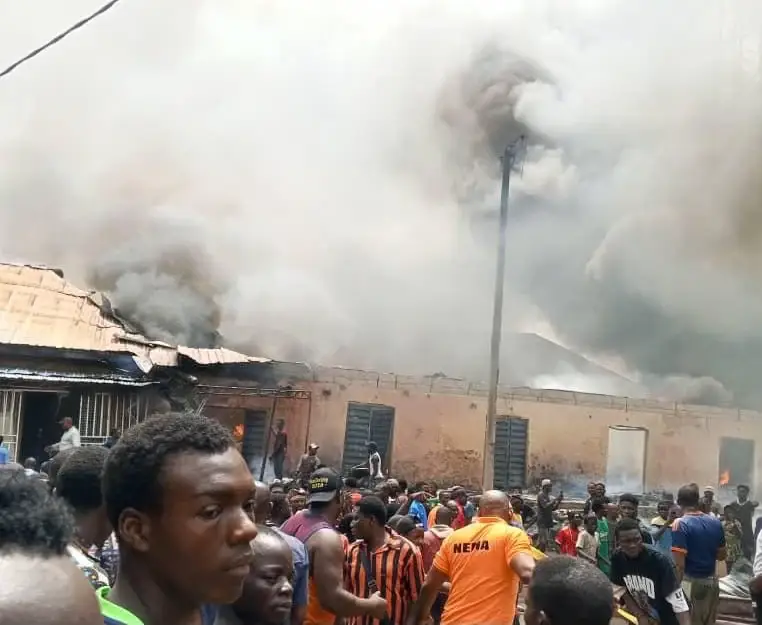
A fire outbreak has destroyed 21 shops and one vehicle at the Kugbo Furniture Market along the Abuja-Keffi Expressway, leaving traders to count losses estimated at more than five hundred million naira and prompting renewed calls for government intervention to prevent recurring infernos at the popular commercial hub.
The National Emergency Management Agency confirmed the incident in a statement issued by its Abuja Operations Office, saying its Emergency Response and Ambulance Bay received a distress call at about 11:15 a.m. on Friday, October 2, 2026. Following the alert, NEMA immediately activated relevant emergency response stakeholders, including the Federal Fire Service and other responders, who moved to the scene to prevent the fire from spreading further. NEMA responders supported crowd control efforts while firefighters worked to contain the blaze and prevent it from engulfing adjoining shops and properties. The agency said the fire was eventually brought under control and the affected area thoroughly dampened to guard against possible secondary outbreaks, with emergency operations concluded at about 1:40 p.m. No casualties were recorded. A preliminary assessment showed that one vehicle and 21 shops were affected. Some valuable items were successfully recovered from the affected shops during the operations, potentially helping to reduce the losses suffered by some traders.
The fire broke out in the early hours of Friday, according to the Chairman of the Kugbo Wood Machinist Association, Mr Godswill Ndukwe, who confirmed the incident. He said the fire started before most traders arrived at the market to open their shops. The affected section of the market housed foam, wood, local and foreign boards, and furniture accessories, materials that are highly combustible and contributed to the rapid spread of the blaze. Ndukwe said the cause of the outbreak had yet to be established. He lamented the repeated occurrence of fire incidents at the market and appealed to the Abuja Municipal Area Council and the Federal Capital Territory Administration to intervene and put measures in place to prevent a recurrence. "The fire outbreak this morning is terrible. The fire started when most of the shops were not open," Ndukwe said. "We are yet to know the cause of the fire, but goods worth five hundred million were burnt. We are appealing to AMAC and the FCT Administration to do something. We have had several of these incidents, and officials will come and make promises, but nothing happens afterwards. Please, let the government help us."
An eyewitness account linked the outbreak to an electrical spark. Mrs Mary Aniekan, who was at the market when the fire started, said the blaze began suddenly after an electrical spark was noticed in the affected area, and that traders and others around the market immediately raised the alarm and made frantic efforts to put out the fire and salvage their belongings. "I was in my shop when we saw the fire and people running to safety, while others were trying to put the fire out but they could not," she said. "The fire started when AEDC restored electricity. Firefighters came but their water finished and up till now they have not been able to put the fire out." The exact cause of the fire has not been officially established, and the eyewitness account has not been independently confirmed by emergency authorities.
The incident caused panic among traders and residents in the area, with affected business owners calling for urgent assistance to assess the damage and help them recover from the losses. Several traders were seen trying to recover whatever they could from their shops, while others watched helplessly as their businesses and properties were consumed by the fire. One trader, Okechukwu Chilke, who deals in different types of boards, declined to speak on the incident, appearing overwhelmed by the extent of his loss as he watched the remains of his shop. The Kugbo Furniture Market is a major commercial hub along the Abuja-Keffi Expressway, and the section affected by the fire is occupied by dealers in wood, foam, local and imported boards, and furniture accessories. The materials stored in these shops are highly flammable, making the market particularly vulnerable to fire outbreaks.
The incident is the latest in a series of fires that have ravaged the Kugbo Furniture Market in recent years. In January 2026, a major fire outbreak gutted parts of the market before firefighters from the Federal Fire Service and other emergency responders brought the inferno under control after several hours of intense firefighting. The Federal Fire Service said the blaze was suspected to have been caused by an electrical surge, and property worth approximately N1.8 billion was saved during that operation. In February 2026, traders and residents of the market sought urgent government assistance after a fire destroyed more than fifteen shops and some adjoining residential buildings. The recurrence of these incidents has raised questions about the adequacy of fire safety infrastructure at the market, the reliability of electrical installations, and the capacity of emergency responders to reach the scene quickly enough to prevent extensive damage.
The Kugbo Market fire comes amid a broader pattern of market fires across Nigeria. In September 2026, a fire gutted a building at the Computer Village in Ikeja, Lagos, destroying goods and property worth millions of naira. In October, a mysterious fire razed the Creek Road Market in Port Harcourt, destroying goods worth millions and leaving traders to count their losses. The frequency of these incidents reflects systemic challenges: many Nigerian markets lack adequate fire hydrants, water supply and emergency exits, and traders often store flammable materials in close proximity without proper ventilation or electrical safety measures. The Federal Fire Service and state fire services have consistently complained of inadequate equipment and personnel to respond effectively to large-scale fires, particularly in markets where access roads are narrow and congestion delays the arrival of firefighting vehicles.
For the traders at Kugbo Furniture Market, the destruction of their goods represents not only a financial loss but a threat to their livelihoods. Many operate on thin margins, financing their inventory through personal savings, family loans or informal credit arrangements. A fire that destroys their stock can wipe out years of accumulated capital in a single morning, leaving them unable to restock or meet their financial obligations. The absence of comprehensive insurance coverage for small-scale traders compounds the problem, as most market operators cannot afford premiums or are unaware of available insurance products. The government's response, when it comes, will be watched closely to see whether it goes beyond expressions of sympathy to provide tangible support for affected traders. The NEMA statement reaffirmed the agency's commitment to supporting affected communities and coordinating effective emergency response operations in collaboration with the Federal Fire Service and other relevant stakeholders. For the traders of Kugbo, however, the immediate priority is assessing what remains and finding a way to rebuild businesses that were reduced to ashes before most of them had even opened their shops for the day.
📩 Stone Reporters News | 🌍 stonereportersnews.com
✉️ info@stonereportersnews.com | 📘 Facebook: Stone Reporters News | 🐦 X (Twitter): @StoneReportNew | 📸 Instagram: @stonereportersnews
Add comment
Comments