

Reported by Ariajegbe Sylvia Esezobor
The Dangote Petroleum Refinery has announced plans to double its crude processing capacity to 1.4 million barrels per day by the first quarter of 2029, a $14.3 billion expansion that would make it one of the largest refining complexes in the world and position Africa's richest man's flagship industrial project at the centre of the continent's energy transformation.
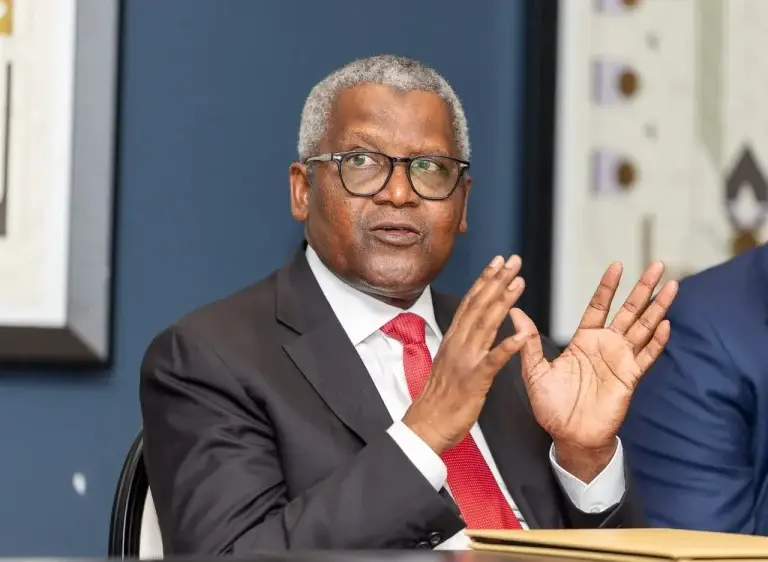
Aliko Dangote, President of Dangote Industries Limited, disclosed the target on Monday during a virtual session at the final Initial Public Offering roadshow in Rivers State. "By 2029 beginning, we will be at 1.4 million barrels per day. That is a total of 10 per cent of America's total refining capacity," Dangote said. The refinery currently operates at approximately 700,000 barrels per day, having surpassed its original nameplate capacity of 650,000 barrels per day following a successful performance test conducted by its Process Licensors in June 2026.
The expansion, estimated at $14.3 billion, is being financed in part by an ongoing Initial Public Offering that opened on September 14 and closes on October 13, 2026. The offer comprises 4.1 billion ordinary shares priced at N525 each, with a minimum subscription of 10 shares valued at N5,250. If fully subscribed, the IPO would raise approximately N2.15 trillion, or about $1.6 billion, making it the largest public offering in Africa's history. Dangote described the offer as "the people's IPO," targeting traders, cooks, drivers and managers across the continent, and assured smaller investors that they would be accommodated. "Most of the smaller people who are bidding for 50,000 shares and below will definitely be sure that we accommodate all of them," he said.
The expansion will double the refinery's workforce, according to Edwin Devakumar, Vice President of Oil and Gas at Dangote Industries Limited. "Within the refinery, the workforce will practically become double, except in the water treatment section, because there we already have substantial capacity," Devakumar said. He said the second phase would cost less than the $20 billion first phase because critical infrastructure including a granite quarry, welding gas plant, port facility and developed land already exists. Engineering and design costs will also be reduced because the new plant is a replica of the existing facility, and most equipment has already been ordered with major contracts signed and advance payments made to contractors. "Our target is three years, and we may even finish earlier," Devakumar said.
Beyond refining, the expansion will significantly increase petrochemical production. Dangote said the facility would produce 2.5 million tonnes of polyolefin and 400,000 metric tonnes of linear alkylbenzene, which he described as major milestones for Africa's industrial development. The refinery also plans to increase fertiliser output from three million tonnes to 12 million tonnes annually. The company posted $1.8 billion in after-tax profit in the first half of 2026 on $13 billion in revenue, according to its prospectus.
Dangote also disclosed plans to pursue a secondary listing on the New York Stock Exchange after completing the expansion. "We are doing a primary listing in Nigeria and then we will also hopefully list in New York. But that is after we deliver the expansion to 1.4 million barrels a day by the first quarter of 2029," he said during the Qatar Economic Forum. The proposed overseas listing would give the refinery access to a broader pool of international investors and capital. A listing on the New York Stock Exchange would subject the company to stringent United States regulatory and disclosure requirements, signalling its ambition to compete on the global stage. The company is also pursuing listings in Johannesburg, Nairobi and other African exchanges, and is working with banks to enable Africans outside Nigeria to participate in the primary Nigerian listing.
The refinery is designed to process a wide range of crude grades, including most African crudes and West Texas Intermediate, to reduce dependence on Nigerian crude, much of which is committed to existing export obligations. It is configured to maximise petrol output at 53 per cent of production capacity, compared with about 22 per cent in conventional Nigerian refineries, with 95 per cent of production comprising high-value petrol, diesel and jet fuel. It produces Euro 5 and Euro 6-standard petroleum products and currently exports petrol, aviation fuel and diesel to markets in the United States, Europe and other regions. The facility is more than 70 per cent automated, with major processing units controlled from a central control room.
The expansion comes amid broader challenges in Nigeria's petroleum industry. Dangote has been a vocal critic of the regulatory environment and the difficulty of securing adequate crude feedstock. The Minister of Finance, Taiwo Oyedele, disclosed in October 2026 that Nigeria does not currently produce enough crude to supply the refinery with 700,000 barrels per day, forcing it to import heavy crude to supplement domestic supply. The naira-for-crude arrangement introduced by the Tinubu administration was designed to provide some stability, but the fundamental constraint of insufficient free crude remains.
The political context of the expansion is significant. The 2027 general elections are less than four months away, with the presidential and National Assembly elections scheduled for January 16, and the governorship and state assembly elections for February 6. President Bola Ahmed Tinubu is seeking a second term on the All Progressives Congress platform, while former Vice President Atiku Abubakar of the African Democratic Congress, former Anambra Governor Peter Obi of the Nigeria Democratic Congress and Oyo State Governor Seyi Makinde of the Allied Peoples Movement are among the major challengers. The refinery has become a symbol of Nigeria's industrial ambitions and a central issue in the debate over the country's economic direction. The government has pointed to the refinery as evidence that its reforms are attracting investment and reducing dependence on imported petroleum products, while critics argue that the benefits have yet to reach ordinary Nigerians facing high fuel prices.
For Nigeria, the expansion promises to strengthen energy security, create jobs, generate foreign exchange through exports and deepen the country's industrial base in petrochemicals, packaging and plastics. For Dangote, it represents the next phase of a project that has already reshaped the country's downstream sector. For the continent, it signals that African capital can build world-class industrial infrastructure. As Dangote put it, by 2029, the refinery will be at 1.4 million barrels per day, producing 2.5 million tonnes of polyolefin, the largest in African history. The coming months will determine whether the IPO is fully subscribed, whether the expansion is delivered on schedule, and whether the refinery becomes the transformative force its promoters have promised.
📩 Stone Reporters News | 🌍 stonereportersnews.com
✉️ info@stonereportersnews.com | 📘 Facebook: Stone Reporters News | 🐦 X (Twitter): @StoneReportNew | 📸 Instagram: @stonereportersnews
Add comment
Comments