

Reported by Ariajegbe Sylvia Esezobor
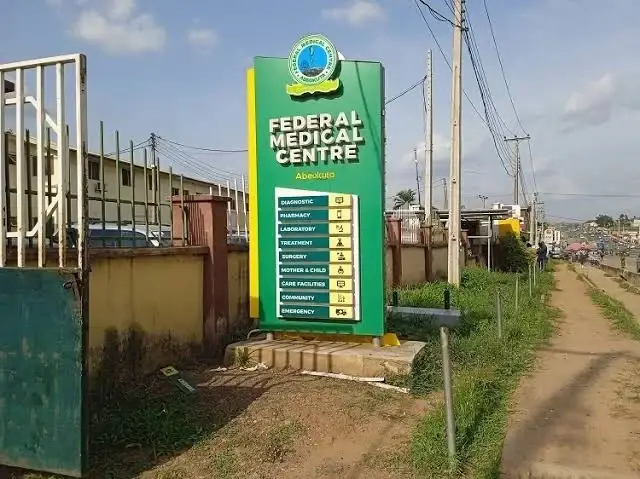
Health workers at the Federal Medical Centre, Abeokuta, Ogun State, commenced a three-day warning strike on Monday, October 12, 2026, in protest against the alleged stabbing of a medical laboratory scientist by a patient's relative within the hospital premises, shutting down services across the facility and demanding urgent action to protect staff from violence.
The strike, declared by the Joint Action Committee comprising five unions, began at 11 a.m. and is scheduled to end at 8 a.m. on Thursday, October 15. The unions involved are the Medical and Health Workers Union of Nigeria, the National Association of Nigeria Nurses and Midwives, the Senior Staff Association of Universities, Teaching Hospitals, Research and Associated Institutions, the Nigerian Union of Allied Health Professionals, and the Non-Academic Staff Union of Educational and Associated Institutions.
The victim, Mr Lawal Toheeb Olasunkanmi, a medical laboratory scientist, was allegedly stabbed on Sunday night, October 11, 2026. A colleague, Comrade Oladejo Abiodun, said he received a distress call at about 6:30 p.m. that a scientist on duty had been stabbed in the head and was bleeding. He said he rushed to the hospital and confirmed the injury, adding that photos and videos of the incident exist. The circumstances leading to the attack were not immediately clear, and as of the time of reporting, it was unclear whether the alleged assailant had been arrested or whether the police had commenced an investigation.
In a protest letter dated October 12 and addressed to the Medical Director of the hospital, the unions expressed profound displeasure and outrage over what they described as an unacceptable act of violence against a healthcare worker carrying out his professional duties. "This barbaric act of violence against a healthcare worker carrying out their professional responsibilities is condemnable and must not be treated with levity," the letter read. "It is deeply disturbing that a facility established to preserve life and promote healing has become a place where healthcare workers may be subjected to physical attacks while discharging their lawful duties." The unions stressed that the incident was not merely an attack on one individual but an attack on the entire workforce of the centre. "An injury to one member of our professional community is a matter of collective concern, and we cannot remain silent while the safety of our members is placed in jeopardy."
The Joint Action Committee demanded that the hospital management formally report the incident to law enforcement authorities to ensure that the alleged assailant is investigated and prosecuted in accordance with the law. They warned against any attempt to conceal, trivialise or resolve the matter in a manner that would undermine accountability. The unions also demanded comprehensive medical care and psychological support for the injured laboratory scientist throughout his recovery, along with all appropriate institutional assistance.
Beyond the immediate response to the attack, the workers called for an urgent review of security arrangements across the facility, particularly in clinical and laboratory areas, emergency units and other vulnerable locations. They demanded tighter access control, the deployment of adequate security personnel and the establishment of a rapid-response mechanism to prevent similar attacks. They further called for a clear institutional policy against threats, intimidation, harassment and physical assault on hospital staff, with defined procedures for reporting incidents and collaborating with security agencies. The unions also requested an urgent meeting between hospital management and union leadership to examine the security failures exposed by the incident and agree on practical measures, including specific timelines, to guarantee the safety of workers.
The strike is the latest in a series of security-related disputes at the Federal Medical Centre, Abeokuta. In September 2026, resident doctors at the hospital embarked on a five-day warning strike over unresolved welfare and security concerns. Their complaints included alleged assaults on healthcare workers, inadequate security personnel, poor lighting in parts of the hospital and concerns about access control around the Emergency Treatment Room. Among their demands were the immediate deployment of adequate armed security personnel to strategic, vulnerable and high-risk locations within the hospital, and the strengthening of security at the Emergency Treatment Room to prevent the unauthorised influx of patients' relatives and other persons. In June 2026, resident doctors also embarked on a three-day warning strike following burglaries at the House Officers' Quarters located within the hospital premises. Their demands at the time included the replacement of stolen items, the engagement of a more competent security service provider, and the installation of adequate lighting around the hospital and residential quarters.
The recurrence of these incidents has drawn attention to the persistent safety challenges facing healthcare workers in Nigeria. The Nigerian Medical Association has repeatedly called for stronger measures to protect medical personnel, and the Minister of Health and Social Welfare, Professor Muhammad Ali Pate, has emphasised the importance of a safe working environment for health workers. The Federal Government has acknowledged the need to improve security at public health institutions, but the pace of intervention has not matched the frequency of attacks.
The strike at FMC Abeokuta comes amid a broader climate of industrial tension in Nigeria's health sector. The National Association of Resident Doctors has issued a fresh ultimatum to the Federal Government over unmet welfare demands, warning that failure to address outstanding issues could trigger industrial action. The Joint National Public Service Negotiating Council has also commenced strike action over petrol prices and the minimum wage. The political context of these disputes is significant, with the 2027 general elections less than four months away. President Bola Ahmed Tinubu is seeking a second term on the All Progressives Congress platform, while former Vice President Atiku Abubakar of the African Democratic Congress, former Anambra Governor Peter Obi of the Nigeria Democratic Congress and Oyo State Governor Seyi Makinde of the Allied Peoples Movement are among the major challengers. Healthcare delivery and the welfare of public sector workers have emerged as key issues in the campaign, and the government's handling of disputes in the health sector will be part of the broader assessment of its record.
For the patients at FMC Abeokuta, the strike means disruption of services and uncertainty about access to care. For the health workers, it is an expression of their determination to demand a safe working environment. For the hospital management, the strike is a test of its willingness to address the security failures that have now produced multiple strikes in a single year. For the injured laboratory scientist, the priority is recovery, and the support he receives will be a measure of whether the institution values the people who keep it running. As the unions put it, no healthcare worker deserves to be threatened, assaulted, or stabbed in the course of providing care, and violence against hospital staff must not be allowed to become normalised. The coming days will determine whether the strike produces the security reforms the workers are demanding or whether the cycle of attacks and industrial action continues.
📩 Stone Reporters News | 🌍 stonereportersnews.com
✉️ info@stonereportersnews.com | 📘 Facebook: Stone Reporters News | 🐦 X (Twitter): @StoneReportNew | 📸 Instagram: @stonereportersnews
Add comment
Comments