

Reported by Ariajegbe Sylvia Esezobor
The United States has urged Ethiopia and Eritrea to pursue dialogue and de-escalation as rising military tensions between the neighbouring Horn of Africa countries fuel fears of another devastating regional conflict.
US Secretary of State Marco Rubio reinforced Washington’s position during a telephone conversation with Ethiopian Prime Minister Abiy Ahmed on Wednesday, October 14, 2026. According to a statement from Rubio’s office, he stressed that countries across the Horn of Africa must respect their neighbours’ sovereignty and territorial integrity and avoid cross-border incursions.
The diplomatic intervention comes amid increasingly hostile exchanges between Addis Ababa and Asmara, with Ethiopia accusing Eritrea of sending troops into its territory and supporting armed groups fighting the Ethiopian government. Eritrea has rejected the allegations, describing Ethiopia’s accusations as a possible justification for military confrontation.
The dispute has raised concerns that fighting in northern Ethiopia could escalate into a direct confrontation between the two countries, whose history includes a devastating border war and a more recent period of renewed cooperation.
Washington has warned that another military conflict would have consequences far beyond the immediate border. The United States has emphasised that the Horn of Africa cannot afford another war and humanitarian crisis, particularly given the region’s existing political instability, displacement and economic difficulties.
In an earlier statement issued on October 3, the US State Department called on both countries to exercise maximum restraint and return to dialogue and cooperation under their 2018 peace framework. The statement warned that escalating tensions could affect the entire region and jeopardise American cooperation with both governments.
The renewed diplomatic effort follows reports of clashes and troop movements around Ethiopia’s northern border, particularly in the Tigray region. Fighting has intensified since late September, raising fears of a return to the violence that devastated northern Ethiopia between 2020 and 2022.
Ethiopia has accused Eritrean forces of crossing into its territory and cooperating with armed groups opposed to Abiy’s government. Ethiopian officials have described the alleged military activity as a violation of national sovereignty and have indicated that the government is prepared to defend its territory.
Eritrea has denied carrying out the alleged incursion. Its government has instead accused Ethiopia of escalating tensions through statements and actions that could provide a pretext for war.
The disagreement has reached the United Nations Security Council. In a letter dated October 10, Eritrean Foreign Minister Osman Saleh urged the council to condemn what Asmara described as Ethiopia’s hostile posture and take appropriate measures to deter further escalation.
Eritrea argued that Ethiopia’s accusations amounted to a declaration of war. However, the reported movement of Eritrean troops into Ethiopian territory has not been independently verified, leaving competing claims about the border situation unresolved.
Meanwhile, Ethiopia has maintained that it is acting in self-defence against Eritrean military involvement and alleged support for armed opposition groups. Both governments have presented their actions as responses to security threats, highlighting the difficulty of establishing a shared account of events.
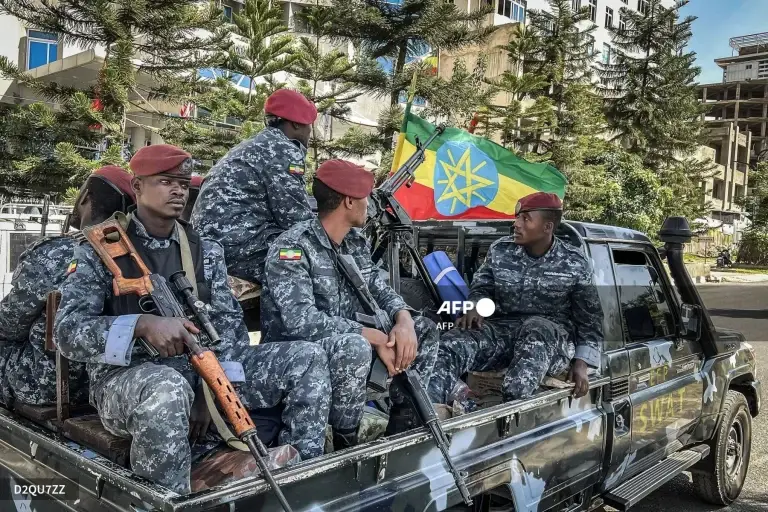
The military situation has remained tense. Ethiopian forces reportedly regained control of the strategic border town of Adigrat following recent clashes, while troops subsequently advanced into Zalambessa, another border town previously controlled by Tigrayan rebels.
These developments have increased concern among diplomats and regional observers that the fighting could spread beyond the existing conflict in Tigray. Any direct confrontation between Ethiopia and Eritrea would risk creating a wider crisis involving other countries already affected by insecurity around the Red Sea and the Horn of Africa.
The United Nations has also called for immediate restraint. Secretary-General António Guterres expressed grave concern about renewed fighting in Ethiopia’s Tigray, Afar and Amhara regions and urged all parties to cease hostilities and return to dialogue under the framework of the Pretoria Agreement.
The agreement, signed in November 2022, ended the devastating two-year war between Ethiopia’s federal government and the Tigray People’s Liberation Front. Although it brought a significant reduction in large-scale fighting, the political settlement has faced continuing difficulties, and renewed violence threatens to undermine the fragile peace.
The African Union has similarly urged Ethiopia, Eritrea and other concerned countries to avoid inflammatory actions and statements. Its commission has called for communication channels to remain open and encouraged the countries to resolve their differences through established diplomatic processes.
The European Union has also warned that escalating violence in Ethiopia and worsening relations with Eritrea could trigger a broader regional conflict. It has called for de-escalation, implementation of existing peace commitments and protection of civilians, while stressing the importance of unhindered humanitarian assistance.
The latest tensions are rooted in a complicated history. Ethiopia and Eritrea fought a border war from 1998 to 2000, leaving tens of thousands dead and relations deeply damaged. The countries subsequently remained hostile for nearly two decades before Abiy and Eritrean President Isaias Afwerki signed a peace declaration in 2018.
The agreement restored diplomatic relations and raised hopes of lasting reconciliation. Abiy received the 2019 Nobel Peace Prize partly in recognition of his efforts to resolve the longstanding conflict with Eritrea.
However, relations deteriorated again as regional disputes and Ethiopia’s internal conflicts intensified. Eritrea supported Ethiopian federal forces during the 2020–2022 Tigray war, but cooperation between the former partners later weakened.
Another major source of tension is Ethiopia’s desire for reliable access to the sea. The country became landlocked when Eritrea gained independence in 1993. Abiy’s government has described access to the Red Sea as an important national interest, while Eritrean officials have expressed concern about statements suggesting Ethiopia should obtain sovereign maritime access.
Ethiopia has said it seeks a peaceful solution to the issue. Nevertheless, the dispute has added another sensitive dimension to relations already strained by allegations of military interference and support for armed groups.
For civilians in northern Ethiopia, the renewed fighting threatens to reverse fragile recovery efforts following years of conflict. Communities across the region continue to face serious challenges involving food security, healthcare, infrastructure and displacement. A wider confrontation could further restrict humanitarian access and place additional pressure on already vulnerable populations.
The United States has not announced a comprehensive settlement or confirmed that either government has agreed to a new round of negotiations. Its immediate message is that restraint and diplomatic engagement offer the best opportunity to prevent further escalation.
The coming days will be important as international organisations and regional governments seek to keep communication open between the two countries. Whether those efforts succeed will depend partly on the willingness of both governments to address security concerns without resorting to military action.
For now, Washington’s intervention reflects growing international anxiety that unresolved disputes could transform Ethiopia’s internal conflict into a broader confrontation. With the region already facing multiple security and humanitarian challenges, preventing another war has become an urgent diplomatic priority.
📩 Stone Reporters News | 🌍 stonereportersnews.com
✉️ info@stonereportersnews.com | 📘 Facebook: Stone Reporters News | 🐦 X (Twitter): @StoneReportNew | 📸 Instagram: @stonereportersnews
Add comment
Comments